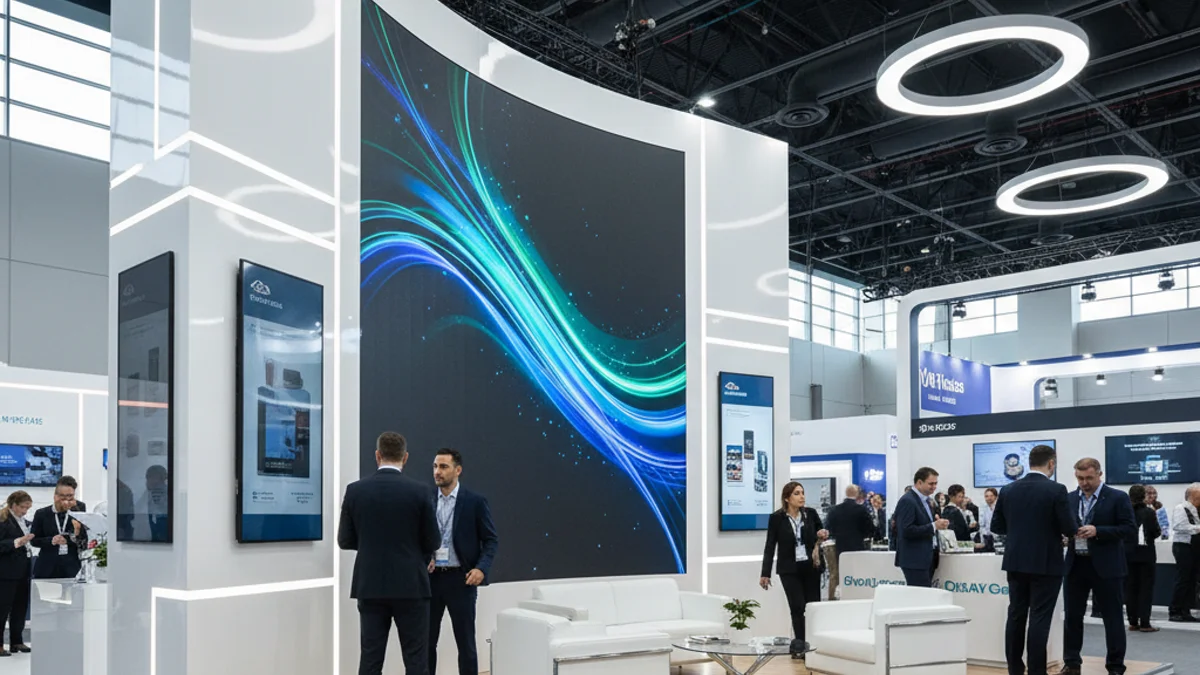
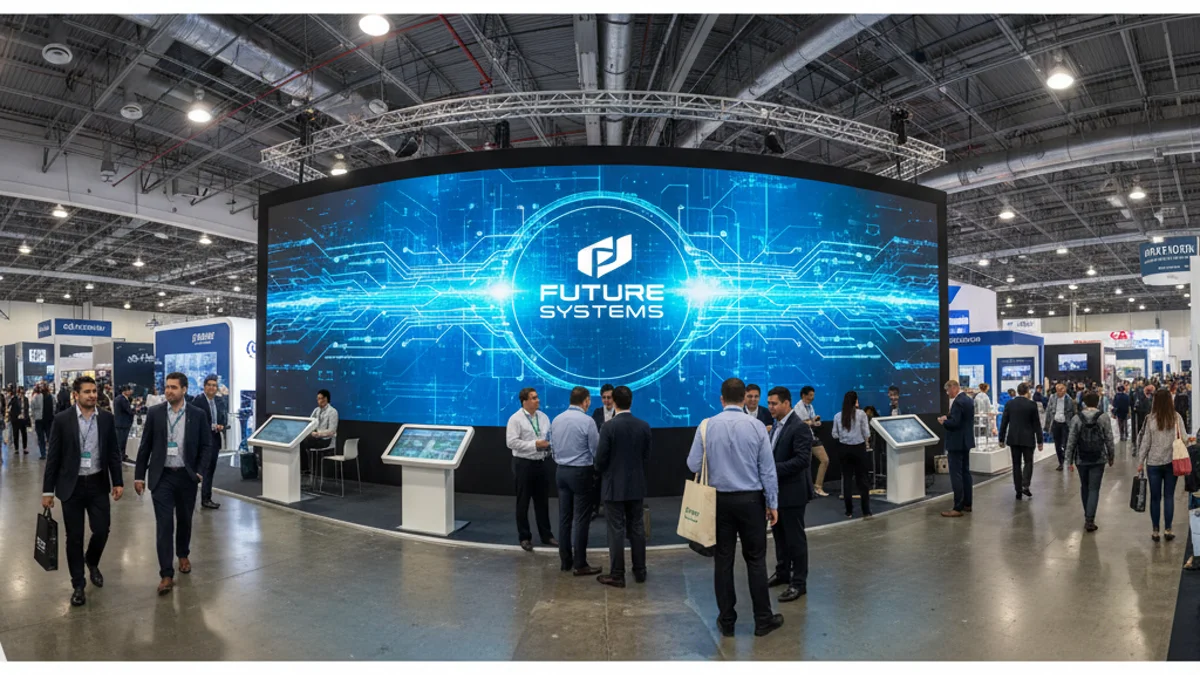
Hall lighting in a French exhibition hall is brutal. Overhead floods wash out glossy print, flatten colour, and make every stand in the aisle look the same. If your graphics disappear under venue lighting, you have already lost the visitor who was scanning from three rows away. The single most reliable fix is not a bigger logo. It is a lit, moving surface — an LED wall or a digital display — that holds a face, a loop, or a live demo at eye height.
This guide is written for exhibitors and event agencies producing stands in France. It covers the display equipment that actually earns its floor space: LED video walls, direct-view panels, LED posters, kiosks, screens and the power and rigging that keep them alive. It does not cover furniture hire or carpet choices. Those matter, but they are not what draws a crowd into an aisle.
Why LED and display equipment beat static graphics on an exhibition stand
A fabric wall shows one message all day. A video wall shows ten, and switches between them on a schedule you control. On a busy floor at a Paris or Lyon venue, the difference is measurable in dwell time rather than impressions. Visitors stop for motion first, then read.
Three practical reasons exhibitors move display budget to the top of the list:
- Visibility across an aisle and beyond. A 2.6 mm or 3.9 mm pitch panel carries an image from 3–8 m without the viewer needing to stand directly in front of a printed wall.
- Space efficiency. A single 3×2 m LED wall replaces several roll-up banners and a projector screen in a footprint under one square metre of stand surface.
- Content flexibility. Product launches, keynote reels, live social feeds and lead-capture prompts can rotate on the same hardware, so one screen serves the whole show.
That flexibility is why display hardware now anchors most modern builds. If you are planning a stand from scratch, the display layout should be decided alongside the structure, not bolted on the week before move-in. For layout inspiration, browse our trade show booth ideas using LED walls.
Turning a display brief into a working stand: the step checklist
The equipment list only works if the decisions behind it are sequenced. The following order keeps you from ordering the wrong screen for the wrong wall.
- 12 weeks out — define the measurable goal. Lead capture, product demo, brand awareness and press briefing each demand different hardware. A demo needs a high-refresh screen close to a seated area. Awareness needs a large, distant-readable wall. Write the goal and the equipment follows.
- 10 weeks out — lock the stand footprint and viewing distances. Confirm stand dimensions and the nearest aisle walkway. Choose pixel pitch from the minimum viewing distance, not the maximum. Too fine a pitch is wasted budget; too coarse looks soft.
- 8 weeks out — map content to each surface. Assign a single job to every screen: main wall shows the brand loop, a side kiosk runs interactive product detail, a counter monitor handles lead capture. One screen, one job.
- 6 weeks out — confirm rigging and structure. An LED wall is a structural load. Decide whether it hangs from a truss, floors on its own base, or mounts to a totem. Confirm venue hanging restrictions before the excess-height and rigging forms are due.
- 6 weeks out — calculate power honestly. Total the draw of every screen, media player, laptop and light, then add a 25–30 % buffer. Order venue electricity against that figure, not the nameplate of one screen.
- 4 weeks out — check connectivity and signal path. Decide venue Wi-Fi or a dedicated wired drop. Plan how content reaches each screen: on-site media players with pre-loaded loops are more robust than live streaming over congested show Wi-Fi.
- 2 weeks out — rehearse the content. Test every loop, slide deck and interactive build on the actual players. Cut anything longer than 90 seconds from a background loop.
- Move-in day — verify before doors open. Power on and soak-test every surface for a full cycle. Check brightness against the hall lights and adjust. Label every cable.
Choosing the right display surface: a comparison
Not every space wants an LED wall. The table below compares the display options most stands end up weighing against each other. Figures describe typical rental behaviour, not fixed prices.
| Display type | Best for | Relative cost to rent | Setup and complexity | Watch out for |
|---|---|---|---|---|
| LED video wall (modular panels) | Large feature walls, distant viewing, high-impact brand loops | High | Needs structure or rigging, precise panel alignment | Structural load; venue hang permits; minimum viewing distance |
| Direct-view LED totem / LED poster | Entrances, product plinths, narrow aisles | Medium | Free-standing, quick to position | Single-aspect content only; check stability in busy aisles |
| Commercial display / TV on stand | Meeting areas, kiosk detail, small stands | Low–medium | Fits standard mounts, minimal rigging | Seam between panels if tiled; label and cable tidiness |
| Interactive touchscreen kiosk | Self-guided demos, surveys, product configurators | Medium | Needs software build time and a stable network | Content build lead time; hygiene and screen-clean routine |
| Projection and screen | Conference-style sessions inside a large stand | Low | Needs throw distance and light control | Washed out under ambient hall lighting |
A common and expensive mistake is ordering the finest pitch LED wall the budget allows, then placing it where nobody can stand far enough back to appreciate it. Match the surface to the sightline and the goal. For most exhibition stands, one well-positioned wall plus a couple of kiosks outperforms a scatter of mismatched screens.
The practical essentials that ruin a stand when missed
Displays get the attention. Power, rigging and storage decide whether they work. Three things derail stands again and again.
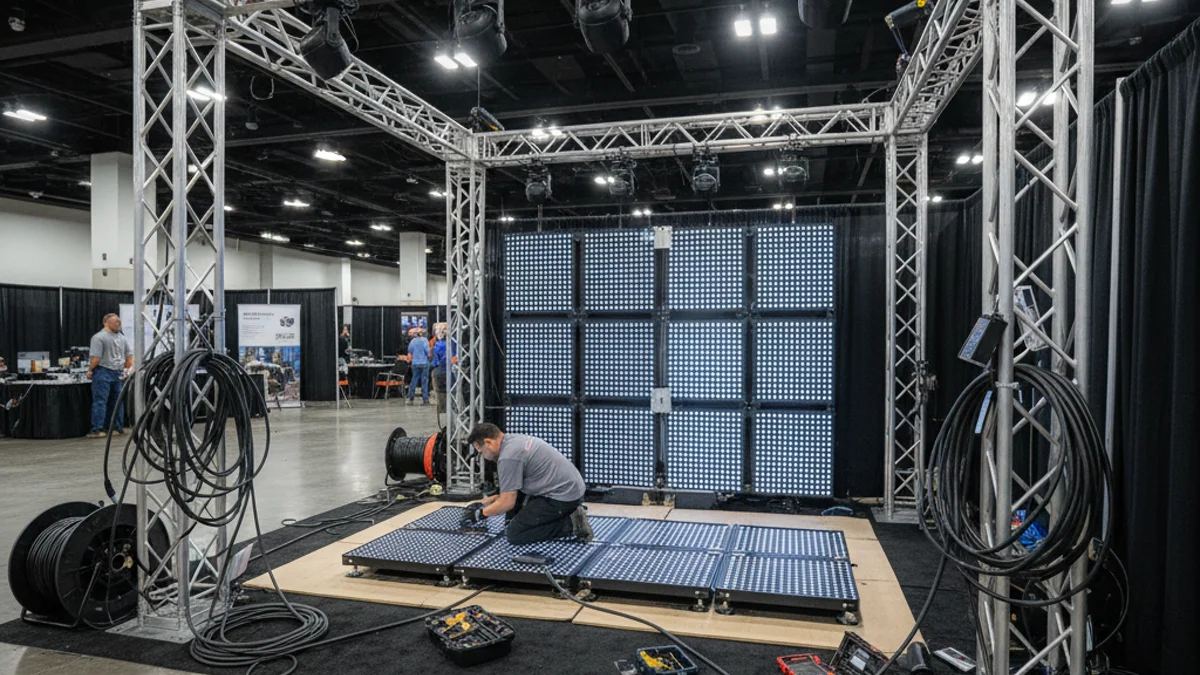
Power ordered late. Venue electricity is cheapest and most flexible booked early. Late orders can mean expensive single drops and daisy-chained leads that trip the venue electrical inspection. Calculate the total, add the buffer, and order once.
Signal assumed, not tested. Show Wi-Fi is congested by default. Interactive demos and lead-capture tablets should sit on a wired connection or local player wherever possible. Rehearse the failover.
Nowhere to put the spares. Cables, a spare media player, cleaning cloths and personal bags need a home inside a counter or locking cabinet. A stand with visible clutter reads as disorganised no matter how good the wall looks.
Rent or buy display equipment for a French exhibition?
Buying makes sense for a small display you will use monthly in your own showroom. For anything tied to a specific stand, rental is usually the better call. LED panels, media servers and interactive kiosks change quickly, and shipping or storing them yourself adds cost and risk. Renting also brings the technicians who know the calibration and alignment settings for a modular wall — settings that are easy to get wrong on a first solo build.
If your stand is being fabricated for a Paris venue, the display plan and the build plan should be drawn up together so the wall lands where the structure can carry it. That is where exhibition booth building in Paris and display specification intersect, and where a coordinated brief saves rework on the show floor. For practical tips on making the most of the screen, our trade show exhibit LED walls tips are worth a read.
Frequently asked questions
What is the single most important piece of display equipment for a stand?
There is no universal winner, but for most stands it is one large, lit, moving surface — an LED wall, a direct-view totem or a tiled screen — placed where the aisle can read it. Everything else supports it.
What pixel pitch do I need for an exhibition stand?
Choose pitch from your minimum viewing distance. As a rough guide, a coarser pitch works when viewers stand several metres away, and a finer pitch is needed when people stand close to read fine detail. Match the pitch to the nearest realistic sightline rather than the best-case one.
Can I just use the venue’s own screens?
Rarely. Venue-provided AV is usually shared, generic and sized for signage rather than a brand loop. Bring your own or rent, so you control content, timing and calibration.
How much power will my display equipment need?
List the draw of every screen, player, laptop and light, sum it, then add 25–30 % headroom. Order venue electricity against that total, early. Consult your rental provider for the draw of any modular wall, since it varies by panel count.
Do I need an internet connection for a video wall?
Only if content streams live. Pre-loaded loops on local media players need no network and are far more reliable on a congested show floor. Reserve connectivity for interactive kiosks and lead capture.
How far ahead should I order LED and display rental?
Treat four to six weeks as the practical minimum for a scheduled show, and earlier for large walls or bespoke interactive builds, so content and calibration time is not squeezed before move-in.
Wiring the display plan into the whole stand
Display equipment is not a bolt-on. It decides where the wall goes, how the stand is rigged, how much power you order and how content is built. Get those four things sequenced and the screens do their job: hold attention long enough for a conversation to start. Leave them to the last minute and the most expensive kit on the stand becomes the thing that fails at the worst possible moment.
For pixel pitch, panel sizes, totems and kiosks sized to a specific French venue, start with the hardware in context — digital signage and display rental covers the screens, players and mounting options that fit an exhibition stand. To see how display and structure are specified around a show stand, the LED screen rental for trade show booth building page walks through the layout decisions.
Ready to size a video wall or display package for your next exhibition in Paris, Lyon, Marseille, Nice or Cannes? Request a quote with your stand dimensions and show dates, and we will come back with a display plan that fits the floor. For large-format shows, our guide to LED video wall rental for large trade shows in France covers scale and logistics.