
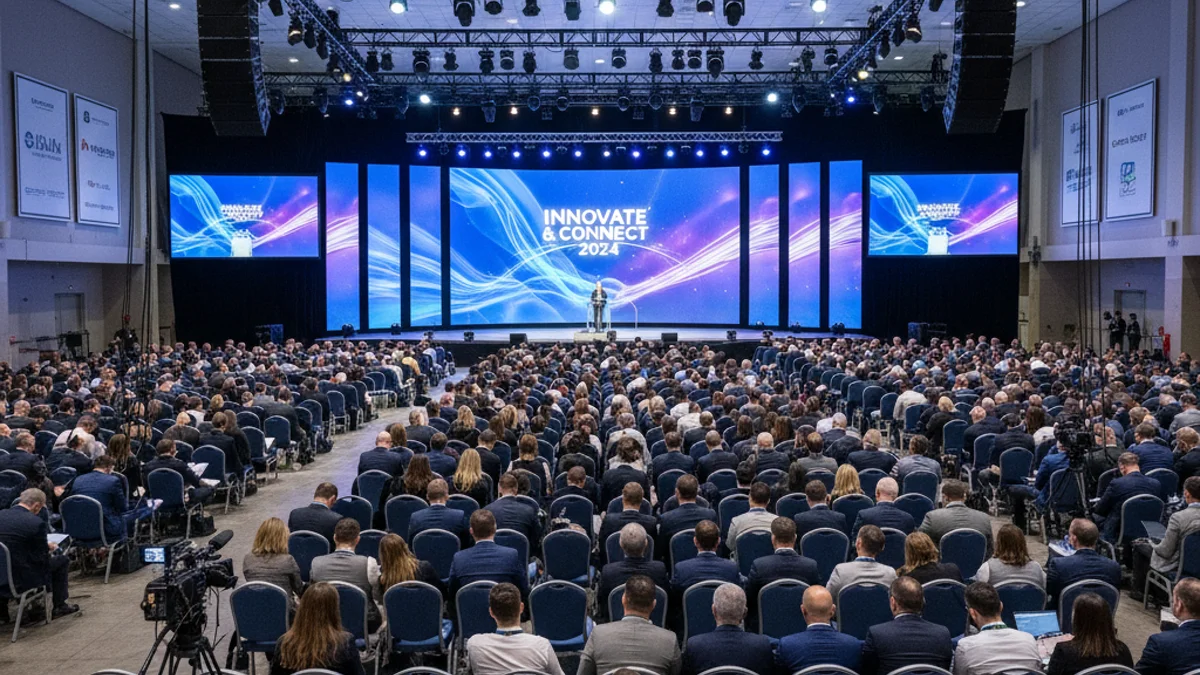
The AV layer is where convention budgets quietly die
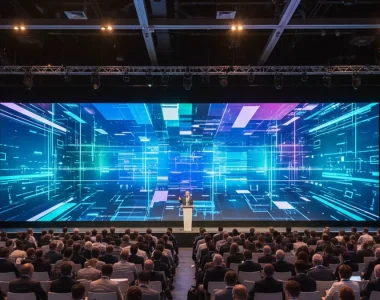
Most convention post-mortems blame the programme. The real failure usually sits twelve metres behind the main stage, in the rack room. A 6 m × 3 m LED wall specified at P3.9 because someone wanted a bigger surface, then fed 1080p content, then asked to carry a live caption feed and a sponsor loop at the same time. The wall is fine. The content chain is not.
That is the gap this article covers. Not how to book a venue or write a call for papers — see our conference and event management in Paris page for that layer. This is the production layer: what the screen has to do, what the building will let you do, and the sequence of decisions that has to be locked before the technical rider goes out — the same equipment logic covered in choosing AV equipment for conferences and seminars.
Start from the sightline, not the screen size
Every LED specification argument in a convention brief starts with dimensions. It should start with the back row.
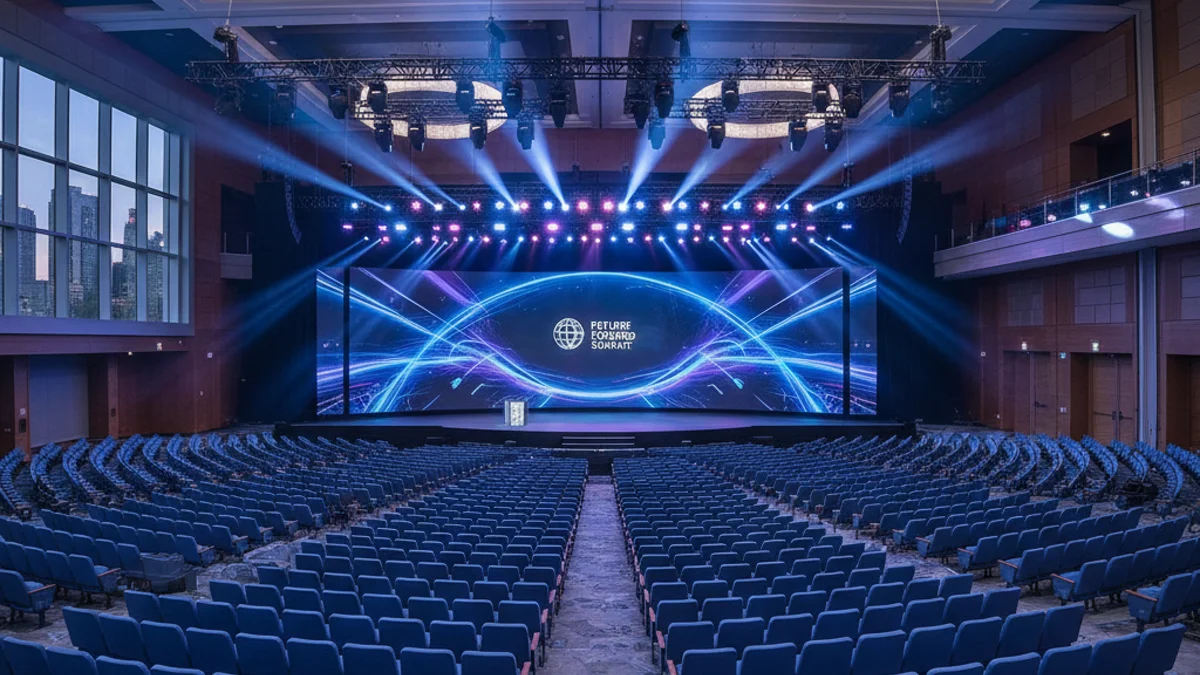
Work backwards. Take the furthest seat in the general session, measure the throw to the stage, and set the minimum legible cap height for a slide headline. That gives you a pixel pitch. A delegate at 35 m cannot resolve detail below roughly P4, and pushing P2.6 into that room buys nothing but cost and weight. Conversely, a 12 m-wide wall at P2.6 in a room where the front row sits 3 m back will look like a television and read as one.
Three practical constraints then narrow the choice:
- Processing headroom. A wall running 4K canvas plus picture-in-picture plus a translator’s lower-third needs a processor with spare layers, not a processor at 100% capacity. Novastar and Brompton units behave differently under layer load; ask which one is being quoted and how many free layers remain.
- Brightness versus the room. A general session under 200 lux of house light needs far less output than a sponsor activation in a glazed atrium. 1,200 nits is generous indoors. 5,000 nits in a bright exhibition hall is not extravagant, it is the entry price.
- Weight and rigging. Absen and ROE cabinets differ by a few kilos per square metre, which multiplies fast across 80 m². That number decides whether you hang from the venue’s roof steel or build a ground-support tower — and whether the venue’s rigging plan needs a structural sign-off.
LED wall, projection, or both: an honest comparison
This is the table to bring to the production meeting. It is not a ranking. It is a list of what each option costs you in a French convention venue.
| Approach | Best for | What it demands from the venue | Where it breaks |
|---|---|---|---|
| Direct-view LED wall (P2.6–P3.9, indoor cabinets) | General sessions over 400 seats, brand-critical graphics, high ambient light, camera-facing backdrops | Rigging points or floor space for ground support; dedicated three-phase power; cable routes clear of fire exits | Close front rows see pixel structure; weight forces roof steel or tower; needs a real content spec |
| Large-format projection (dual 20K laser, edge-blended) | Wide cinematic stages, listed or heritage rooms where hanging is restricted, tight budgets | Long throw distance, controlled ambient light, projector positions inside the room | Washed out by house lights or daylight; front-row shadows; blend seams if geometry shifts |
| Hybrid: LED wall + projection side screens | Plenary plus breakout overflow, translated sessions, rooms with a shallow stage | Two power drops, two signal paths, separate processing | Doubles the failure surface; needs one operator per surface or a very good show file |
| LED poster / digital signage cluster | Registration, sponsor wayfinding, session-live boards, exhibition aisles | Nothing beyond standard 16 A circuits and floor space | Read as decoration if content is not scheduled; nobody owns the playlist |
For rooms where the convention is being streamed or recorded, the calculation changes again. Camera-facing LED delivers a clean backdrop with no refresh banding, provided the wall is driven at a shutter-safe refresh rate and the processor is genlocked to the camera. If hybrid delivery is part of the plan, read the hybrid event production breakdown before you fix the stage geometry — retrofitting a camera-safe wall after the set is drawn is expensive.
What French venues actually impose
Venue rules, not equipment catalogues, decide the schedule. A few patterns repeat across the main convention buildings.
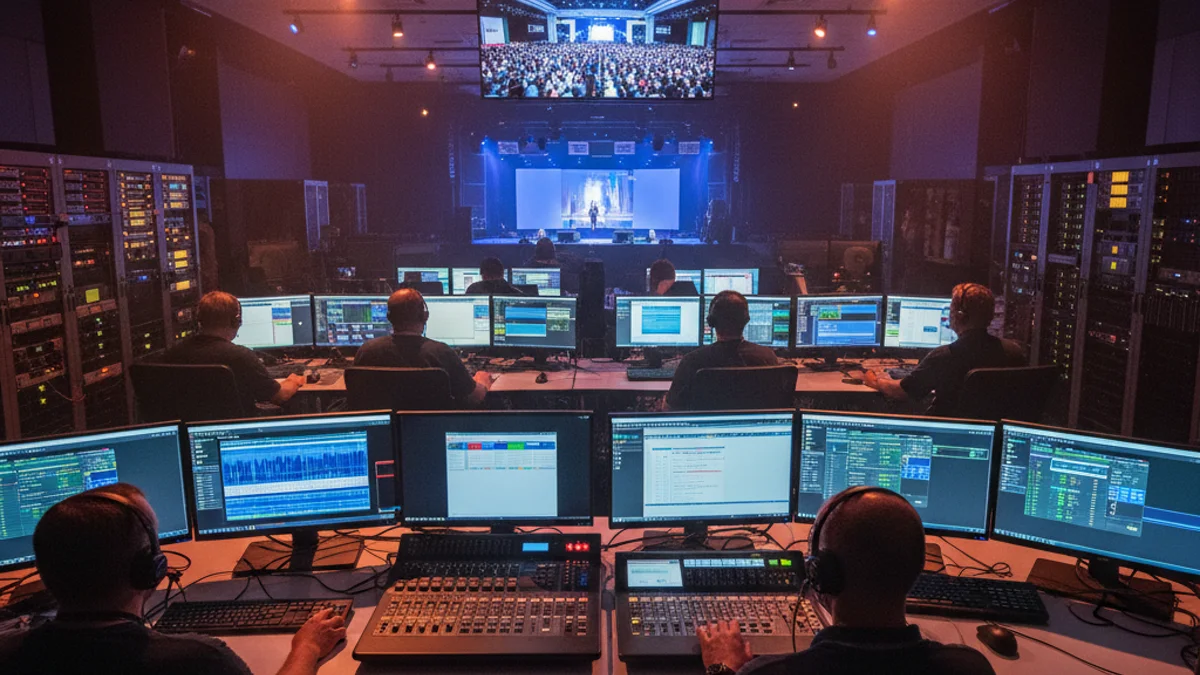
Paris. Palais des Congrès, Paris Expo Porte de Versailles and the Pullman/Montparnasse clusters all run public-assembly classifications that bring a commission de sécurité into the conversation. Anything that narrows an escape route, blocks a fire hose cabinet or hangs over an audience needs to be in the plan reviewed before build, not discovered on build day. Ceiling heights vary enormously between halls in the same building — measure the actual room, not the sales deck.
Lyon. Halle Tony Garnier and the Cité Internationale give you generous volume and awkward rigging. Ground-supported LED towers are often the saner route than chasing roof points, and load-in access needs to be timed against the venue’s other bookings.
Marseille and Nice. Parc Chanot and the Acropolis bring coastal humidity and, in the case of Nice, a building where some rooms were not designed around heavy AV. Cable runs get long; plan signal distribution over fibre rather than hoping copper holds.
Cannes. Palais des Festivals runs on tight, rigid load-in windows. If your build slot is 04:00–09:00, the wall has to arrive pre-built in touring frames and pre-addressed. There is no time for a first-time rig.
In all cases: get the venue’s technical annexe in writing, confirm the electrical supply in amps per phase rather than “sufficient”, and ask who signs the rigging plan.
The production checklist, in the order it actually happens
Timelines compress. These milestones, which sit inside the wider convention planning timeline, are the ones that cause real damage when they slip.
Six months out
- Lock the general session room and record its true dimensions, ceiling height, rigging capacity and power supply.
- Decide wall size from the sightline calculation, not the sponsor’s wish list.
- Write the content specification: canvas resolution, frame rate, safe areas, lower-third zones, caption position.
- Confirm whether the convention is being streamed, recorded, or both. This drives refresh rate and camera positions.
Ninety days out
- Issue the technical rider to the venue and get written acceptance of rigging and power.
- Book LED, processing, switching and crew as one package — split vendors are where signal-path blame lives.
- Confirm the power distribution plan: three-phase intake, distro positions, and separation from catering circuits.
- Agree the redundancy level. Spare processor, spare cabinet count, spare data run.
Thirty days out
- Receive and test all content at final resolution. Not a placeholder deck — the real one.
- Run a full playback test through the actual processor and switcher, at the actual frame rate.
- Confirm the interpreter booths, caption feed and sign-language camera inputs are on the signal map.
- Finalise the show file: scene list, sponsor loop durations, handover cues between sessions.
Build day
- Mark the floor before the first truss lands. Ground support goes where the plan says, not where it fits.
- Rig, then power, then data, then test — in that order, no shortcuts.
- Run a full brightness and colour calibration with house lights at show level.
- Photograph every cable route and label both ends.
Show days
- Doors-open check ninety minutes before each session, not five.
- One operator owns the wall for the whole day. Rotating operators is how cues get missed.
- Log every fault, however small, with a timestamp.
Derig
- De-rig in reverse order of build. Cabinets out before truss down.
- Count and scan every flight case against the manifest before the truck leaves.
- Debrief within 48 hours while the detail is still accurate.
Content is half the production
A correctly specified wall showing a 4:3 deck stretched to 32:9 will be the thing people remember. Convention content arrives from a dozen sources — keynote decks, sponsor assets, pre-recorded panels, live cameras, lower-third graphics — and each one has a different aspect ratio, frame rate and colour profile.
Standardise early. Publish one canvas spec to every contributor, with the safe area marked, and reject anything that does not match it. Set one frame rate for the whole event and hold it. Convert everything to a single codec before it touches the playout machine. This is unglamorous work that decides whether the general session opens cleanly.
For the exhibition floor meanwhile, the same discipline applies to sponsor screens and wayfinding. That is a scheduling problem more than an equipment one — see LED screen rental for conferences and events for how the display estate is usually split between plenary, breakout and public areas.
Crew, language and the small stuff
French convention crews are good and they are booked early. Two things trip up international organisers. First, assume the working language on the floor is French unless you have agreed otherwise in the contract — brief in French, or budget for a bilingual production manager. Second, labour rules around night work and rest periods are not negotiable flex. A build that runs to 03:00 may leave you short-handed at 08:00.
Also budget the boring items: cable ramp, matting, black wool serge to dress the tower base, gaffer in the right colours, a spare laptop with the show file, and someone whose only job is to hold the spare laptop.
Frequently asked questions
How far in advance should we book an LED wall for a convention in France?
For a plenary over 500 seats, three to four months is comfortable and gives you choice of pitch and cabinet type. Peak season around major Cannes and Paris event weeks compresses that considerably. Late bookings usually mean accepting a pitch or a cabinet family you did not want.
Can we use the venue’s in-house AV instead?
Often yes, and sometimes you should. In-house teams know the building’s rigging points and power quirks better than anyone. The trade-off is equipment range and flexibility on specification. Ask for the actual kit list, not a service description, and compare it against your content requirement.
What pixel pitch do we need for a 1,000-seat general session?
Usually P3.9 to P4.8 for the main wall, driven by the distance to the back row rather than the seat count. A room that deep also needs the content designed for it — bigger type, fewer words, higher contrast. Pitch alone will not fix a dense slide.
Do we need a backup wall?
No. A spare cabinet count, a spare data run and a spare processor input are the realistic redundancy. A second wall is rarely justified; a tested failover path almost always is.
How do we handle a bilingual convention on screen?
Reserve screen real estate for the second language from the start — a dedicated lower band or a side panel, not an overlay. Overlay captions sit on top of the presenter’s graphics and both become unreadable. Confirm the caption feed is on the signal map and tested at the thirty-day mark.
Get the production layer specified before the venue is signed
The order of decisions matters more than any single piece of equipment. Sightline, then pitch, then rigging, then power, then content, then crew. Get that sequence right and the general session opens on time. Get it wrong and no amount of on-site improvisation recovers it.
Tell us the room, the seat count and the content you need to show, and we will come back with a wall specification, a power and rigging plan, and a build schedule that fits your load-in window, whether it is a corporate convention or an academic conference. For launches staged on the same principles, see product launch technical production.

1 Comment