Two ways to fill a wall: pick the medium before the content
Every large-format show asks the same question early: do we build the image on an LED wall, or throw it onto a surface with projection? Both can carry a keynote, a reveal or a festival backdrop, and both can fail in a French venue for reasons that have nothing to do with the creative. The choice is decided by ambient light, surface geometry, budget shape and how the room is built. If your show leans on immersive, irregular surfaces, look at how we run LED and display rental for experiential marketing, because the two media solve different problems.
This is the working comparison we use on site: what each medium does well, where each one breaks, and how to read the room so you pick correctly before you commission content.
How projection mapping actually works
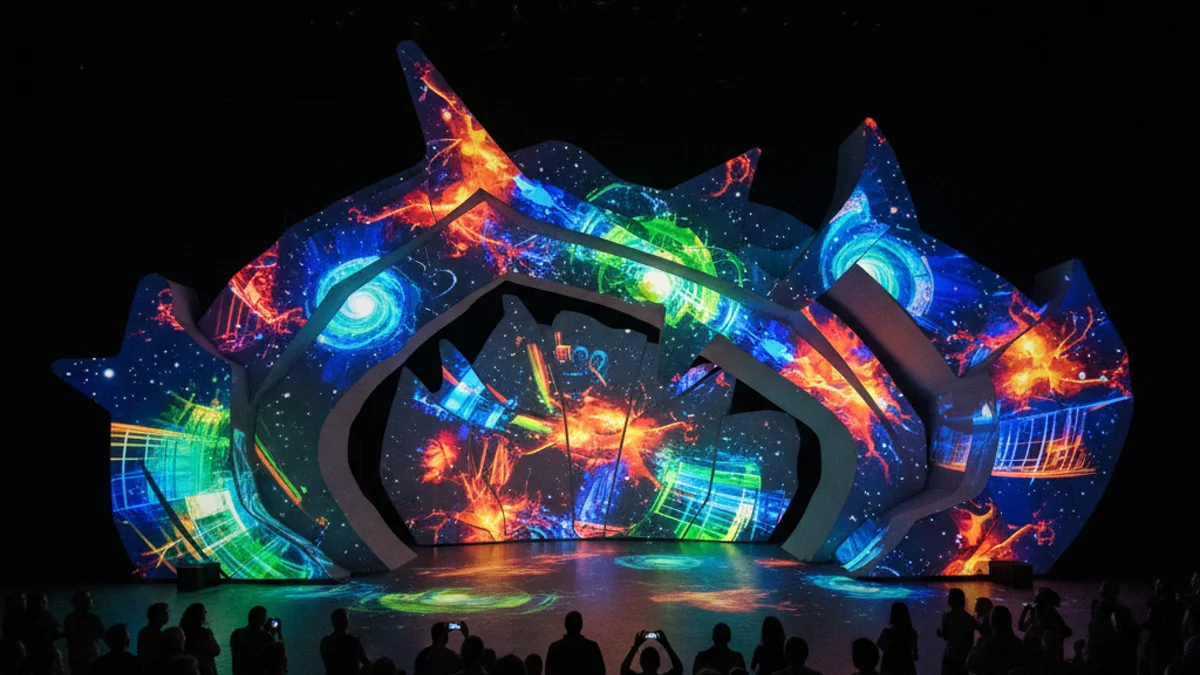
Projection mapping lines up a projector’s output with the real contours of a surface — a wall, a set piece, a façade, an object. Three parts do the work: the projector, the mapping software and the content. The software outlines the surface, then warps and masks the visuals so they land exactly where you want them, correcting for angle, curve and obstruction.
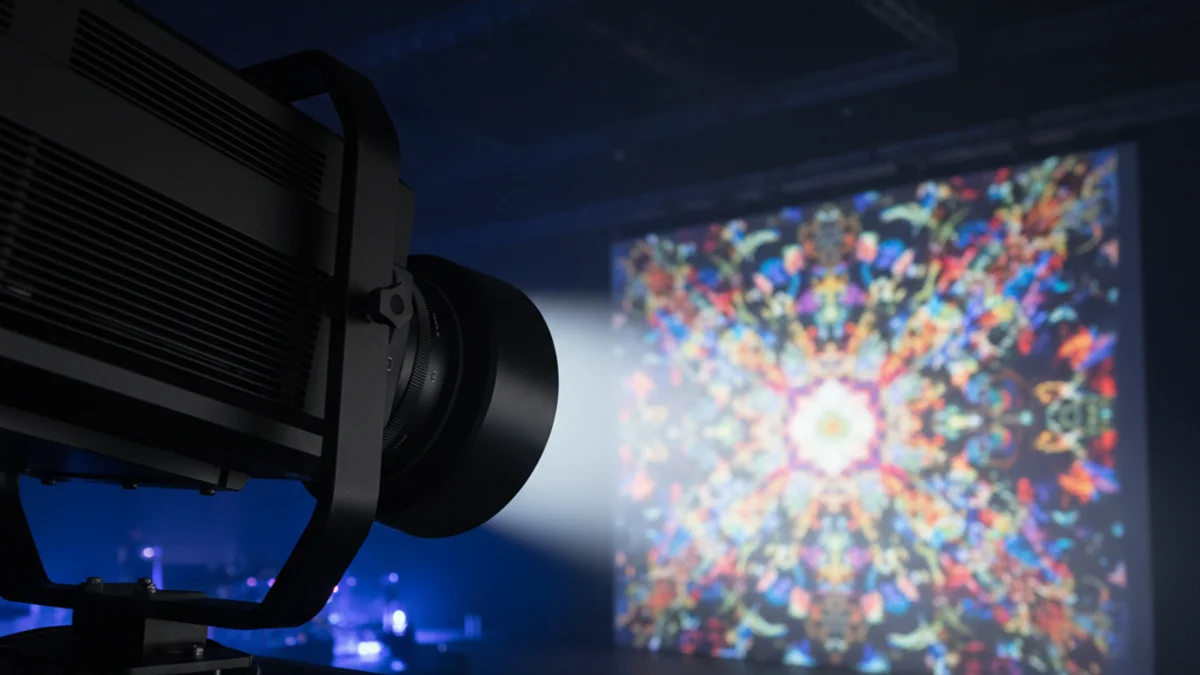
The hardware side is unforgiving. An indoor mapping show usually wants projectors in the region of 3,000 lumens; an outdoor or large-scale setup needs 10,000 lumens or more to survive ambient light. Throw distance — the gap between projector and surface — sets how bright and how sharp the image can be. A long throw in a bright room is the classic profile that looks washed out because nothing was specified against the room’s light level. Standard tools are MadMapper, Resolume and TouchDesigner for the mapping and playback, with real-time control for interactive pieces.
Projection needs geometry it can grip. Flat matte surfaces are easy; sculpted set pieces and building façades give you the striking stuff but demand calibration time. Reflective, glossy and transparent surfaces scatter light and wreck clarity, so a glass-walled room is a poor first choice unless you plan for it.
LED walls vs projection: the honest comparison
| Factor | LED video wall | Projection mapping |
|---|---|---|
| Ambient light | Holds up in bright rooms and daylight; brightness is a spec you choose | Fights daylight; needs dimming or a night show |
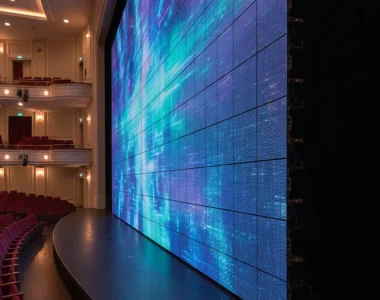
| Surface | Flat, built from 500 mm cabinets in 0.5 m increments | Follows any shape: curves, sculptures, façades |
| Shadows | None — the light source is the surface | Front projection casts shadows if anyone crosses the beam |
| Assembly | Physical build on truss or ground support | Projector on a mount plus calibration, no structure |
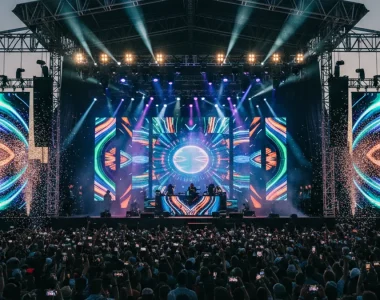
| Best at | Stage backdrops, IMAG, close-up product detail | Immersive rooms, façades, irregular set pieces |
| Recurring cost | Cabinet stock and rigging labour | Lamp/laser service, software, long calibration windows |
The practical split is simple. When the audience sits in a lit room and needs a crisp image at close range, LED wins on control. When the surface is irregular, the room can be darkened and the budget is tighter on structure, projection wins on flexibility.
Front versus rear projection
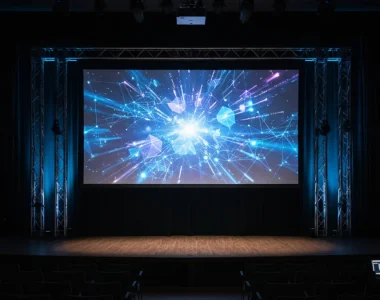
Front projection puts the projector in front of the surface. Setup is quick and flexible, and it suits stages and outdoor shows. The trade-off is shadows: any performer or object between the projector and the screen throws a silhouette onto the image, which matters in a packed room.
Rear projection hides the projector behind a translucent screen and removes the shadow problem, giving a clean image for exhibits, immersive rooms and trade show walls. It costs you depth — you need space behind the screen for the throw — and that space is exactly what tight venue footprints do not have. Decide this against the venue’s plan, not the creative brief.
When LED is the stronger choice in a French venue
French venues push you toward LED more often than you might expect. Rigging goes through the régie technique with venue-approved riggers, so a projection design that wants to fly a projector on a convenient truss still needs the technical file and a structural note. Ambient light is the other driver: an exhibition hall during loading hours, a sunlit atrium or a daytime conference room all wash out projection but leave an LED wall readable.
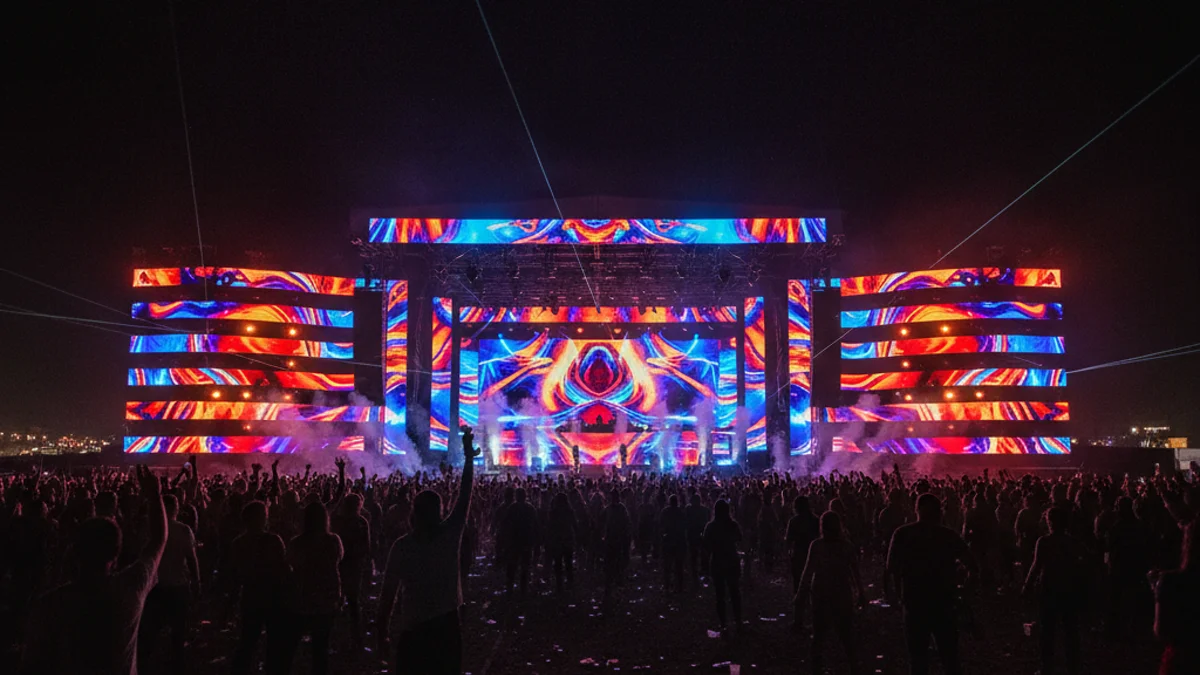
Content rules differ too. Projection mapping rewards long, slow, sweeping motion that reads across a big surface. LED walls on a stand are viewed at walking pace, so segments of 6–10 s with one idea each work better, and text-heavy content needs a finer pitch. If you are mapping content onto a screen on a booth, follow the same discipline we set out for immersive AV experiences at trade shows: one idea per loop, no audio dependency, subtitles sized for the room. For brand work, the framing in our guide to LED video walls for brand activations applies to projection too — the medium is not the message.
Calibration, rehearsal and the mistakes that cost a show
Projection lives or dies on calibration. Corner pinning, mesh warping and edge blending bring the image onto the surface; brightness and colour balance then have to be tuned across every projector so the blend line disappears. This is hours of work, not minutes, and it needs a rehearsal on site with the real content.
The failure modes are predictable. Skipping a site check leaves the surface texture and light level as unknowns. Locking content only after calibration introduces timing errors. Rushing the setup compresses the one window where alignment can still be fixed. Build a spare content copy and a recovery plan, because a frozen media server mid-show is a bad time to discover there is no second player.
LED removes most of that calibration risk but adds build risk: rigging approval, power load and cabinet availability. Whichever medium you pick, the technical file and the load-in window are the real constraints. Get them wrong and it does not matter how good the image is.
Power, load-in and the technical file
The two media carry very different loads through the venue. An LED wall draws continuous power across its whole surface and travels as heavy cabinets on pallets: a 5 m P2.6 wall draws in the region of 3–4 kW at show brightness, and the flight cases have to clear the dock doors and freight lift. Projection moves the weight to the projector and the mount, so the load-in is lighter, but the projector still draws a dedicated feed and needs a stable platform a fixed distance from the surface.
Both paths run through the same French paperwork. Stand plans, electrical load and rigging details go to the régie technique weeks before the show, and the LED cabinets and rigging hardware need documented M1 or B-s1,d0 reaction-to-fire classification. A projection rig that flies from a hall truss still needs venue-approved riggers and a structural note, so it does not escape the rigging queue. Power is metered and ordered, never bundled into the room rate, which is why the load count belongs in the planning visit for either option.
Frequently asked questions
Can projection mapping work in daylight?
Only with limits. Direct sun washes out even high-lumen projectors. For outdoor shows, schedule after sunset or use a shaded, dark surface. LED walls are the more reliable answer where the room stays bright.
Does projection mapping need a special screen?
No, but the surface decides the result. Matte, light-coloured and reasonably flat surfaces map cleanly. Gloss, glass and transparency fight you, and heavily textured surfaces need more calibration time.
How long does a mapping setup take?
Small indoor displays can be aligned in a few hours; a large architectural show can take days of calibration, testing and rehearsal. Budget the rehearsal as part of the production, not an afterthought.
If the room is bright, the audience is close, or the content is text-heavy, an LED wall gives you more control. If the surface is irregular and the room can be darkened, projection opens creative doors an LED build cannot. Tell us the venue, the surfaces and the lighting, and we will recommend the medium and price the build. Start with our concert and festival LED rental, or request a quote with your show details and we will come back with a concrete plan.