Two technologies with opposite physics
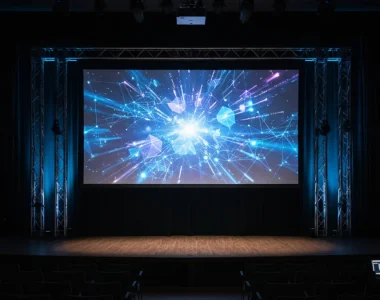
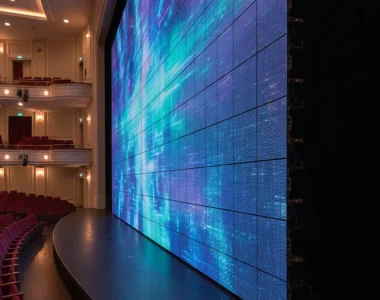
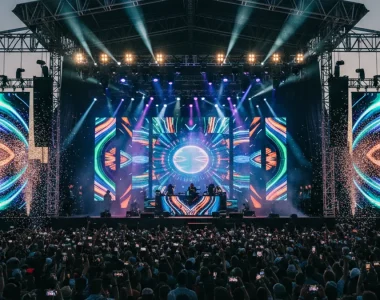
A projector throws light at a surface. An LED wall emits light from the surface. Everything that follows — brightness, blacks, viewing angle, blackout requirements, rigging load, power draw — falls out of that one difference. Most bad display decisions come from comparing the two on a price line before comparing them on the actual room.
This is not about which technology is better. It is about which one the room allows. That question gets answered by four measurements you can take before you sign anything: ambient light level, throw distance available, ceiling height, and the distance from the screen to the closest person in the audience. If you are choosing between the two for LED screen rental in Paris, take those four numbers to the conversation.
Side by side, on the things that decide the outcome
| Criterion | LED wall | Projector and screen |
|---|---|---|
| Light source | Self-emissive; each diode is a pixel | Reflected; image travels from lens to surface |
| Brightness unit | Nits measured off the panel | Lumens out of the lens, then divided across the screen area |
| Ambient light | Largely unaffected at normal indoor levels | Directly degraded; washes out in daylight or with house lights up |
| Blacks | Pixel off is genuinely dark | Black is the absence of projected light on a lit surface — rarely black |
| Space behind the screen | None unless rear-service cabinets are specified | Rear projection needs a room’s depth behind the screen |
| Scaling | Add cabinets in 0.5 m steps | Add projectors and blending, or increase throw distance |
| Weight and structure | Heavy; flown walls need suspension calculations | Lighter, but alignment-critical and needs a screen surface |
| Power | High for the wall area (a 5 m P2.6 wall runs in the region of 3–4 kW) | Lower per unit, but multiple units add up |
Read the brightness row carefully, because it is where most comparisons go wrong. Lumens describe light leaving the lens. What the audience sees is lumens spread across screen area and reflected back at them with the screen’s gain. A 10,000-lumen projector on a 6 m screen is not a bright image; it is a modest one, and the maths changes every time the screen grows.
Ambient light: the number that settles most arguments
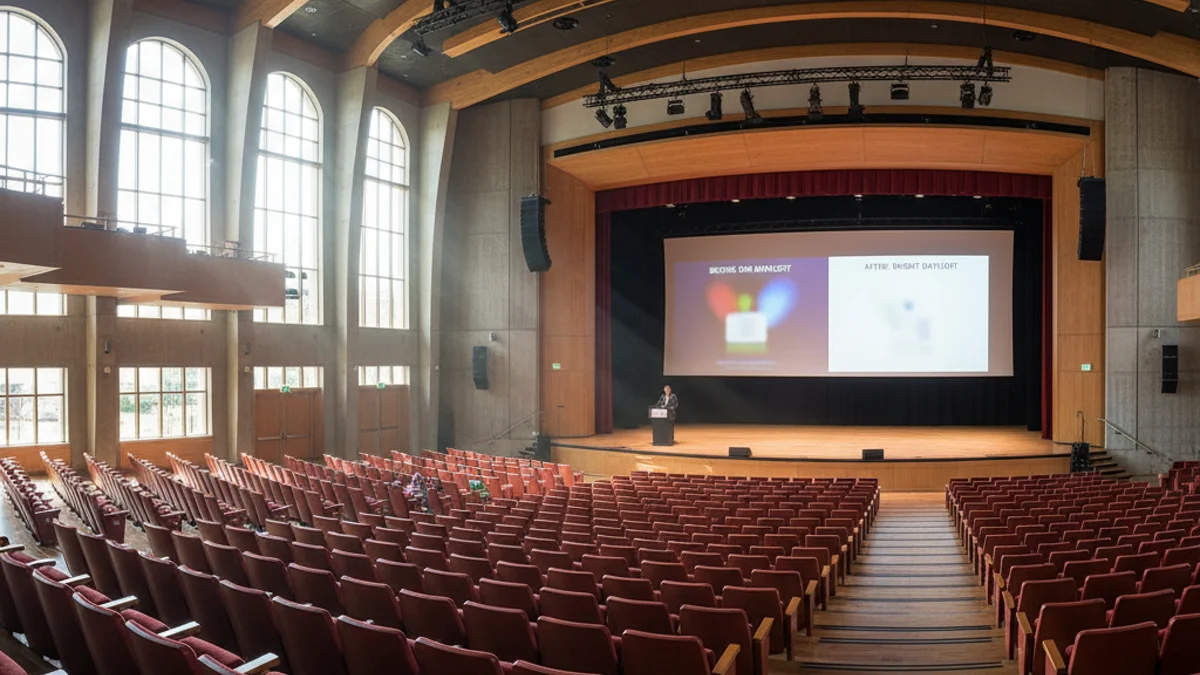
In a blacked-out auditorium with no spill, a good projector produces a beautiful, film-like image. That is a real advantage and worth paying for. The problem is that most business events are not blacked out: a keynote at 9am with daylight coming through the venue’s glazing, an exhibition hall where the stand opposite runs its own lighting, a plenary room with house lights at 40% because the audience needs to take notes.
Once ambient light is meaningful, the projected image loses contrast, and no amount of extra lumens restores it fully. You are fighting reflected light with more reflected light. An emissive wall simply does not have that problem — it is a lit surface competing with a lit room, which it wins comfortably.
The practical test: stand where the audience will sit, at the hour the session runs, with the room lit the way it will be lit. If you can read a newspaper comfortably, you are probably in LED territory.
Throw distance and ceiling height are venue constraints, not preferences
Front projection needs distance between the lens and the screen, and that distance is often the thing French venues cannot give you. Low truss heights, a stage that is already deep, sightlines that must stay clear for the audience — each one pushes the projector closer and the image smaller or the lens wider and the brightness lower.
Rear projection solves the sightline problem and creates a different one: it needs a darkened room’s depth behind the screen, which on a trade show stand is floor space you are paying for by the square metre. Add the classic rear-projection trap — a walkway behind the screen where someone’s silhouette appears — and the case usually collapses.
LED walls take their space in the other dimension. They need a frame, a structure to stand on or hang from, and service access. On a flown build that means a suspension calculation and venue-approved riggers, not the supplier’s crew clipping to hall trusses. That paperwork belongs in the venue’s technical file weeks before the build, alongside the stand plan and electrical load. Reading a French venue’s technical pack is the fastest way to find out whether a flown wall is even possible in your hall.
Resolution, seams and what your content actually is
Both technologies can be sharp. The failure modes differ.
- LED: resolution comes from pitch and area. A 5 × 2.5 m wall at P2.6 gives roughly 1920 × 960 — near-HD but wider than 16:9, so a 16:9 master letterboxes. Design to the native canvas.
- Projection: resolution comes from the projector’s native panel. Feed a 4K source to a Full HD unit and you get a downscale, not detail.
- Blending: a very large projected image usually needs two or more units edge-blended. The blend zone needs content that tolerates it, and the alignment has to survive a full session of someone brushing the projector.
- Cabinet seams: an LED wall is built without visible joints, but a dead module is a visible black rectangle. Spares on site and a test pattern before doors are not optional extras.
For close-up product work and text-heavy slides viewed from two metres, pitch dominates and LED wins on sharpness. For a cinematic playback in a dark room viewed from twelve metres, a projector is a perfectly sensible and often cheaper answer.
Where the money actually goes
A projector plus screen is usually cheaper on the equipment line for a comparable image size. That is the honest starting point. The comparison only becomes meaningful once three other costs are in it:
- Light control. If the room needs blackout drapes, blinds or a lighting redesign to make projection work, that cost belongs in the projector budget.
- Multi-unit complexity. Blending two projectors adds a second unit, a blend processor, and alignment labour — and the alignment has to be checked before every session.
- Failure consequences. A lamp or laser failure in a single-projector setup ends the visual. An LED wall loses a module, not the picture.
Run the comparison on “cost to achieve a legible image in this specific room at this hour”, not on “cost per square metre”. That reframing is where LED walls stop looking expensive and start looking like the cheaper way to avoid a bad session.
The decision checklist
- Is the room controllable? Full blackout available and acceptable → projector is on the table. Daylight or fixed house lights → LED.
- Is there throw distance? Less than the lens needs → LED, or a very wide lens and a dimmer image.
- Is rear space available? Rear projection needs depth plus a dark cavity; rarely worth it on a stand.
- How close is the closest viewer? Under three metres, fine pitch matters and LED is usually the answer.
- How large is the image? Beyond roughly 8 m wide in a bright room, LED is generally the more reliable route.
- What is the rigging and power situation? A flown LED wall needs a structural note and venue approval; a projector needs a mount and a clear path.
- What happens if it fails mid-session? Spare modules and a technician, or a spare lamp and a prayer.
FAQ
Can I mix the two in one room?
Yes, and it is common: a main LED wall for the stage and a projector for a side screen or a break-out. Keep the content brightness matched so the two do not look like different events, and make sure both are on the same content pipeline.
Is projection still worth it at all?
In a properly darkened auditorium with a controlled rig, absolutely. The image is genuinely pleasant, the equipment is lighter and the cost for a large surface is lower. The mistake is putting a projector in a room that was never dark.
What about projection mapping instead of a flat screen?
That is a different question — mapping is about shaping content onto an irregular surface, and it has its own trade-offs in calibration, shadows and viewer position. Projection mapping versus LED walls covers that decision separately.
Do LED walls need a darkened room too?
No. That is the point of an emissive display. They do still benefit from controlled lighting for contrast and audience comfort, but they do not fail when the lights come up.
Deciding on the room, not the technology
Take the four measurements — ambient light, throw distance, ceiling height, closest viewer — and the choice usually makes itself. Where it does not, the tie-break is failure behaviour: which option still delivers a legible image when something goes wrong at 09:00 on the opening morning.
For venue-side constraints in the five French markets we cover, event venues in France for LED production sets out what each city’s halls actually allow. Request a quote with your room dimensions and the time of day your sessions run, and we will tell you which technology the room supports before you commit the budget.