Outdoors is a different engineering brief, not a bigger version of indoors
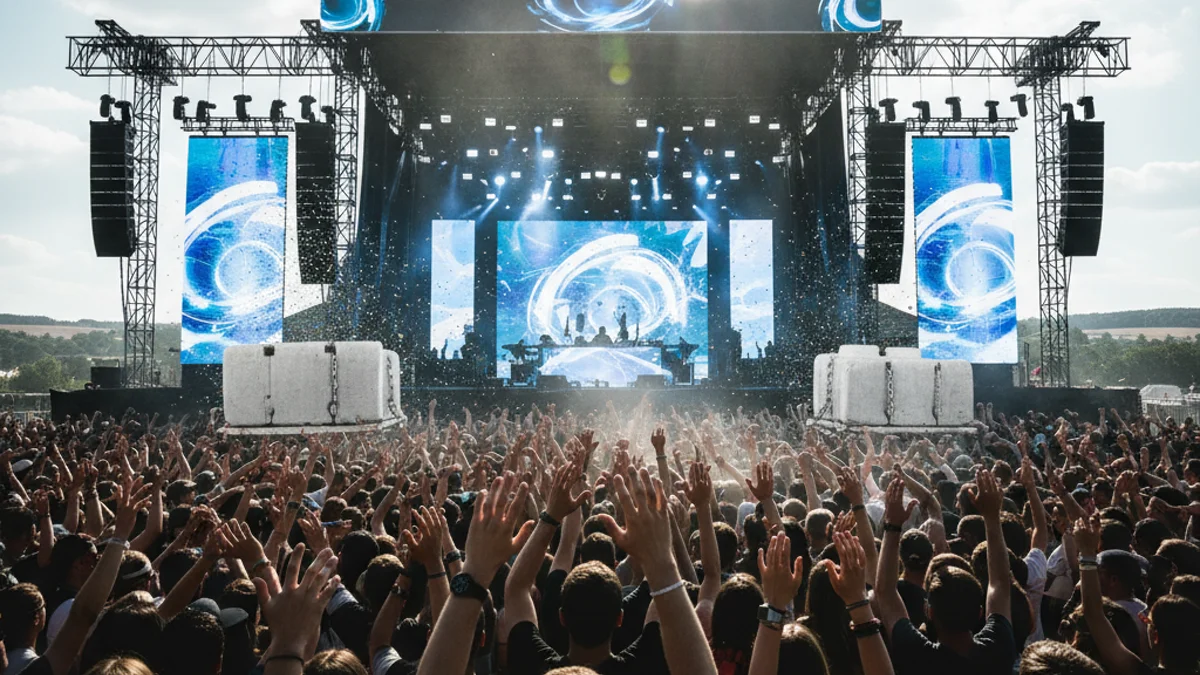
Take an LED wall that behaves perfectly in a conference hall, put it at the end of a festival field in July, and four new variables appear at once: the sun, the weather, the ground, and the fact that nobody is supplying you with power. A wall specified for an indoor room is not the same product as a wall that has to be legible at 14:00, survive a shower, stand up to wind, and run off a generator.
Most outdoor screen failures we see are not equipment failures. They are briefs copied from an indoor event and re-issued for a field. If you are arranging LED screen rental for a concert or a festival stage, these are the parameters that actually change.
Daylight legibility comes before resolution
Indoors, brightness is mostly about comfort and contrast. Outdoors, it is the whole game. A screen competing with direct sun needs an order of magnitude more output than one in a blacked-out auditorium, and on a festival site the practical answer is a high-brightness outdoor-rated panel driven hard, not a fine-pitch indoor cabinet pushed to its limit.
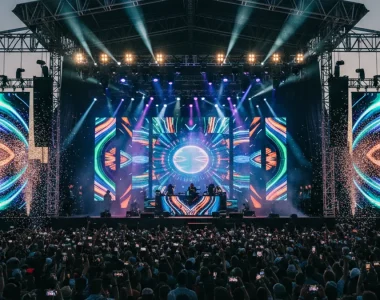
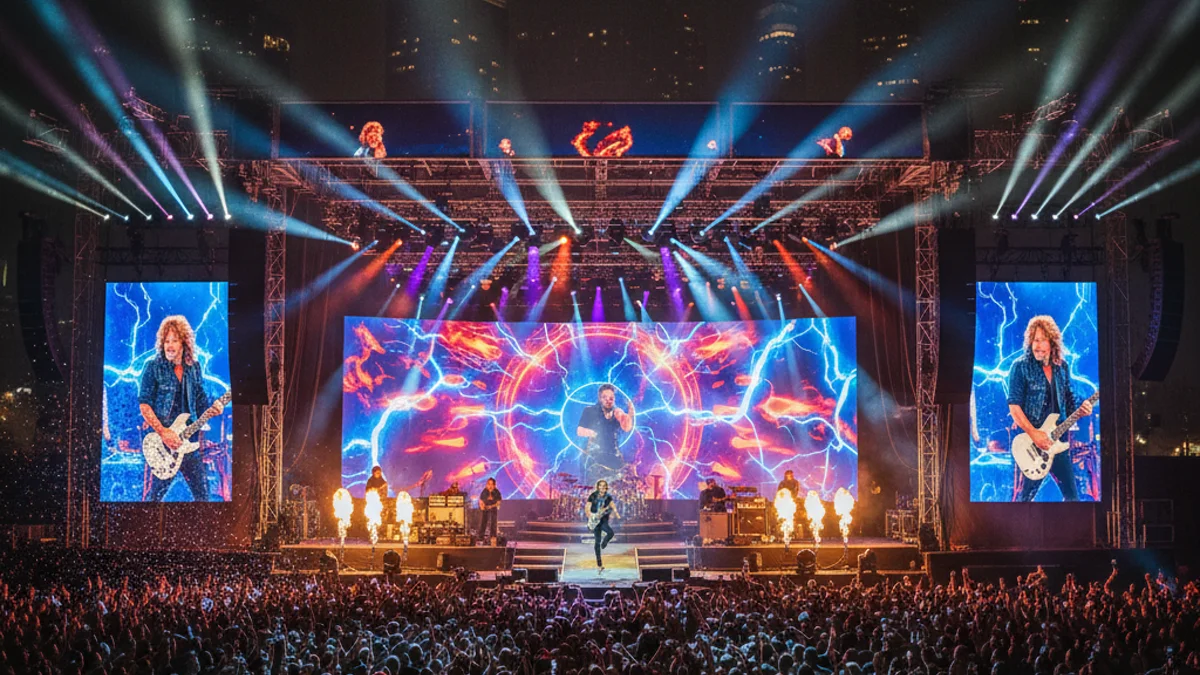
The trade-off runs the other way from an exhibition stand. Nobody at a festival stands two metres from the wall — they are twenty, forty, sixty metres back. That means a coarser pitch is not only acceptable, it is correct:
| Application | Typical pitch | Why |
|---|---|---|
| Main stage backdrop, viewer at 15–40 m | P4.8 or coarser | Structure invisible at that distance; more brightness budget per diode |
| Side screens for IMAG at 10–25 m | P3.9 | Camera content needs slightly more density than graphics |
| Brand activation tent, viewers at 2–4 m | P2.6 | Close viewing returns; this is an indoor spec in a tent |
| Sponsor tower signage at 5–10 m | P2.9–P3.9 | Mixed distance, text-heavy content |
The common outdoor error is ordering fine pitch “for quality” on a main stage. It costs more, draws more power, and delivers nothing the back of the field can perceive. Spend that budget on brightness and on shade for the operator position instead.
Weather is a specification, not a risk you accept
- Ingress protection. Outdoor cabinets carry an IP rating. Ask for it in writing and match it to the site’s realistic worst case — a covered stage and an open field are different exposures. A rental contract that says “outdoor screen” without an IP rating is not a specification.
- Rain covers and drainage. Even IP-rated cabinets need the cable entries and the frame’s low points managed so water does not pool against connectors.
- Condensation. A cold night followed by a warm, humid morning puts moisture inside a structure. Panels powered but idle for a period before doors help dry them out.
- Heat. A wall running at high brightness in direct sun is running near its thermal limit. Shade the processor and the media players — they fail before the panels do.
- Fire classification. Outdoor events still get inspected. Cabinets and rigging should arrive with documented reaction-to-fire classification — the M1 or B-s1,d0 paperwork that French venues and safety officers ask for.
Power comes from a generator, so the load calculation matters more
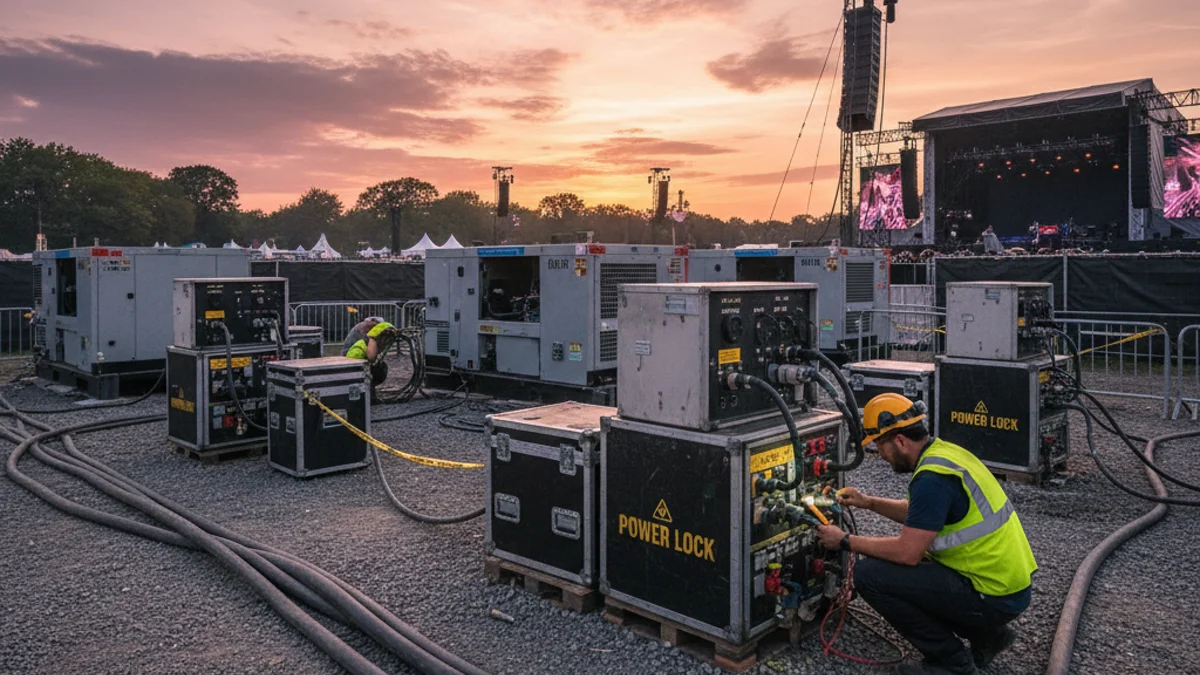
Indoors, you order amperage from the venue and someone else owns the distribution board. On a site, the generator is yours to specify. A 5 m P2.6 wall runs in the region of 3–4 kW; a festival main-stage wall is many times that, plus processing, plus the lighting rig sharing the same supply.
Three practical rules:
- Size the generator on connected load plus headroom, not on the wall’s average draw. Content brightness changes the load, and a bass-heavy drop on a full-brightness wall is not the moment to discover the margin was thin.
- Balance across phases. Put the screen, the audio and the lighting on separate phases and separate distro feeds. Sharing a circuit with audio processing is how hum gets into a PA.
- Decide the redundancy question explicitly. A backup generator or an A/B supply for the video system is a budget line. Buying it after the first dropout is more expensive and less convincing to the client.
Rigging outdoors changes the approval path
An indoor flown wall goes through the venue’s régie technique: suspension calculation, venue-approved riggers, load checked at the specific truss point. Outdoors there is no hall roof to hang from, so the structure itself becomes the engineering problem.
- Ground-support towers and ballast. Wind load acts on the screen like a sail. The ballast or anchoring plan is designed for the structure, the sail area and the site’s wind exposure — and the screen’s surface area is the number that drives it.
- Wind limits are operating limits. Outdoor structures have a rated wind speed at which the show stops. That is not a suggestion, and the decision sits with the structure’s engineer, not the show caller.
- Ground conditions. Ballast on asphalt, grass after rain, or a temporary deck behave differently. A site visit before the design is fixed is cheaper than a redesigned base on build day.
- Certified crews only. The crews doing this at festival scale are specialists. Budget for them; do not substitute general stagehands.
Venue-side constraints still apply even when the venue is a field: event venues in France for LED production covers how the country’s major sites handle power, access and approval, and the same logic extends to open-air sites with their own technical régie. Venue selection and AV constraints is the checklist version.
IMAG across a field is a latency and cabling problem
Camera-to-screen on a festival site is harder than in a hall for two reasons that have nothing to do with the panel.
Distance. Camera positions can be a hundred metres from the screen. Copper SDI does not travel that far reliably; the run needs fibre or a proper conversion path, and the signal chain needs to be designed rather than improvised with a long cable from the venue’s spares box.
Audio sync. Delay towers down the field are already delayed so the sound arrives together with the main PA. Add a screen showing a live camera feed and you have a third timing reference. The video delay has to be measured and the audio aligned to it for the zones where the audience can see both — otherwise the crowd at the barrier is watching lips that move a beat late.
This is the single most under-briefed part of outdoor video. On an indoor conference, one engineer can chase it in an afternoon. On a festival site it needs to be in the production schedule before load-in.
What changes from an indoor hall
| Parameter | Indoor event | Outdoor festival |
|---|---|---|
| Brightness driver | Contrast and comfort | Direct sunlight and ambient sky |
| Pitch driver | Closest viewer, often 1.5–3 m | Furthest viewers, 20–60 m |
| Power source | Metered venue supply | Generator, sized and phased by you |
| Structure | Venue truss, approved suspension | Ground support with wind load and ballast |
| Weather | Rain cover for load-in | IP rating, drainage, condensation, heat |
| Failure recovery | Technician on stage side | Spares and access plan across a site |
Site checklist before you confirm the wall
- Site visit at the same time of day as the show. Photograph the sun position on the screen face.
- Power plan — generator size, phase balance, distro positions, redundancy decision.
- Structure plan — ballast or anchors, wind rating, show-stop threshold, engineer sign-off.
- Weather plan — IP rating confirmed in writing, covers, drainage, spare modules under cover.
- Signal plan — fibre runs, camera positions, video delay measured, audio alignment scheduled.
- Paperwork — fire classification certificates, structural note, crew certifications.
FAQ
Can I use an indoor LED cabinet outdoors under a stage roof?
Sometimes, if it is genuinely sheltered and the supplier accepts the exposure in writing. A stage roof keeps direct rain off but not driven rain, and it does nothing about humidity. Get the IP rating and the supplier’s position documented rather than assumed.
How bright does an outdoor screen need to be?
Bright enough to hold contrast against the ambient light at the screen face at show time — which for a sunlit daytime slot is a very different number from an after-dark headline set. Specify per session, not per festival.
Do I still need a fine pitch for close-up product shots on site?
If the camera is doing the close-up work, no — the screen only has to show the camera’s output legibly at distance. Fine pitch belongs on the activation stand where people stand close, not on the main stage.
What is the biggest cause of outdoor screen downtime?
Power and water, in that order. Undersized generator margin shows up under a loud, bright number; moisture shows up the morning after a cold night. Both are prevented in the plan, not on site.
Building an outdoor video plan that holds
The wall is the visible part of an outdoor production and the least likely thing to fail if the brief is written correctly. Sun, wind, water and generator capacity decide the outcome, and all four are knowable weeks before load-in.
Bring the site plan, the session times and the closest and furthest audience distances to the conversation. LED screens for sports events covers the stadium version of the same problem, and request a quote with your site details and we will size the wall, the structure and the supply together rather than one at a time.