The construction method decides how the wall behaves on site
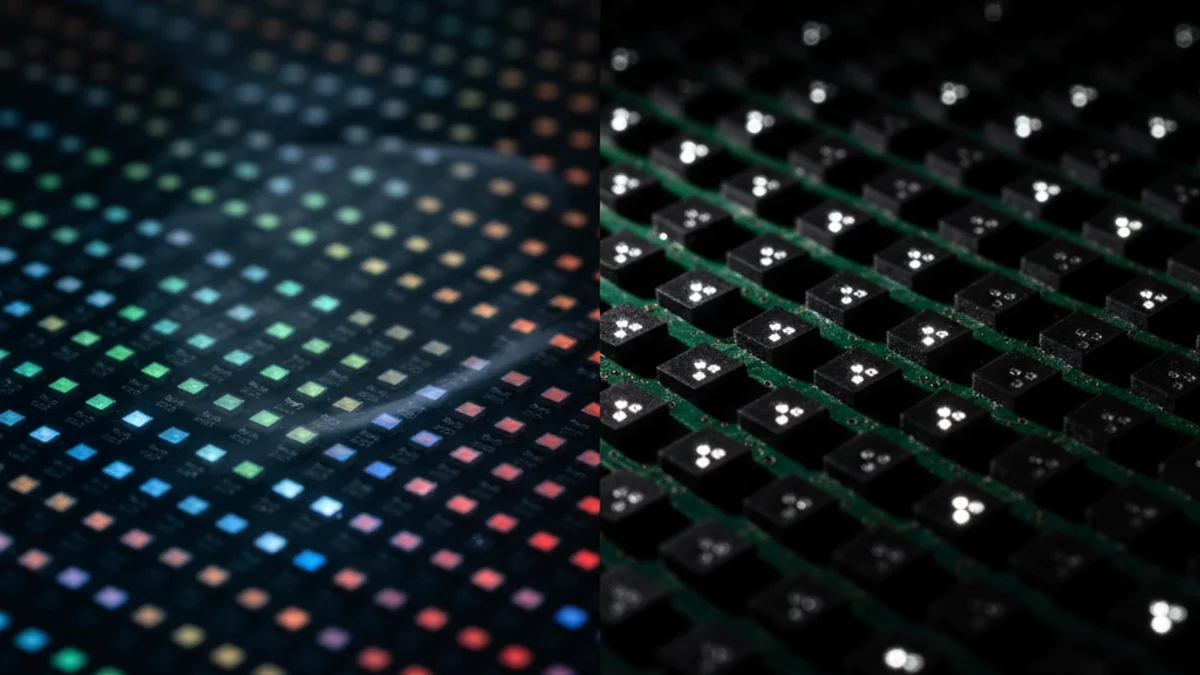
Two LED walls can share a pixel pitch, a size and a price band, and still fail a show in completely different ways. The dividing line is how the diodes are packaged. COB (chip-on-board) embeds the LEDs in a resin-sealed module; SMD (surface-mount device) mounts each LED as a separate package on the panel surface. That single choice ripples through brightness, durability, weight, camera performance and how easily a dead pixel can be fixed mid-show. If you are booking LED screen rental for concerts and festivals, it decides whether the wall survives the load-in.
This is the comparison we run when specifying a wall for an event, stripped of spec-sheet marketing and reduced to what changes on the floor.
DVLED in one paragraph
Direct-view LED works without a backlight: every LED makes its own light, which is why it stays readable in bright rooms where projection washes out. A wall is built from modular cabinets — commonly 500 × 500 mm — that lock together borderless, so the display scales in 0.5 m steps and a failed cabinet can be swapped without replacing the whole surface. COB and SMD are simply two ways of building those modules.
COB vs SMD: the comparison that matters
| Factor | COB (chip-on-board) | SMD (surface-mount device) |
|---|---|---|
| Surface | Resin-sealed module, smooth and sealed | Exposed diode packages on the panel |
| Pixel pitch | Fine pitch readily, down to sub-1 mm | Fine pitch possible, higher cost and fragility |
| Brightness | Moderate — well suited to indoor shows | High — built for daylight and large venues |
| Contrast | Deeper blacks, accurate colour indoors | Bright whites, strong saturation |
| Camera | Smooth surface reduces moiré | More moiré risk on camera, varies by panel |
| Viewing angle | Wide, consistent off-axis | Wider reach but slightly narrower clean angle |
| Handling | Impact- and moisture-resistant | Exposed LEDs need careful dry handling |
| Service | Often front-serviceable; module-level replacement | Individual diode or section replacement |
| Best at | Premium indoor stages, close-up detail, camera work | Outdoor concerts, stadiums, high-brightness public screens |
The takeaway is not that one wins. It is that the room picks the winner: an indoor stage viewed close wants COB, and a daylight arena wants SMD’s brightness.
Pixel pitch and viewing distance
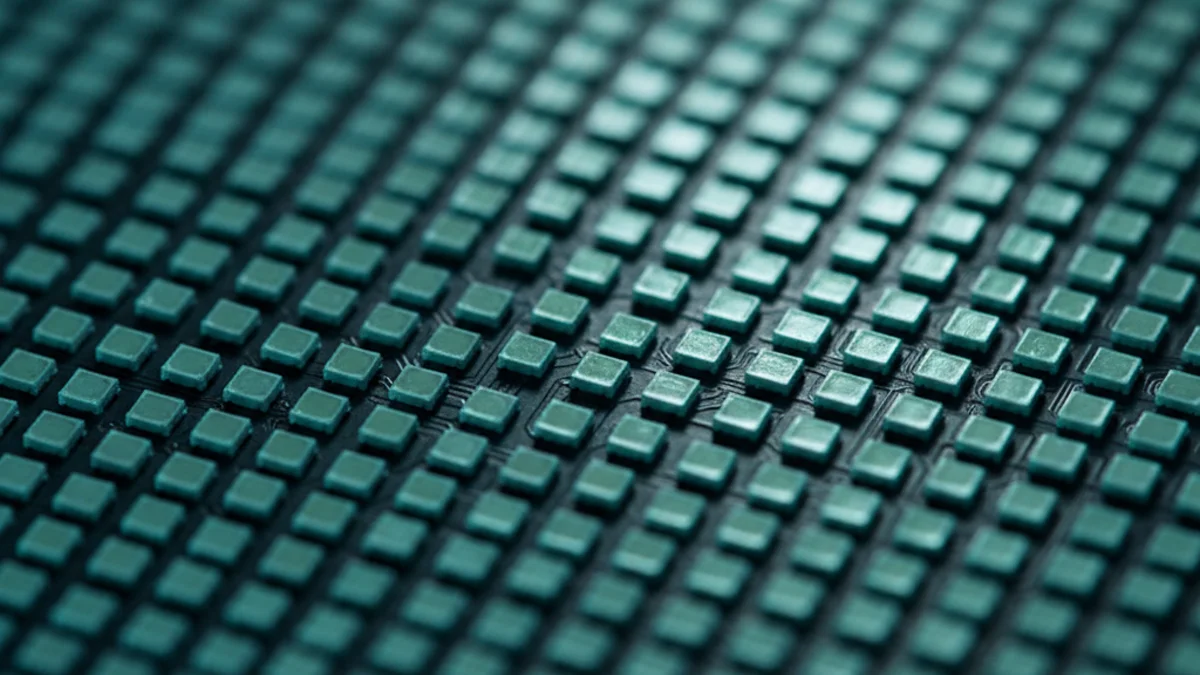
Pitch is the distance between LEDs and it sets how close the audience can stand before the image breaks into visible dots. The working rule across the rental trade is roughly 1 mm of pitch per 1 m of comfortable viewing distance. A 3 × 2 m wall at P2.6 gives a native canvas of about 1152 × 768 — near-HD but wider than 16:9, so a 16:9 master letterboxes with black bars unless the content is designed to the native canvas. This is the detail exhibitors miss most: the wall is not a TV, and content must be built for its exact pixel dimensions.
COB makes fine pitch more practical because the sealed surface holds up when people stand close and handlers move it repeatedly. SMD can reach fine pitch, but the exposed diodes make it a fragile and expensive choice for a stand where visitors lean in.
Brightness: nits against the room
Brightness is measured in nits, and more is not automatically better. SMD panels push high nits, which is exactly what you need to cut through daylight at an outdoor festival. Indoors, that same output washes out faces and text and forces the cameras to fight the screen. COB runs at lower, indoor-appropriate brightness with better contrast, which reads as a cleaner image in a ballroom or a conference hall. Specify brightness against the venue’s light level, not against the biggest number on the quote.
Camera, broadcast and hybrid shows
If the wall appears on camera — IMAG, a livestream, a broadcast cut — refresh rate and surface matter. Walls used on camera want a high refresh rate so the image stays flicker-free; lower-end panels leave rolling bands and moiré on the feed. COB’s smooth surface reduces moiré and holds fine detail for close shots, which is why it is the safer pick when cameras get near the screen. That matters for any production shooting the stage, and it is a core reason the spec for conference displays leans toward fine-pitch, camera-friendly stock.
Weight, rigging and power on a real build
Weight decides the rig. COB modules are typically lighter than equivalent SMD units, which means fewer rigging points, simpler truss and a faster build. On a flown wall that weight difference turns into fewer suspension calculations and less labour through the venue’s approved riggers. SMD walls can still fly, but the extra mass and handling care add rigging cost and build time.
Power follows the same logic. An LED wall draws continuous power, and as an order of magnitude a 5 m P2.6 wall draws in the region of 3–4 kW at show brightness, before audio, lighting and the media server. The cooler, more efficient module keeps the total inside the venue’s metered supply more easily, and in France that supply is ordered and metered rather than bundled into the room — so the load count belongs in the technical file, not on move-in day.
Durability and service access
Rental stock is handled constantly: loaded, stacked, transported and built again every week. The sealed COB surface tolerates that better than exposed diodes, which is why COB suits high-use fleets and the SMD trade-off — higher initial brightness, more careful handling — suits fixed or large outdoor installs. Service access changes the design too: SMD walls traditionally want rear access for repairs, eating backstage depth and limiting where you can place them. COB modules are increasingly front-serviceable, so a module can be pulled from the viewing side and the wall can sit flush against a surface. On a tight stand or a shallow stage, that front-service capability is the difference between a wall that fits and one that does not.
Which technology for which event
- Conference and product launch, indoor: COB — fine pitch, clean on camera, close-up detail.
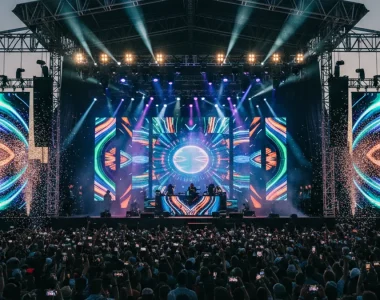
- Concert and outdoor festival: SMD — high brightness, scalable, daylight-readable.
- Exhibition stand, close viewing: COB — sealed surface, fine pitch, front service.
- Stadium or large public screen: SMD — brightness and scale at lower cost.
Booth equipment that earns its floor space follows the same pitch-versus-distance logic — see our notes on trade show booth LED equipment, and confirm every spec against the venue before it enters the technical file.
Content rules that follow the module
The module choice changes how the content should be built. Design to the wall’s native canvas, not a 16:9 master, or you pay for pixels that end up as black bars. On a stand where visitors walk past at 1–2 m, use segments of 6–10 s with one idea each and no audio dependency, and run a 45–90 s loop so returning visitors see something new. Text that works on a fine-pitch indoor wall becomes unreadable once it is burned into a bright outdoor screen at distance. Match the creative to the wall’s pixel dimensions, brightness and viewing distance and the hardware disappears behind the message.
Frequently asked questions
Is COB always the better choice?
No. COB wins indoors on durability, fine pitch and camera performance. Outdoors in daylight, SMD’s higher brightness is the practical choice, so the room decides.
Do COB walls flicker on camera?
Properly driven panels with a high refresh rate do not flicker visibly. Refresh rate, not the COB/SMD label, is what keeps the image clean on a broadcast camera.
Can a dead pixel be fixed on site?
On SMD, a diode or small section can often be replaced. On COB you usually swap the whole module — which is why front-serviceable modules matter for a fast repair during a build window.
Tell us the event, the viewing distance and whether cameras are rolling, and we will specify the right module and pitch. Start with our fashion show LED rental, or request a quote and we will come back with a concrete configuration for your venue.