Why the screen line is the one that gets re-cut
Ask eight AV suppliers to quote “a video wall for 400 people” and you will get eight numbers that cannot be compared. One has priced a 4 m P3.9 wall on a ground frame with two technicians; another has priced 8 m at P2.6, flown, with a processor and a show operator. Both are honest quotes. Neither answers your question, and the difference between them is not margin — it is specification.
The LED line in a large event budget is the least standardised part of the whole production, which is exactly why it is the first thing a finance director questions. This is how the number is actually built, and where it goes wrong.
What moves an LED budget, in order of impact
None of these are prices. They are the variables that swing a price, and knowing the direction each one pushes lets you hold a quote to account.
| Driver | What changes | Effect on the number |
|---|---|---|
| Total surface area | Every additional m² is more cabinets, more flight cases, more rigging load | Steps up in blocky increments, not smoothly — walls build in 0.5 m cabinet units |
| Pixel pitch | P1.9 versus P3.9 for the same wall | The largest single multiplier. Fine pitch means more diodes, more driver electronics, higher rental rate per m² |
| Mounting method | Ground-supported frame versus flown from trusses | Flown adds structural note, venue-approved riggers, motors and inspection |
| Rental duration | One show day versus a five-day build and run | Drives both equipment days and crew days, which is where the real cost sits |
| Power and distribution | Metered supply ordered from the venue plus distro | Often a separate venue invoice nobody put in the AV budget |
| Crew | Build crew, show operator, de-rig | Scales with complexity and hours, not with screen size |
Two of those rows are habitually underestimated. Pitch is chosen late, after the design is fixed, and then forced onto a wall that needed a different one. Crew is treated as a day rate when it is really an hours calculation that includes a build day, a rehearsal, the show and a strike.
Read the quote as four separate invoices
A well-built LED proposal breaks down cleanly. If yours arrives as a single equipment figure with a “labour” line underneath, you cannot audit it and you will not be able to defend it internally.
Equipment
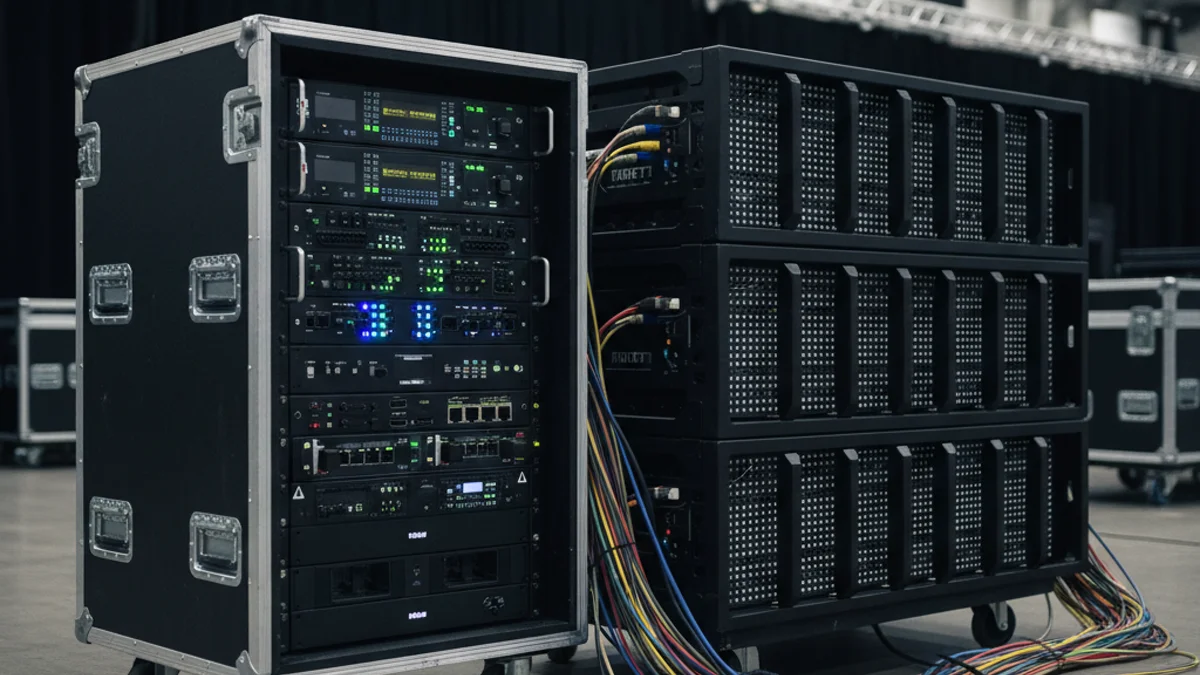
Cabinets, processor, media player, cabling, spares. Ask for the cabinet count and the pitch in writing, plus the native resolution of the assembled wall. If the supplier cannot state the native canvas, they have not designed the wall — they have quoted a size.
Rigging and structure
Ground frames, truss, motors, suspension calculation, riggers. In France this is where the venue’s technical department inserts itself: suspension is approved through the régie technique, with a structural note for the load at the specific truss point. Budget the engineering, not just the hardware.
Power
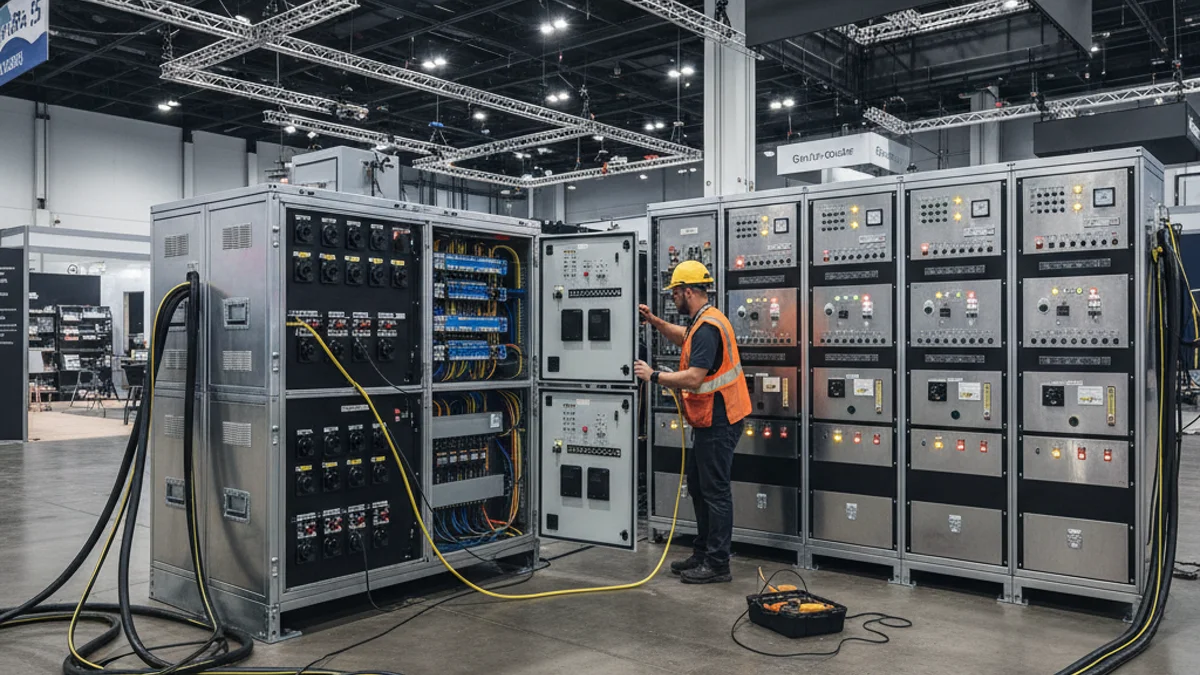
A 5 m P2.6 wall draws in the region of 3–4 kW at exhibition brightness. Add processor, players, and anything else on the same supply. Venues meter power and bill it as an ordered line item, and an on-site upgrade is expensive when it is possible at all. Put the connected load in the power application weeks out, not on move-in day.
Crew
Build, show, strike, plus travel and accommodation if the crew is not local. For a multi-day conference the crew line routinely exceeds the equipment line on smaller walls, because a 3 m screen still needs a build day, an operator and a strike.
The venue charges that never appear in the AV quote
This is the predictable surprise. Most French venues bill separately for the things your screen depends on, and none of it is the supplier’s cost to carry:
- Rigging points and approval — charged per point, plus the structural review.
- Metered electricity — ordered by amperage, billed on consumption or flat rate.
- In-house AV or preferred-supplier clauses — some venues levy a fee even when you bring your own supplier, and a few restrict certain works to their own team.
- Load-in windows and supervision — out-of-hours access often carries a staff charge.
- Fire classification of materials — certificates for the cabinets and rigging are expected; missing paperwork can stop a build at the door.
Get these in writing from the venue before you approve the AV number, and decide explicitly whether they sit inside the supplier’s contract or as your own line. The ambiguity is what causes the argument in week one of the invoice cycle.
Where contingency gets eaten
A 10–15% contingency on the AV line is standard and it is not padding. It absorbs the things that genuinely change: a keynote adds a live camera feed, a sponsor wants their logo on the wall, a processor needs a second output, a module fails on build day and the spare is in a case two halls away.
Contingency does not absorb scope change. If the wall grows from 4 m to 8 m in the final month, that is a re-quote, not a contingency draw — and the delivery lead time may not exist anyway. Track the two separately or the contingency disappears into a change nobody approved.
The same discipline applies to displays beyond the stage: if you are also budgeting wayfinding or welcome screens, those sit under digital signage and display rental and follow a different cost logic, driven by player count rather than surface area.
Budget timeline that holds
- 12 months out — fix the room and the audience size. Room geometry sets the wall, not the other way round.
- 6 months out — decide pitch from the closest viewer distance, and mounting method from the hall’s truss plan. Both decisions are cheap now and expensive later.
- 4 months out — issue one specification to three suppliers, identical in every detail, so the quotes are comparable. Choosing an AV vendor covers what to ask beyond the number.
- 3 months out — submit the venue technical file: stand plan, electrical load, rigging details. Late submission means the venue assigns your build slot.
- 6 weeks out — lock crew hours, confirm the power order, and confirm fire certificates are on file.
- Build week — test pattern before doors: solid red, green, blue and white to expose dead modules and cabling faults that content hides.
FAQ
Is a bigger wall always more expensive per square metre?
No. The rate per m² often falls as the wall grows, because processor, crew and transport are largely fixed. What rises is the absolute number and the structural demand. A small wall in an awkward room can cost more per m² than a large one in a loading-dock-friendly hall.
Can I save money by using a coarser pitch?
Only if nobody sits close to it. On a stage backdrop seen from six metres, P3.9 or P4.8 is correct and cheaper. On a stand where visitors pass at 1.5 m, a coarse pitch is a visible failure that no discount compensates for.
Should the venue’s in-house AV team be used instead?
Sometimes. It is usually simpler logistically and sometimes mandatory for certain works. Compare on specification, not loyalty: ask for the same pitch, same wall size, same crew hours and the same power line, then compare.
How much of the budget should be labour?
On multi-day events, plan for labour to be a substantial share of the AV total rather than a rounding item. The precise split depends on build complexity and hours, so budget crew as hours at a rate, with overtime defined, instead of as a lump sum.
Getting the number right the first time
A defensible LED budget comes from four decisions made early — room, wall size in cabinets, pitch from the closest viewer, and mounting method — plus the discipline to keep venue charges visible as their own line. Everything else is arithmetic.
If you are building that budget now, planning the AV layer for a French conference walks through the sequencing, and LED screen rental for conferences sets out what a stage build includes. Request a quote with your room dimensions, dates and closest viewing distance, and you will get a line-by-line number you can put in front of a finance team.