

A big hall punishes the screen plan that worked at a small stand
Renting an LED video wall for a large trade show is a different job from putting one on a three-by-three stand. The hall is taller, the rigging grid is shared and load-limited, the power drop sits further away than the cable you brought, and the visitor who decides whether to walk over is standing eight metres back, not one. Most of the grief on a large show floor traces back to four decisions made weeks earlier: how big the wall is, how fine the pitch is, how it is held up, and how the content was built for it.
This guide is for organisers, exhibitors and agencies producing large stands and convention builds in France. It turns the operational lessons from running a video wall at a big American convention venue into a sequence you can apply to a hall in Paris, Lyon, Marseille, Nice or Cannes — the parts that decide whether the wall reads from the aisle or turns into a grey rectangle.
What changes when the show gets large
A small stand wall is one or two cabinets on a totem or a counter. A large-convention wall is a structural object: weight that has to be carried, a signal chain that has to survive long cable runs, and a viewing distance measured in metres.

- Viewing distance drives the spec. At a small stand people stand close, so you need a fine pitch and a modest size. At a large show the audience scans from across a walkway, so size and brightness matter more than pitch.
- The mounting becomes the risk. A large wall is either hung from the venue grid or ground-stacked on a base. Both carry lead times and paperwork, and both are load calculations.
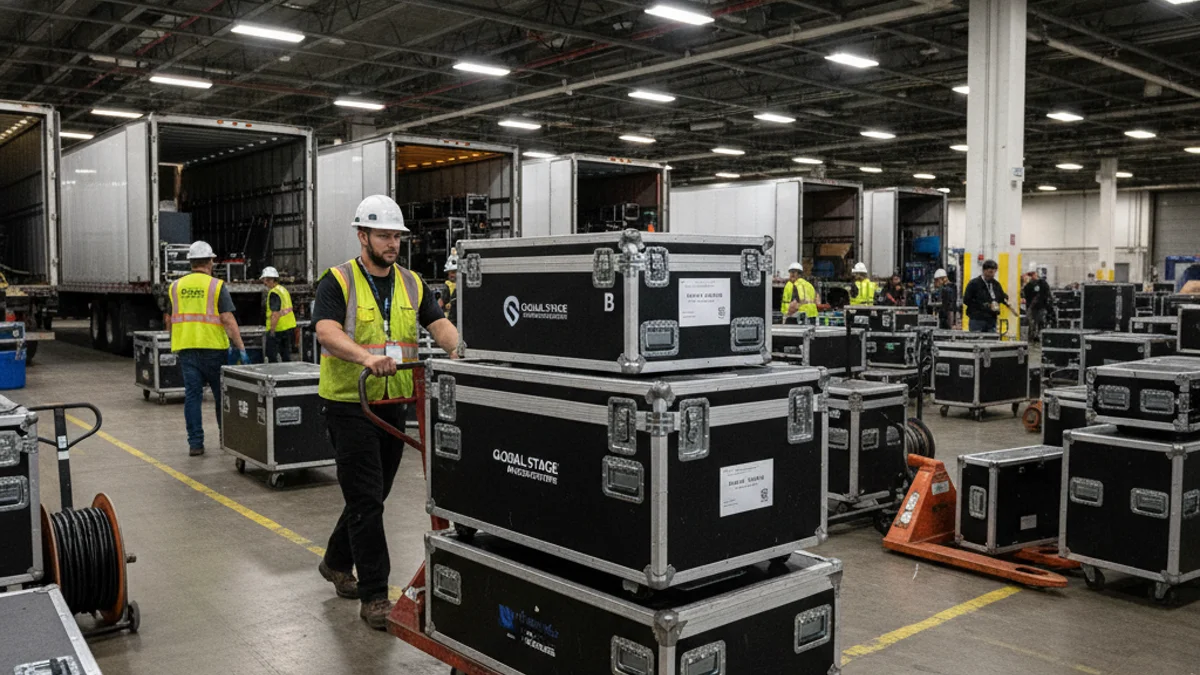
- The build window stays short. Large halls run tight move-in slots and shared dock access. A wall that would take half a day in a warehouse has to go up, be calibrated and be rehearsed inside a window the venue controls.
Matching the wall approach to the build
Before anything is quoted, agree how the wall will physically exist on the floor. The table below is the first pass we run with a large-stand brief.
| Approach | Best for | Footprint and setup | Watch out for |
|---|---|---|---|
| Ground-stacked on a truss base | Large walls where ceiling rigging is restricted or approval is slow | Level floor plus ballast or base plates; keeps rigging crew off the floor | Base and ballast consume floor space; height capped by stability |
| Truss-hung from the venue grid | Tall feature walls and clean-floor builds with rated points | Depends on approved rigging points and documented load limits | Permit lead time; rigger rules; point-load limits |
| Mobile LED trailer or unit | Outdoor forecourts, entrances and drive-past promotion | Self-contained with its own power and structure | Daylight brightness requirement; weather protection |
A ground-stacked build is often the right answer on a large stand. It sidesteps the rigging permit and the load-limit argument, and leaves the ceiling budget free for lighting and signage. Hanging earns its place when you want a tall wall and a clean floor. If the wall is going onto a modular booth rather than a bare floor, it pays to align the screen spec with the trade show booth LED wall equipment you are hiring.
Size the wall to the content, not the price list
The most common large-stand mistake is choosing a standard wall shape and forcing content into it. Video is shot and slides are built at 16:9. If the wall is close to square, you either crop the edges off the picture or letterbox it into a band, and both look like a mistake.
Work the other way. Start from the content’s aspect ratio and the intended width, then let the panel grid decide the height. Panels tile on a fixed grid, so a wall is built from whole cabinets, not a measurement picked off a sketch. Agree the native pixel map of the array before anyone designs a frame — an LED wall can only show the detail it is fed, at the shape it is built to.
On a large build a coarser, cheaper pitch is a false economy. Stepping down one grade saves a small fraction of the rental but costs sharpness for every visitor who steps in close to read a demo. Book the pitch that holds up at the nearest realistic viewing distance.
Pixel pitch is a viewing-distance decision
Pixel pitch is the distance between the centres of two adjacent LEDs, measured in millimetres. The working shorthand is that the minimum comfortable viewing distance, in metres, is roughly the pitch number. A 2.6 mm wall reads cleanly from about 2.6 m; a 3.9 mm wall from about 3.9 m; a 4.8 mm wall from around 4.8 m.
On a large show floor the audience arrives from three directions at once. The person crossing the walkway reads the wall from eight metres and only needs size and brightness. The visitor who steps to the stand edge reads from two or three metres. The press or client leans in to a demo at under two metres. Spec the pitch from the closest of the three, then size the wall so the furthest can still see it. Miss the close one and the demo looks soft; miss the far one and nobody crosses the aisle.
Where the wall is built around a stand rather than sitting on one, screen and structure have to be planned together so the wall lands where the frame can carry it. That intersection is behind our work on LED screen rental for trade show booth building.
Rigging, power and signal at scale
Three logistics problems account for most large-stand failures.
Rigging. Anything suspended over the stand is a structural question. Large venues require approved riggers and documented load calculations, and approval runs in weeks, not days. If the design depends on a hung wall, that paperwork sits on the critical path and has to start before the equipment is booked. A ground-stacked build removes the dependency.
Power. A large wall draws more than people expect, and a stand’s basic allocation rarely covers it. Total the draw of every cabinet, media player, laptop and light, add headroom, and order the venue electricity against that total. Confirm the amperage at your stand position and the distance to the drop.
Signal. Long cable runs across a large stand carry the picture, and at high bandwidth they need the right copper or fibre or you get dropouts and colour shifts. Keep the media server close to the wall, run pre-loaded loops on local players, and test the failover before the doors open.
When the wall is only one of several screens — registration, wayfinding, sponsorship loops in the foyer — those are a lighter, separate build from the main wall. Our digital signage and display rental page covers the screens, players and mounting that carry branding away from the stage.
Step checklist: from brief to load-out
- 120 days out — define the goal and the sightlines. Lead capture, product demo or brand awareness each demands a different wall. Confirm the stand footprint and the nearest realistic viewing distance from the walkway.
- 90 days out — lock the wall size and pitch. Choose width from the sightline and the content’s aspect ratio, then set pitch from the closest viewer.
- 75 days out — decide the mounting and submit the forms. Choose ground-stacked or hung. If hung, start the venue’s rigging and power approvals immediately.
- 60 days out — freeze the content brief. Sign off native resolution, aspect ratio and loop length. Keep background loops under about ninety seconds.
- 30 days out — confirm power, signal and access. Order venue electricity against the calculated total, arrange a wired drop for anything interactive, and confirm the dock slot.
- Build-up day one — build the wall first. Stand or fly the frame, hang the panels and power the wall before decorative finishing goes up around it.
- Build-up day two — calibrate and rehearse. Run the real content, match colour and brightness across every cabinet, test the signal chain under load, and rehearse the opening.
- Show days — keep a technician on call. Dead pixels, compression and dropped connections are the faults that surface under real traffic.
- Load-out — agree the strike before the doors open. Panel packing, timing and venue restoration are planned in advance.
Content and crew timing on a large build
The best wall in the hall is worthless with the wrong footage on it. Test everything on the actual players in the actual room light, because brightness and colour temperature change on site in ways a warehouse test never shows.
Crew timing is the quiet risk. Large halls run tight move-in slots and shared dock access, so the rig schedule is driven by when freight reaches the floor, not when your team is ready.
Frequently asked questions
What pixel pitch do I need for a large trade show stand?
Spec it from the closest viewer, not the furthest. If the nearest realistic viewing point is about three metres, a 2.6 mm or 3.9 mm wall holds up. If visitors lean in under two metres for a demo, go finer. Beyond about five metres the difference between pitches is not visible.
Should I hang the wall or ground-stack it?
Ground-stacking on a truss base is faster and avoids the venue’s rigging permit and load-limit approval, which is why it suits tight large-show programmes. Hanging gives a tall wall and a clean floor but depends on rated rigging points and paperwork that runs on a weeks-long lead time.
How much power does a large LED video wall need?
More than a stand’s basic allocation, and it varies with the number of cabinets. Total the draw of every screen, player, laptop and light, add a margin of roughly a quarter, and order the venue electricity against that figure, early.
How far ahead should I book a large-format wall?
Treat three to six months as the working window for a large stand, and earlier where the build depends on a hung wall, because the rigging and power approvals have their own lead time. Peak seasons in Paris, Lyon and Cannes fill early.
Do you cover shows outside Paris?
Yes. We supply, install and support LED video walls and displays for large events across France, including Lyon, Marseille, Nice and Cannes as well as Paris. Delivery, installation and on-site support are quoted together.
Get the wall sized to the hall, not the price list
On a large show the wall is the first thing a visitor sees and the last thing you want to improvise. Set the size from the content, the pitch from the closest viewer, and the mounting from what the venue will actually approve. Leave it to move-in week and the most expensive item on the stand becomes the one that fails in front of the biggest audience.
For a coordinated build that covers the wall, its support and its power from first brief to load-out, start with LED wall supply and installation in Paris, or send us the brief. Request a quote with your stand dimensions, show dates and venue, and we will come back with a panel configuration and a build plan that fits the floor. For the creative side of lifting the stand itself, see our tips for making a trade show exhibit stand out with LED walls.

1 Comment