Why visitors walk past most stands — and stop at walls that glow
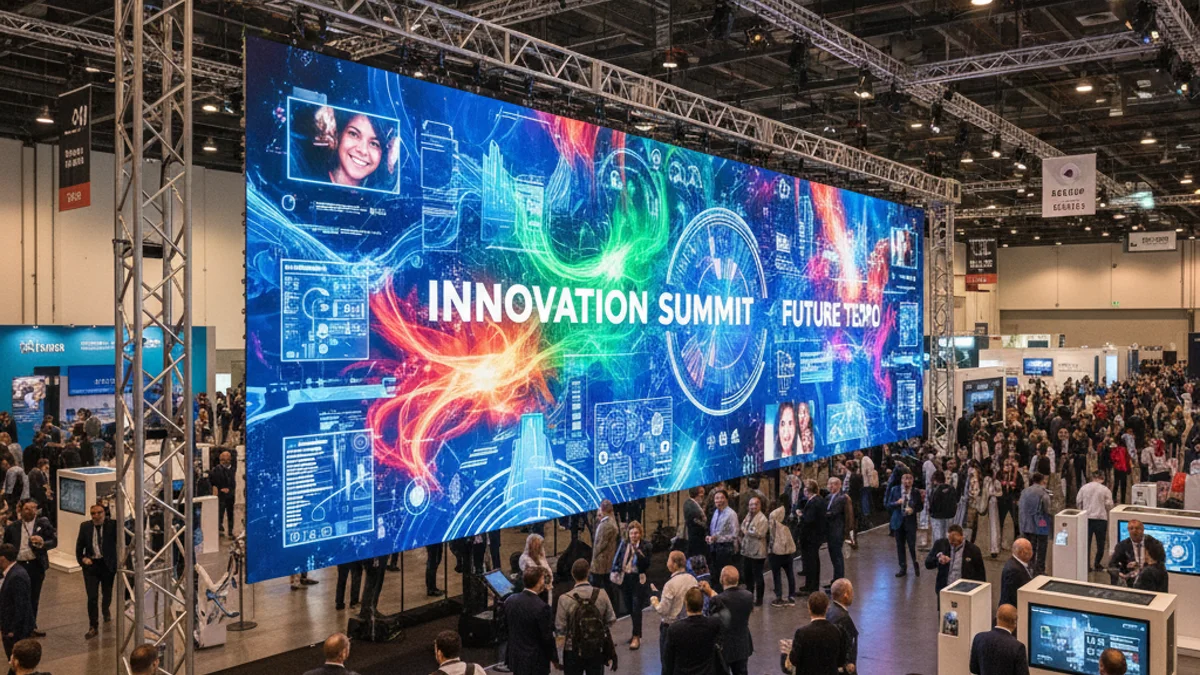
You have spent the budget on the floor space. The stand is built. Then the doors open and the crowd flows straight past your corner toward whoever is showing the brightest, sharpest, most moving thing on the hall floor. On a busy exhibition day at Paris Expo Porte de Versailles or Eurexpo in Lyon, an attendee decides in three to five seconds whether to step onto your stand. A static roll-up banner rarely wins that decision. A 6-metre LED wall running content at 1,000+ nits of brightness almost always does.
This guide is about the hardware and the content that pull people onto an exhibition stand — not the booth furniture. It covers which display format suits which stand size, how to mount it, what to put on screen, and the venue-specific traps that catch exhibitors who plan LED walls late. If your stand is being built around the display rather than having a screen bolted on as an afterthought, the screen does the recruiting for you.
The display formats that actually attract a crowd
Not every screen earns a stop. The three formats that consistently pull visitors are the large-format LED video wall, the freestanding LED poster or totem, and the interactive touchscreen or kiosk. Each solves a different problem, and most strong stands combine two of them. Whichever you pick, the cabinets, rigging and player have to work as one kit — the groundwork we cover in our guide to trade show booth LED wall equipment. A wall creates the visual landmark that is visible from the aisle; a totem carries the brand into the walkway; a touchscreen converts curiosity into a captured contact.
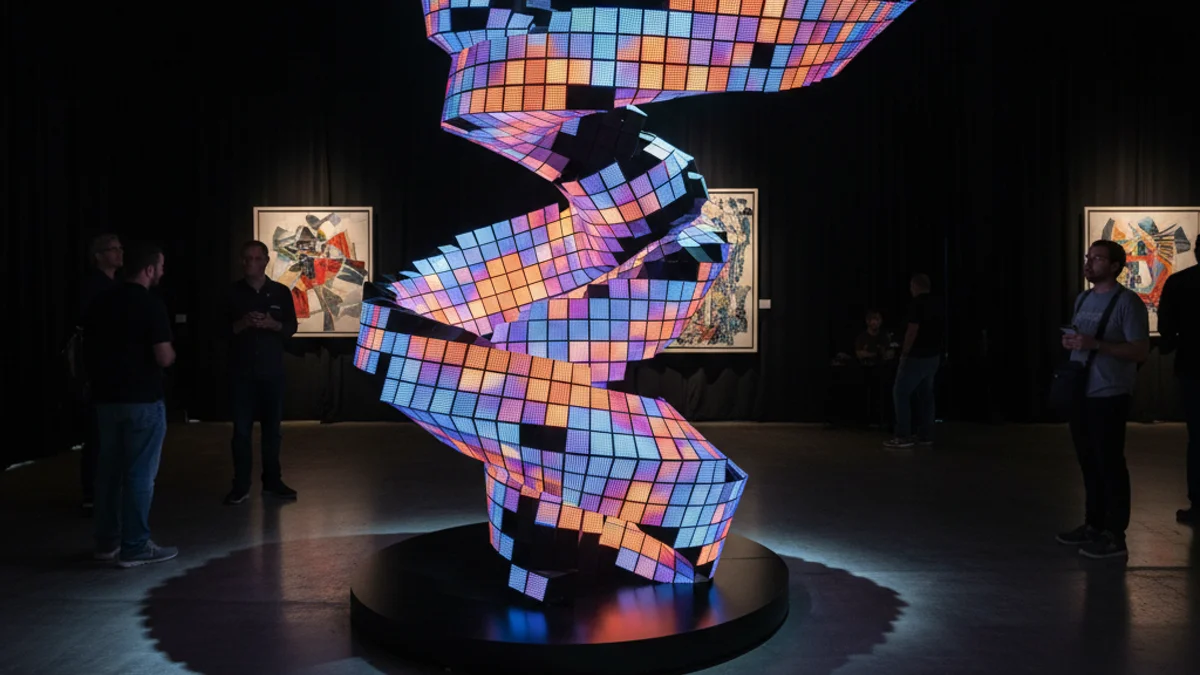
Projectors still have a place, but an exhibition hall is full of ambient light and other exhibitors’ screens. Front projection washes out under that light and needs a dark environment it will never get at a trade show. An LED wall emits its own light, so it stays punchy even when the aisle behind you is brighter than your stand. That single property — self-emissive panels — is why video walls now anchor so many high-traffic stands. When you rent an LED screen for trade show booth building, you are buying visibility that holds up under hall lighting, not a gadget.
Choosing a screen: LED wall vs projector vs LCD video wall vs LED poster
The right choice depends on viewing distance, hall brightness and whether you want passers-by to stop from the aisle. The table below maps the trade-offs as they play out on a French exhibition floor.
| Format | Brightness | Best viewing distance | Best for | Watch out for |
|---|---|---|---|---|
| Large LED video wall (P2.6–P3.9) | 1,000–1,500 nits indoor | From ~2.5 m for P2.6 | Aisle-facing landmarks, brand hero visuals, product reveals | Needs rigging or ground-support structure; plan power/data drops early |
| Fine-pitch LED wall (P1.9 or tighter) | 800–1,200 nits indoor | From ~1.5 m | Close-up product detail, premium stands, on-stand presentations | Higher cost; benefits fade if viewers stay far away |
| LCD video wall (tiled panels) | 500–700 nits | 1–4 m | Meeting-room feel, data dashboards, calendar content | Visible bezels between tiles; weaker at a distance in bright halls |
| LED poster / totem | 1,000+ nits | 0.5–2 m | Walkway messaging, menu-style specs, directional pull | Small footprint — pair with a wall so it isn’t the only draw |
| Projection | Low (diluted by ambient light) | Depends on throw distance | Immersive dark-zone rooms | Washes out in lit halls; needs controlled ambient light |
As a rule, match pixel pitch to how close people will stand. The tighter the pitch, the closer a viewer can get before the individual pixels become visible; the wider the pitch, the cheaper the screen but the further back the audience needs to be. Picking a fine-pitch wall and keeping visitors 8 metres away wastes money. Picking a coarse-pitch wall on a small stand gives visitors a pixelated view and a poor impression.
What to put on screen — content that stops people
The screen is only as good as the loop running on it. Dead, static slides waste a video wall. The content that pulls visitors shares a few traits: it moves, it changes on a short cycle, and it tells a visitor in one glance what your stand is about. If your priority is lifting the whole stand, our tips for making a trade show exhibit stand out with LED walls pick up where this content advice leaves off.
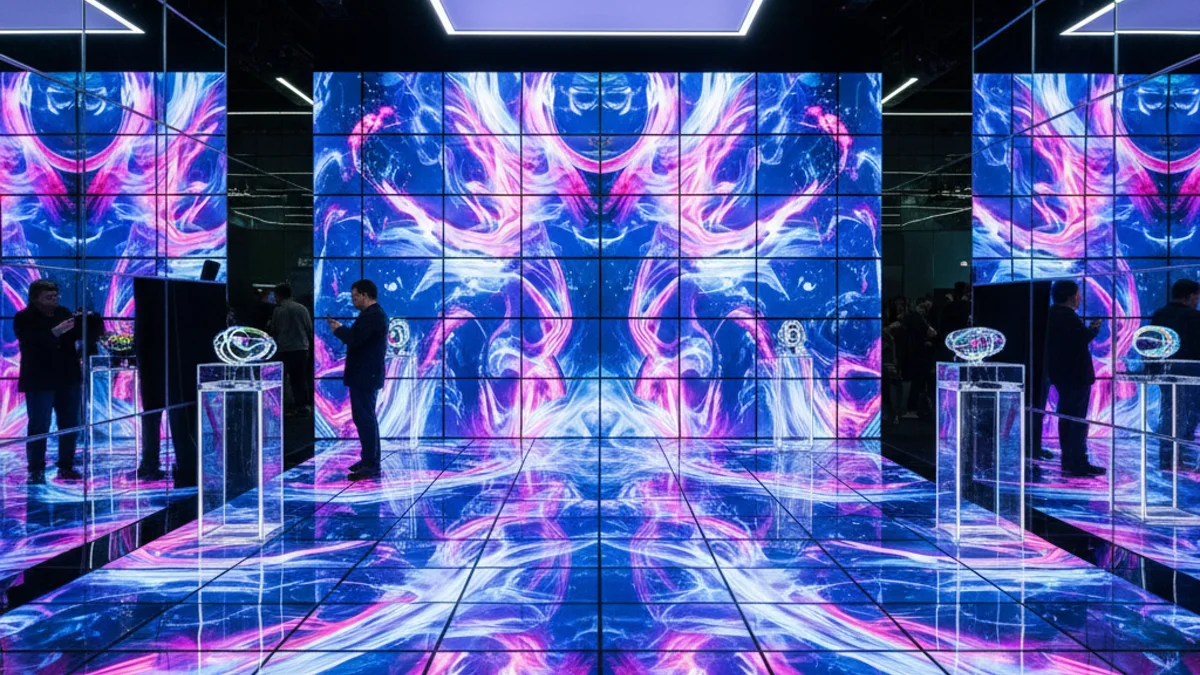
Keep a master loop of 60 to 90 seconds so that anyone crossing the aisle catches a different scene as they pass, not the same frame every time. Use high-contrast, large-type graphics — small text is unreadable from three metres and just looks like noise. Build a clear hero moment: a product reveal, a number that matters, a short captioned clip. Then leave something for the stand itself, where a totem or touchscreen can carry the detail that would clutter the wall.
Run content at the native resolution of the wall and avoid stretching a standard 16:9 video onto an unusual aspect ratio like a two-metre-wide by one-metre-high strip. Mismatched content is the single fastest way to make an expensive wall look cheap. Only moving, high-contrast, correctly framed content converts a passer-by into a visitor.
Mounting: how the wall becomes part of the stand
How you mount the display changes both the budget and the venue paperwork. There are three common approaches.
- Ground-support or freestanding frame. The wall sits on its own truss or chassis on the floor. Best for smaller stands where you cannot hang from the hall ceiling, and the fastest to build overnight.
- Hanging from rigging. The wall flies from a truss or ceiling rig. Creates a floating landmark visible across the hall, but rigging points, load calculations and venue rigging approval usually need documents submitted well before move-in.
- Integrated into a built stand. The wall is set into a wall of the booth, framed by the structure. This is where display planning and stand building should be one conversation — see our work on exhibition booth building in Paris, where the screen is designed into the structure rather than added afterwards.
Whichever you pick, the wall needs power and data. A wall running from a single 16-amp supply is different from one needing three-phase and a dedicated distribution board. Confirm the power, the rigging and the cable routes before you finalise the stand layout, not on move-in night, which is also why many exhibitors bundle screen, sound and rigging labour into one trade show booth AV rental package.
Step-by-step planning checklist
Work backwards from move-in day. These milestones keep the display from becoming the thing that delays your build.
- 8–10 weeks out: Decide the display format and screen size based on stand footprint and viewing distance. Confirm the primary content idea.
- 6–8 weeks out: Lock the mounting method (ground-support, rigged, or integrated). Check venue rules on rigging, height limits and power supply.
- 4–6 weeks out: Order the screen rental and the rigging/labour. Confirm pixel pitch, brightness and aspect ratio in writing.
- 3–4 weeks out: Produce the content loop at the correct resolution. Test it on a real screen if you can.
- 1–2 weeks out: Confirm delivery times, power availability and any venue documentation. Brief stand staff on what the screens are running.
- Move-in day: Build structure, hang or mount the wall, cable it, then run a full content test under hall lighting — not in a dark room.
- Show open: Nominate one person to watch the loop all day. A frozen frame or a black tile loses more visitors than a modest wall ever would.
For stands built around an experience rather than a static product display — games, walk-throughs, hands-on demos — it helps to plan the screen alongside the activation itself. Our notes on LED screen rental for event activation cover how the display supports interactive activities rather than simply decorating them, and our guide to planning immersive AV experiences for trade shows shows how the screen, sound and lighting lock together into one moment.
Venue notes for exhibitors in France
French exhibition centres each have their own rules on rigging approval, allowed structure heights and move-in windows. Paris Expo Porte de Versailles, Eurexpo Lyon, Marseille’s Parc Chanot, the Nice Acropolis and the Palais des Festivals in Cannes all run strict build schedules. A hanging wall needs its rigging plan approved ahead of move-in; a ground-support frame is simpler but takes more floor space you must count in your layout.
Plan the amperage. Large walls draw real power and the venue’s floor boxes have limits. If your screen is the centrepiece, decide the power requirement before the stand contractor quotes the electrics, or you will retrofit a bigger supply at premium rates.
FAQ: LED walls on exhibition stands
How big should my LED wall be for a trade show stand?
Size it to your viewing distance and aisle position. A wall on a small 3×3 stand still needs to be readable from the walkway, so go for a wider-pitch panel you can afford to make bigger rather than a fine-pitch panel you can only make small.
Can an LED wall be seen clearly in a brightly lit hall?
Yes — this is the main reason to choose LED over projection. Self-emissive panels at around 1,000 nits and above hold contrast even when ambient hall light is strong.
What content works best on a booth LED wall?
Short, moving, high-contrast loops of 60 to 90 seconds, with a clear hero moment and minimal small text. Correctly matched resolution and aspect ratio matter as much as the visuals.
Do I need special permission to hang a screen?
Most French venues require a rigging plan and load details submitted before move-in. A ground-support frame avoids that process but uses more floor space. Confirm with the organiser early.
How far in advance should I book the screen?
Book the rental four to six weeks out as a minimum, and earlier for large walls or peak show weeks, so that panel availability, rigging and labour can be confirmed together.
Get the display right, and the stand sells itself
A stand built around a strong LED wall recruits visitors for you. The wall is the landmark; the content is the pitch; the mounting and power are the logistics that keep it running. Plan them together, well before move-in, and the display stops being a cost line and starts being the reason people stop walking.
Tell us your stand size, city and show date, and we will recommend the right screen, pitch and mounting for the venue. Request a quote and we will come back with a practical plan for your next exhibition in Paris, Lyon, Marseille, Nice or Cannes. If your stand sits in one of the larger halls, our guide to LED video wall rental for large trade shows in France covers the scaling decisions that matter most.