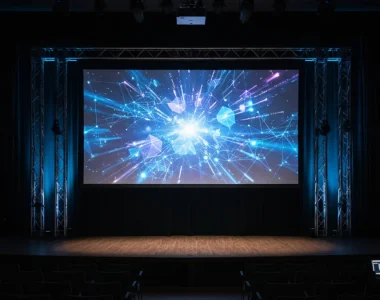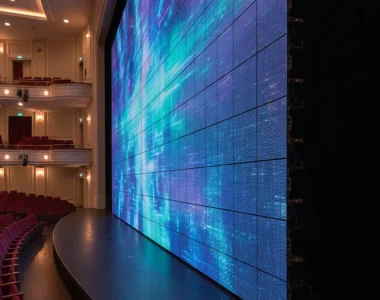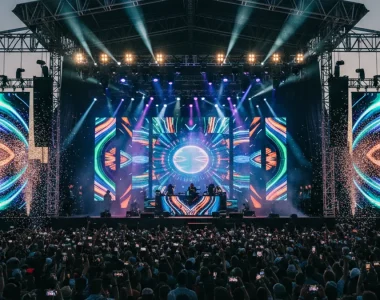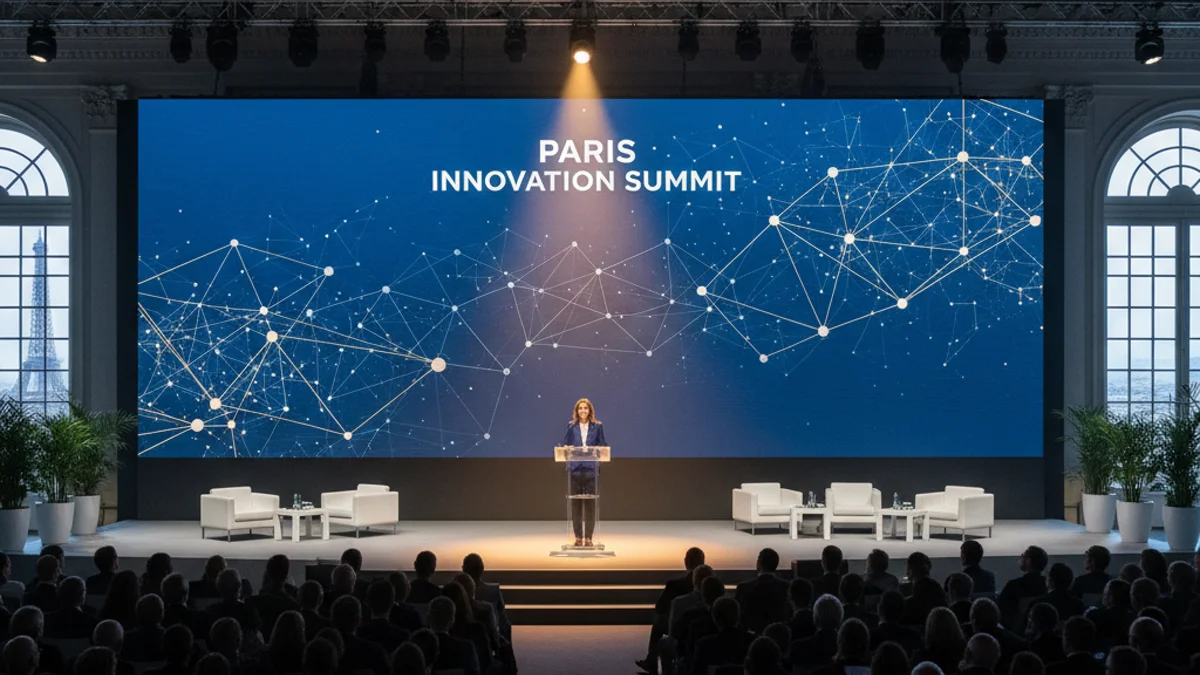
A corporate lighting plan is usually written as if the screen were a neutral object: a rectangle that receives light and gives nothing back. An LED wall is not neutral. It is a luminaire with its own colour temperature, its own brightness in nits, and its own black level, standing in the same room as every profile, wash and moving head on the rig. Design the two independently and the room fights itself: presenters lit warm against a cold blue wall, camera exposure set for the screen while faces fall into shadow, or a polished floor throwing the wall’s reflection back at the audience.
This coordination is the part of LED screen rental for conference events that rarely appears in a quote, and it decides whether the stage reads as a production or as a screen bolted onto a set.
Treat the wall as a luminaire, not a backdrop
An indoor rental wall at event brightness typically runs in the region of 800 to 1,500 nits. That is far brighter than a projected image and comparable to a large soft source. Once you accept that, the design questions change. You stop asking “where does the screen go” and start asking “what is the ratio between the screen and the person standing in front of it”.
That ratio is the whole game. If the wall is at full white and the presenter is lit at a fraction of that level, the camera exposes for the screen and the face goes dark. If the presenter is lit far hotter than the wall, the screen looks dull and the content loses authority. The working target for a keynote is a presenter key light that sits close enough to the wall’s average luminance that both survive the same exposure. In practice that means dimming the wall’s content for talking-head segments rather than pushing more light onto the stage.
Two practical levers do most of the work:
- Content luminance, not wall brightness. A dark-background slide deck at 40 percent average brightness is easier to light against than a white deck at full output. Ask the content team for a darker master rather than asking the lighting team for more fixtures.
- Key light as a controlled source. A tight, flagged key on the presenter keeps spill off the wall. Broad front wash that hits the screen as well as the face flattens both.
Colour temperature and the camera
LED walls are commonly set somewhere between 6,500 K and 9,000 K out of the box, and stage tungsten sits near 3,200 K. Put the two together without correction and the presenter looks orange against a blue-white screen. The fix is not to drag the wall to tungsten; it is to pick one reference and move both towards it.
For a filmed or streamed event, 5,600 K is the usual compromise: the wall is trimmed down to it in the processor, and the stage fixtures are corrected with gel or by using a daylight-balanced LED inventory. For an unfilmed gala, warm stage light and a wall trimmed to 4,000 K often looks better in the room than a technically neutral match, because the audience reads warmth as intimacy.
Whichever direction you choose, write the number into the technical schedule. “Warm” is not a specification. A colour temperature in kelvin, a target for the wall’s white point, and a named person to trim it during the focus session are.
Black level, contrast and the blackout problem
An LED wall cannot produce true black while it is emitting. A dark scene reads as very dark grey, and in a dark room the audience sees the rectangle even when the content is meant to disappear. This matters for two common corporate moments: the reveal, where the screen is supposed to be invisible until the cue, and the awards segment, where a lit rectangle behind the winner competes with the moment.
Options, in order of cost:
| Approach | What it buys | What it costs |
|---|---|---|
| Content-led masking | Black frames on a dark stage read as “off” to most audiences | Nothing but discipline in the content build |
| Physical masking | Genuine blackout for a reveal cue | Masking panels, a cue, and rehearsal time |
| Lower output in a dark room | Reduces the visible glow and lets stage light carry the room | Loses impact on bright content |
For a filmed event, the choice is narrower. Camera dynamic range decides how much of the wall’s glow you can hide. A dark stage with a dim wall and a well-exposed presenter is the safest combination; a bright wall behind a dark-suited speaker is the hardest thing to expose.
Reflections, floors and the room’s own surfaces
An emissive wall puts light into the room in every direction, and hard surfaces send it back. A polished ballroom floor under a 6 m wall produces a visible reflection that reads as a smear under the presenter’s feet. Glass walls at the back of a conference room bounce the screen into the audience’s eyeline.
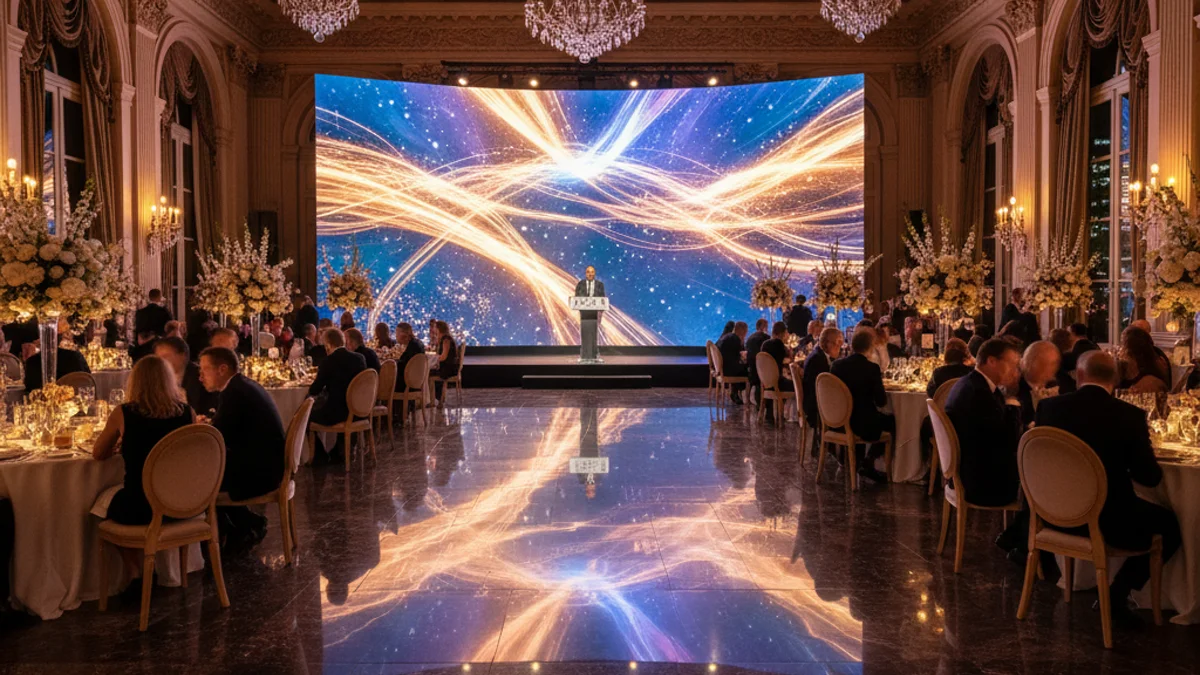
Three checks during the site visit catch most of it:
- Stand at the back row and look at the floor between you and the stage. If you can see the content mirrored, the camera will see it too.
- Look at the side walls and any glazing behind the audience. A bright reflection in the audience’s field of view reduces the perceived contrast of the stage.
- Check the ceiling. A white or light ceiling above the wall bounces light back down and lifts the room’s ambient level, which flattens the screen.
Mitigation is usually cheap: a matte carpet or a darker floor covering in the front zone, black drapes on the reflective wall, and a slight downward tilt on the wall where the rigging allows it. Where the venue forbids floor coverings or drapes, the content brief has to carry the correction instead.
Power, rigging and the French venue file
The lighting and screen departments both draw power, and both are usually metered separately. A 5 m wall at P2.6 draws in the region of 3 to 4 kW at event brightness; add a full stage rig and the combined load is no longer a detail. Order the supply with the stand or event’s power application, not on move-in day, and ask for the amperage and circuit locations in writing.
French venues route rigging through the technical régie. Suspended walls need a structural note, a suspension calculation and venue approval, and the lighting truss may be competing for the same points. Submit both departments’ loads together in the technical file so the venue can see the total weight at each point rather than approving each in isolation. Materials documentation matters too: M1 or B-s1,d0 classification for the wall’s cabinetry and any drapes or set pieces, requested in writing before the build.
Fixed move-in windows make the sequencing tight. The usual order is rigging and power first, wall build and test second, lighting focus third, because the focus session needs the wall running to trim against it. A wall that is still being built when the lighting team arrives pushes the focus into the event’s first morning.
Where the two departments hand over
The handover is a short document, and it prevents most of the friction. It should state the wall’s white point and target brightness, the presenter key light level and colour temperature, the content’s average luminance for talking-head segments, the blackout cue for any reveal, and the name of the person who owns the trim during the show. Lighting and video then have one reference instead of two opinions.
For the room-level decisions that sit upstream of this — whether the event needs an emissive wall or a projected image at all — the comparison in projector or LED wall for business events covers the ambient-light and throw-distance trade-offs. If the event is a multi-day conference, the sequencing in the corporate event AV planning checklist maps these decisions to a timeline so the lighting focus is not the last item squeezed before doors.
Frequently asked questions
Should the LED wall be dimmed for speeches?
Usually yes. Dimming the content to a darker master gives the presenter more presence on camera and in the room. The exception is a show where the wall is the main visual and the speaker is secondary; there the presenter light has to be pushed instead.
Can stage lighting be designed before the wall is specified?
It can be sketched, but not finalised. The wall’s position, height and brightness set the reference the lighting is trimmed against. Specify the wall first, then lock the lighting plot.
Does the wall’s refresh rate affect the lighting design?
It affects the camera, and therefore the lighting. A wall running at a refresh rate that beats against the camera’s shutter shows banding, and the lighting team will be asked to compensate for a problem that belongs to the video department. Agree the refresh rate and camera shutter angle in the same technical meeting.
What about the wall’s heat in a small room?
An LED wall puts less heat into the room than an equivalent tungsten rig, but the cabinets do warm the air immediately in front of them. In a low-ceiling room this can be noticeable on stage. It is rarely a reason to change the design, but it belongs in the venue conversation if the room is small and the ceiling is under 4 m.
If you are planning a corporate event where the screen and the lighting have to share one room, request a quote and send the venue plan with the truss heights. The design conversation is shorter when both departments are briefed from the same drawing.