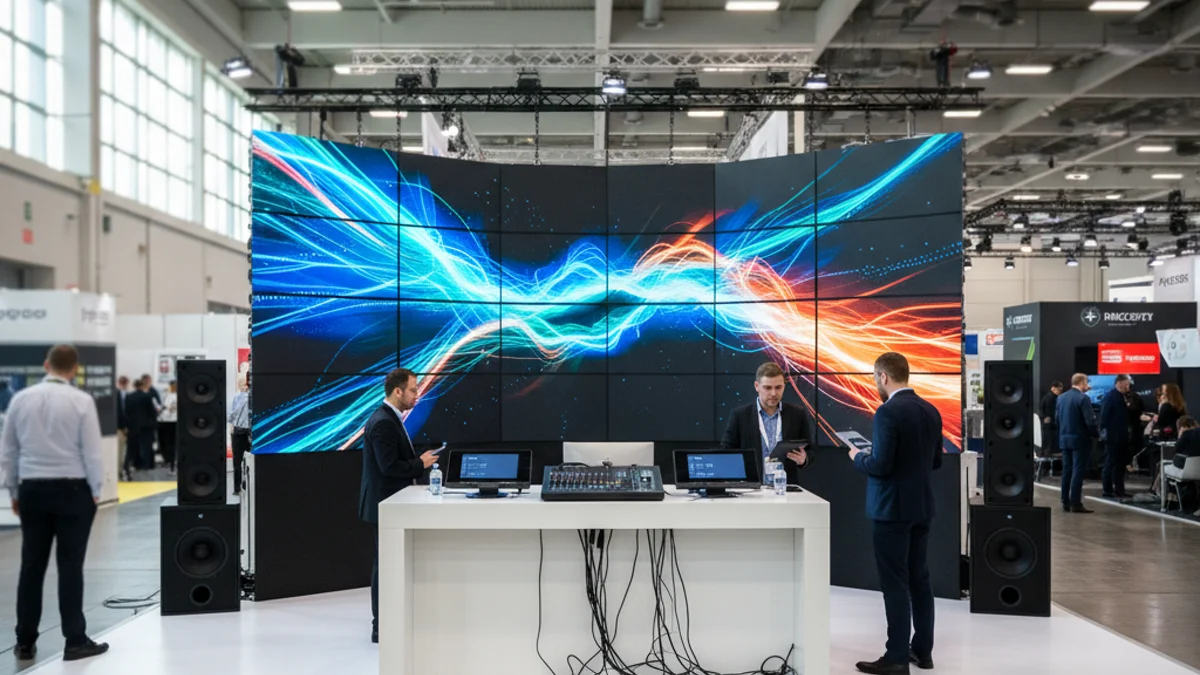
Two suppliers — one building the stand, one shipping the screens — is how exhibitors end up with a video wall that arrives after the graphics do and a content file rendered at the wrong aspect ratio. Bundling AV into the booth rental contract puts the LED wall, the audio chain and the stand structure under one delivery schedule, one power application and one technical file. That is the difference between a stand opening clean on move-in morning and one opening two hours late. If you are commissioning the structure through exhibition booth building in Paris, the strongest move is to fold the LED and AV rental into the same package rather than source them separately.
Why Bundling AV Into a Booth Rental De-Risks the Build
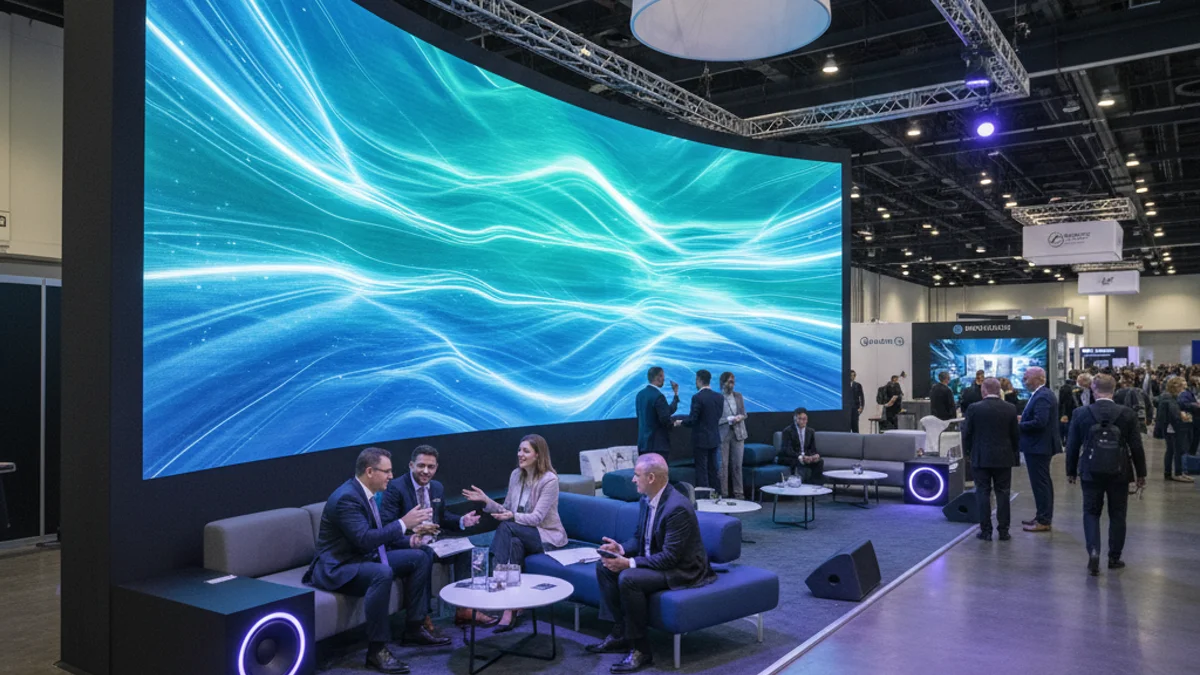
A standalone screen order and a standalone stand order are two projects that only meet on the show floor. When they are bundled, the people clamping the video wall to the structure are the same people who signed off the rigging points, the same people who ordered the electrical drop, and the same people who filed the dossier technique with the venue’s régie. The failure modes that wreck schedules — a wall sized at 5.3 m that cabinets cannot actually build, a P3.9 panel spec’d for an aisle where visitors stand 1.5 m away, a power supply upgraded on move-in day — all disappear when one supplier owns both halves.
Rental also shifts capital risk. A wall you buy is a wall you store, insure, and hope survives four more shows. A bundled rental is priced per event, arrives in flight cases on 500 × 500 mm pallets, and leaves when the carpet comes up.
What Goes Into a Booth AV Rental Package
The bundle is not “a screen”. It is a short list of components that have to be specified together, because changing one moves the others. Here is what a trade show booth AV rental normally carries, and the choice that matters in each slot.
| Component | Typical choice | Decision that matters |
|---|---|---|
| LED video wall | P2.6 cabinets, 2–6 m wide | Pixel pitch set by closest visitor distance, not budget |
| Display / digital signage | LED posters or 55–82″ UHD panels | Brightness (nits) against hall lighting |
| Audio | Compact line-array or powered tops on stands | Booth-footprint dispersion vs neighbouring stands |
| Media player & processor | Looping player + scaler | Native canvas match so content does not letterbox |
| Rigging & mounting | Stand-mounted truss or freestanding frame | Venue-approved suspension if the wall flies |
| Power & cabling | Metered supply ordered with the stand | Load in kW declared weeks ahead, not on move-in |
| Crew | Install, operate, de-rig | Single team keeps the schedule honest |
A booth LED wall equipment list done separately from the stand often reads well on paper and then fights the structure for weight and mounting points. Bundling is what stops that fight.
Pixel Pitch and Power: The Two Numbers That Decide the Bundle
Everything else follows these two. The working rule in the rental trade is that 1 mm of pixel pitch buys roughly 1 m of comfortable viewing distance. Visitors on a stand pass at 1–2 m, which is why P2.6 is the sensible default for an exhibition video wall and P1.9 is reserved for close-up product detail or text-heavy content. A P3.9 wall looks fine from 4 m away and shows diode structure from the aisle edge — the single most common mis-specification we see on stand briefs.
Wall size is built in 0.5 m increments because cabinets lock together borderless. You cannot order 5.3 m. Native resolution is width divided by pitch, times height divided by pitch:
| Wall size | Pitch | Native canvas |
|---|---|---|
| 2 × 1.5 m | P2.6 | ~768 × 576 |
| 3 × 2 m | P2.6 | ~1152 × 768 |
| 5 × 2.5 m | P2.6 | ~1920 × 960 |
| 6 × 3 m | P3.9 | ~1536 × 768 |
Notice that the 5 × 2.5 m wall is wider than 16:9. A 16:9 master file letterboxes with black bars on a wall the exhibitor paid for — always brief content to the native canvas. On power, a 5 m P2.6 wall draws in the region of 3–4 kW at exhibition brightness, which is why the supply is ordered with the stand’s power application rather than on move-in day. See the large trade show LED video wall guide for the rigging and crew timing that sits behind these numbers.
Buying vs Renting vs Bundled: Where the Money and the Risk Sit
| Buy & own | Rent AV alone | Bundled stand + AV rental | |
|---|---|---|---|
| Upfront cost | High — capital outlay | Per event | Per event, single invoice |
| Storage & insurance | On you, year-round | None | None |
| Power application | Your risk to declare | Separate supplier | Filed with the stand’s technical file |
| Mounting compatibility | You solve it | They solve it — blind to the stand | One team owns structure and screen |
| Late spec change | Costly | Gap between suppliers | Handled inside the package |
| Best fit | 10+ identical shows | Occasional exhibitor | Most exhibitors, most venues |
Worked Example: A 6 × 3 m Wall on a 20 × 20 Stand
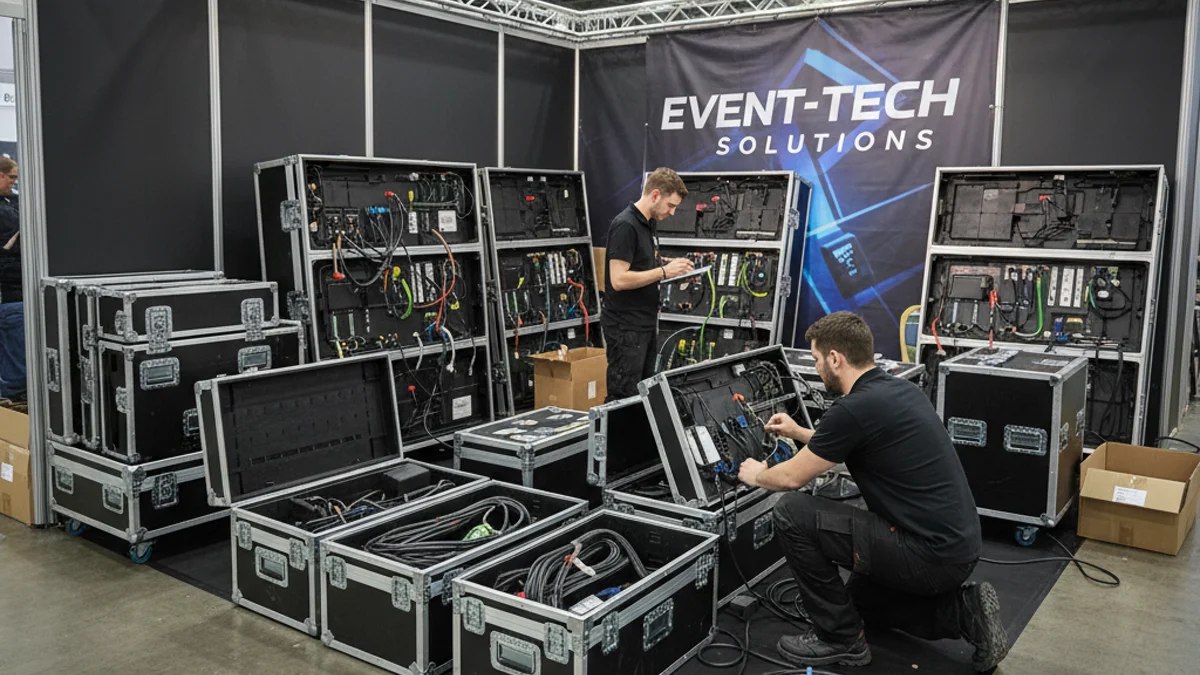
Take a 20 × 20 ft island stand (roughly 6 × 6 m) at a Paris venue. The exhibitor wants a full-height wall on the back return. At 6 × 3 m and P3.9, the native canvas is about 1536 × 768, and the wall hangs on the return truss, which means a suspension calculation and venue-approved riggers through the technical channel. Power is declared at move-in planning as part of the stand’s supply, and the crew installs the wall the same day the structure goes up — because both are on the same flight-case manifest. Compare that to sourcing screens separately: the wall arrives as its own delivery, waits for the rigging slot, and the electrical drop may not be live yet. Same hardware, three more hand-offs, one more chance to lose a day.
Cost Drivers: What Moves the Combined Invoice
Beyond raw hardware, these are the levers that shift a bundled booth AV rental price:
- Pixel pitch. Smaller pitch means more cabinets per square metre, so P1.9 costs more than P2.6 for the same wall.
- Wall area and shape. A taller or wider wall changes cabinet count and often triggers structural notes.
- Rigging method. Flying a wall adds suspension calculations and venue-approved riggers; a freestanding frame does not.
- Venue access. Upper-level halls with tight lifts or narrow dock doors add labour time to every case movement.
- Crew hours. Overnight or single-slot installs cost more than a two-day build window.
- Content production. A looping player is cheap; a bespoke motion piece rebuilt to the native canvas is not.
None of these are invented figures — they are the variables any supplier will price against. Ask for them itemised so the bundle is comparable to a standalone quote.
Step Checklist: Briefing a Bundled Stand and AV Rental
- 12 weeks out. Confirm stand footprint, shape and whether the wall flies or sits on a frame.
- 10 weeks out. Set pixel pitch from the closest visitor distance; pick the wall size in 0.5 m increments.
- 8 weeks out. Declare electrical load in kW and submit the dossier technique to the venue’s régie technique.
- 6 weeks out. Request fire-classification certificates (M1 or B-s1,d0) for cabinets and rigging hardware in writing.
- 4 weeks out. Brief content to the native canvas — 6–10 s segments, 45–90 s loop, no audio dependency, subtitles sized for a standing aisle visitor.
- 2 weeks out. Agree the flight-case manifest, dock access and lift dimensions for the specific hall.
- Move-in day. One crew builds structure and mounts the wall on the same schedule.
- Show open. On-site operator monitors the loop and swaps dead modules from spares in the case.
Frequently Asked Questions
How much does a trade show booth AV rental cost?
It is priced per event, driven mainly by pixel pitch, wall area, rigging method and crew hours — not by a flat rate. A P2.6 wall on a freestanding frame costs less than a P1.9 wall that flies on a truss. Ask for an itemised bundle so you can compare it to a standalone screen quote.
Can I add AV to a booth I already booked?
Yes, and it is common. The earlier you fold the AV spec in, the cheaper it is, because power and rigging can be declared with the stand’s technical file. Bolting a wall on late means re-filing with the venue and absorbing extra labour.
Do I need a bigger pixel pitch if visitors stand close?
No — you need a smaller one. Visitors pass at 1–2 m, so P2.6 is the default. A larger pitch like P3.9 looks sharp from 4 m but shows diode structure up close. Match pitch to the closest viewing distance, not the widest.
What content works best on a rental wall?
Product-in-motion clips, a silent process demo, or interactive configuration. Segments of 6–10 s, one idea each, no audio dependency, and designed to the native canvas so nothing letterboxes. A returning visitor should see something new within a 45–90 s loop.
Will the rental wall meet French fire rules?
Rental LED cabinets and rigging hardware should arrive with documented M1 or B-s1,d0 classification. Ask for the certificates in writing before the build — venues request them as part of the stand’s technical documentation.
Let Us Bundle Your Stand and Your AV
Renting the screen and building the stand as one package removes the hand-offs that lose show-floor time. We size the wall to the content, sit it on the right structure, declare the power with the stand’s technical file, and run install to de-rig with one crew. Pair it with our digital signage and display rental for aisles and LED posters, and read the sibling guide on trade show booth ideas using LED walls if you are still shaping the creative. Tell us the venue, the footprint and the closest visitor distance, and we will come back with a single itemised package. Request a quote to start.