10 Product Launch Event Ideas Using LED Walls
Most launch briefs arrive as a mood board. The organiser knows the product, the guest list and roughly how many people are coming — then draws a blank on the format. That is where the bill climbs: a vague concept forces the AV supplier to over-spec, and the venue’s technical régie charges for changes made late. The fix is to pick a format first, then let the LED architecture follow it. This guide sets out ten launch concepts you can stage with rented LED screens in Paris and across France, with a short brief for each and the display format it needs. Every idea here has been built in the halls named below — Paris Expo Porte de Versailles, Paris Nord Villepinte, Eurexpo Lyon, the Palais des Festivals in Cannes — so treat the venue notes as operating reality, not theory.
The Two Decisions Every Launch Format Hides
Whatever concept you choose, two parameters decide how it looks and what it costs. The first is pixel pitch — the working rule across the rental trade is roughly 1 mm of pitch per metre of comfortable viewing distance. Guests seated 2 m from a launch wall need P1.9 or P2.6; a high-hanging backdrop the audience sees from 8 m can carry P4.8 at a fraction of the cost. The second is native canvas. LED cabinets are built in 0.5 m increments, so a 5 × 2.5 m P2.6 wall lands near 1920 × 960 pixels — wider than 16:9. A 16:9 master will letterbox with black bars on a wall you paid for. Design content to the native canvas, not the other way round. Get these two right and every format below becomes easier to brief.
10 Launch Event Ideas and the LED Format Each Needs
1. The Single-Wall Reveal
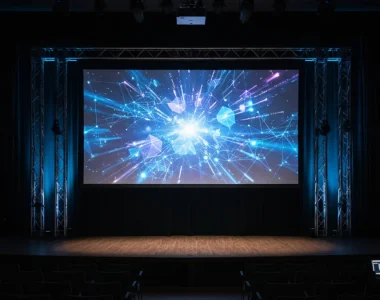
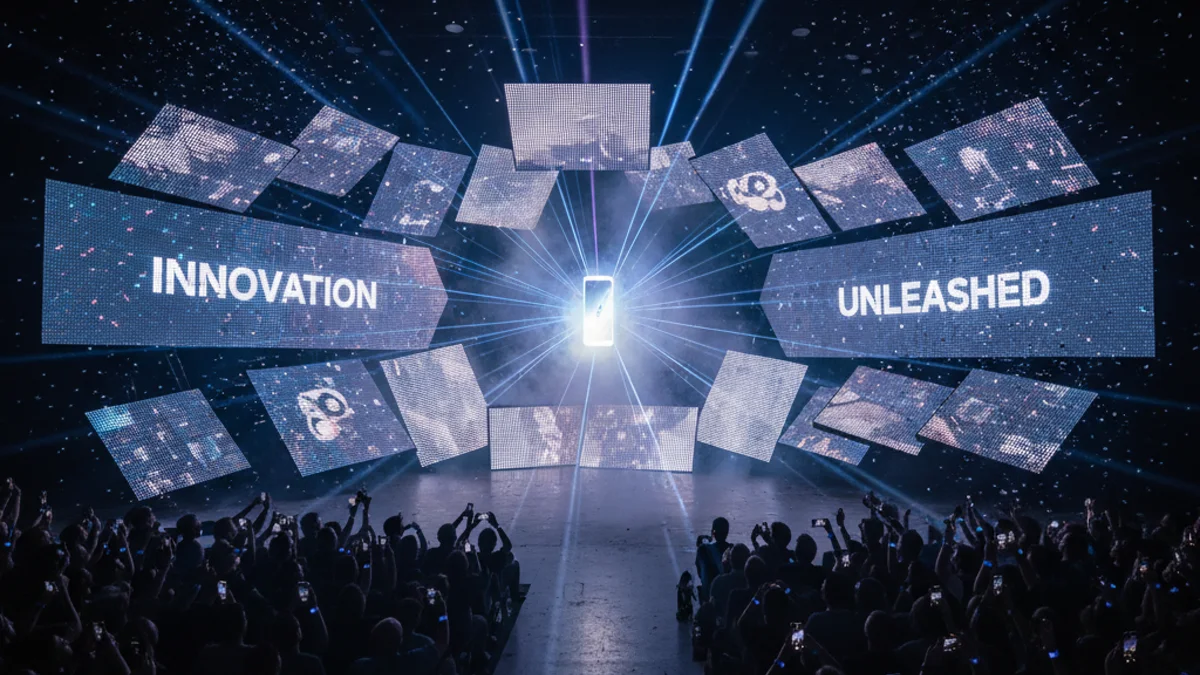
The concept: the whole room faces one large-format LED wall. Content builds — teaser loop, a monologue from the founder, then a blackout and a hard cut to the product on screen as the physical unit is lit on stage. The brief: one wall, 6 × 3 m or wider, plus a blackout cue that kills the wall and the stage wash together. Timing is everything; a reveal that fires half a second off reads as amateur.
2. The Ribbon / Data Wall
The concept: a long, shallow LED wall wraps a balcony or sits above a demo zone, carrying a rolling headline, availability ticker and countdown. It is the least expensive impact per metre. The brief: a 0.5–1 m tall strip wall read from distance, so P3.9 or P4.8 is fine. Great for launches where the product itself is a service or app with no physical centrepiece.
3. The Immersive Corridor
The concept: guests walk through a tunnel or corridor lined floor-to-ceiling with LED, so the product story plays out around them. The brief: two facing walls, or a 270° enclosure, with matched content and a single audio bed. Walk-through time is short — keep segments to 6–10 s each, no audio dependency, and loop the sequence in 45–90 s so returning guests see something new. Covered in more depth in our guide to immersive AV experiences for trade shows.
4. The Product-on-Pedestal with Scrim Wall
The concept: the product sits on a plinth in front of a large LED wall, with content keyed around its silhouette. Guests approach at close range, so pitch is critical — P1.9 or P2.6 on the wall behind the plinth, no diode structure visible at arm’s length. The brief: a 6–10 m² wall and a dedicated content loop timed to the reveal.
5. The Two-Zone Split Stage
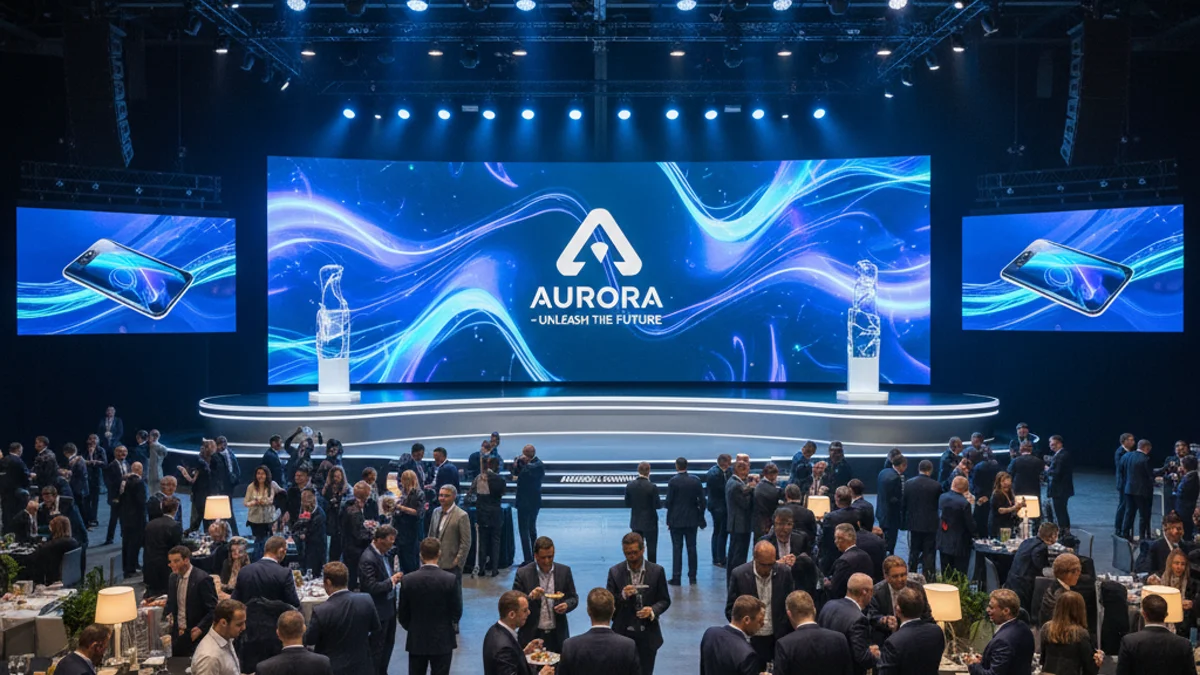
The concept: a main presentation wall carries the keynote, while a second wall in the demo or drinks zone relays the reveal on a delay and carries the QR-driven demo. It doubles dwell time without doubling the headcount. The brief: matching pitch on both walls, one processor and a single content canvas so the two never drift.
6. The LED-Integrated Afterparty
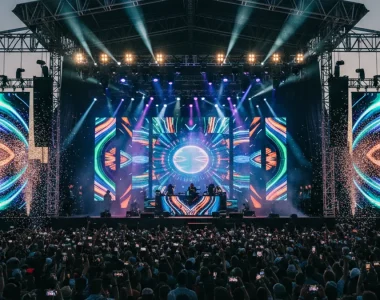
The concept: the launch runs straight into an afterparty, and the wall becomes the set — reactive visuals, a DJ feed and a live social wall. The brief: a wall rated for sustained brightness over long hours, plus a media server with a live-input capability. Budget power early — a 5 m P2.6 wall draws in the region of 3–4 kW at exhibition brightness, and hooking up extra supply on the night usually is not possible.
7. The Interactive Configurator Wall
The concept: guests configure the product on a touchscreen and watch the result render live on a large LED wall. Build-to-order launches — cars, furniture, tech gear — live or die on this. The brief: one touchscreen display feeding one LED wall through a media player, tested end-to-end before the doors open. See the range of digital signage and touchscreen displays we supply for this format.
8. The 270° Wrap Reveal
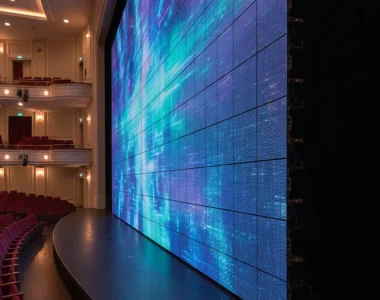
The concept: a curved or corner-wrapped LED wall surrounds the stage so the reveal fills the guest’s field of view. It is the format that reads most like a broadcast moment. The brief: corner cabinets and a single processed canvas; watch the truss capacity at each suspension point, because a wrapped wall loads the rig unevenly.
9. The Hybrid Press Studio
The concept: the launch doubles as a broadcast — a LED wall behind the speaker carries clean backgrounds and branded lower-thirds for the stream, while the room watches the same feed. The brief: a wall with fine pitch (P1.9) so on-camera text stays crisp, plus a lighting plan that serves both the room and the lens. Our creative impact guide for product launch AV covers the colour and cue discipline this format demands.
10. The Pop-Up Showroom Roadshow
The concept: a touring version — one LED wall, a plinth and a modular demo unit that travel together through Paris, Lyon, Marseille and Nice. The brief: road-cased cabinets with quick-lock frames and a marked flight-case plan, so a two-person crew can rebuild the wall in a venue with a fixed move-in window.
Launch Format Comparison: Idea, LED Fit and Venue Demand
| Launch format | Best-fit LED display | Venue demand |
|---|---|---|
| Single-wall reveal | One large wall, 6 × 3 m+, P3.9 | Wide halls: Villepinte, Eurexpo |
| Ribbon / data wall | Strip wall 0.5–1 m tall, P4.8 | Balcony or above-demo sightlines |
| Immersive corridor | Dual facing / 270° wrap, P2.6 | Warehouse or black-box space |
| Product-on-pedestal | Close-range wall, P1.9–P2.6 | Intimate rooms, boutique venues |
| Two-zone split stage | Two matched walls, one processor | Conference centres with two rooms |
| LED afterparty | Sustained-brightness wall, P2.6–P3.9 | Late licence + ordered power |
| Interactive configurator | Touchscreen + LED wall, P2.6 | Demo-zone floor space |
| 270° wrap reveal | Corner cabinets, single canvas | Rigging via venue-approved team |
| Hybrid press studio | Fine-pitch wall, P1.9 | Broadcast power + lighting grid |
| Pop-up roadshow | Road-cased modular wall, P2.6 | Fixed move-in windows, dock access |
How to Plan the Launch: A Step Checklist
- Lock the format before the budget. Choose one of the ten concepts and the display it needs; a fixed format stops the supplier over-specifying.
- Read the venue’s rules early. Most French venues require stand plans, electrical load and rigging details submitted to the technical régie weeks in advance. A late submission gets you the build slot the venue picks, not the one you want.
- Confirm the fire classification. Rental LED cabinets and rigging hardware should arrive with M1 or B-s1,d0 certificates in writing — ask for them before the build, not on the day.
- Order power, don’t assume it. Power is metered and purchased at French venues. Upgrading on site is expensive and sometimes impossible.
- Check the hall’s truss heights. They vary enormously between halls at the same venue; a wall designed for a 4 m ceiling looks lost under an 11 m ridge.
- Design to the native canvas. Match the content master to the wall’s real pixel dimensions so nothing letterboxes.
- Fit the move-in window. A large wall arrives in flight cases on pallets — confirm loading-dock access, door widths and lift dimensions for upper-level halls.
- Run the reveal cue in rehearsal. Blackout, cut and lighting state should be one cue, tested before the guests arrive.
For the staging, lighting and crew layer behind any of these formats, see our companion piece on product launch technical production.
Frequently Asked Questions
What pixel pitch do I need for a product launch wall?
Use the 1 mm-per-metre rule. Guests seated about 2 m away need P1.9 or P2.6; a backdrop viewed from 8 m can carry P4.8. The most common launch mis-specification is P3.9 on a wall guests approach at close range — at the front edge they see diode structure instead of the product.
Can one LED wall serve both the room and a livestream?
Yes, with the right pitch. For a hybrid press studio, specify P1.9 so on-camera text and lower-thirds stay crisp, and light for the lens as well as the room. A coarser wall looks fine in the room but softens on the stream.
How much power does a launch LED wall draw?
A 5 m P2.6 wall draws in the region of 3–4 kW at exhibition brightness. Because French venue power is metered, order the supply with the stand or stage power application rather than on move-in day. Confirm the exact figure against the cabinets’ datasheet with your supplier.
Can we suspend an LED wall from the venue ceiling?
Rigging goes through the venue. Nothing self-clips to hall trusses, and suspended walls need a structural note and venue approval inside the truss capacity at that specific point. Suspension calculations and venue-approved riggers come via the technical channel.
Do launch walls need fire certificates?
Yes. Stand and stage materials typically need documented M1 or B-s1,d0 classification. Rental LED cabinets and rigging hardware should arrive with certificates — request them in writing before the build.
Ready to Stage Your Launch?
Pick the format, then let the display follow. Our team supplies and installs LED walls, screens and staging for product launches across Paris, Lyon, Marseille, Nice and Cannes — see LED screen rental for conference and launch events, or explore how LED walls power modern brand activations. Tell us the format and the venue, and we will size the wall and come back with a tailored quote.