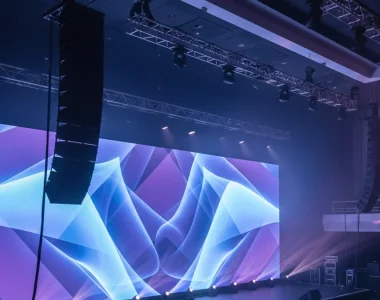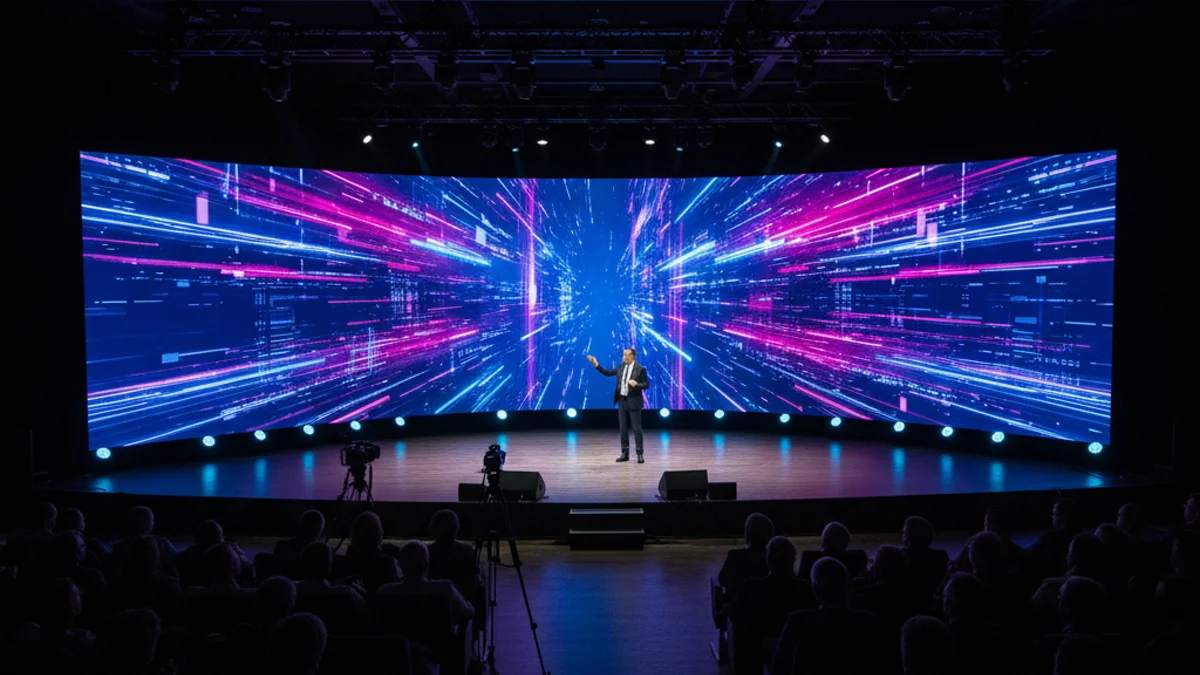
Two quotes for the same 5 m LED wall in Paris can differ by 40%, and the gap is almost never the screen. One quote bundles delivery, install crew, a processor and de-rig; the other lists hardware only and lets the venue charges land on you later. Before you compare numbers, compare scope. If you are pricing an indoor build, start from our indoor LED screen rental options; if the event is outdoors, the spec and the price move again. This guide breaks down what actually sets the number, with indicative 2026 Paris rates, two worked examples, and the line items a serious quote has to show.
Why There Is No Single Price Per Screen
An LED wall is quoted like a build, not a product. The same physical size can carry three different prices depending on the pitch inside it, the venue it lands in, and how long it stays up. That is why a rate card is a starting point and a site-specific quote is the real number. The five variables below explain the spread.
What Drives the Cost of LED Screen Rental in Paris
Five variables decide 90% of the invoice. Everything else is rounding.
- Pixel pitch. Pitch is the distance between LEDs, measured in millimetres. A tighter pitch means more LEDs per square metre, so it costs more to build and to rent. As a rule of thumb you need roughly 1 mm of pitch per metre of comfortable viewing distance: P1.9 holds up from about 2 m, P2.6 from 2.5 m, P3.9 from 4 m. Text and on-camera content want a tight pitch; a large hall or a distant audience does not.
- Wall size. Rental LED cabinets are 500 × 500 mm modules that lock together borderless, so walls build in 0.5 m increments. You cannot order 5.3 m — it is 5 m or 5.5 m. Size drives cabinet count, which drives price, truck space and crew time.
- Indoor or outdoor. An outdoor wall needs far higher brightness and a weather-rated cabinet. That is a different product, not a different setting.
- Duration. Day rates fall for multi-day hires. A three-day booking is rarely three times a one-day rate, because the build and the crew are amortised across the run.
- Venue and labour. Load-in windows, freight lifts, dock access and whether the wall is floor-stacked or flown decide crew hours. Labour hours, not the hardware, are usually what blows the budget.
One more term worth knowing: pitch is only half the story. The definition of dot pitch covers the physical spacing, but perceived sharpness also depends on viewing distance and content — which is why a P3.9 wall viewed from 10 m often looks cleaner than a P2.6 wall viewed from 2 m.
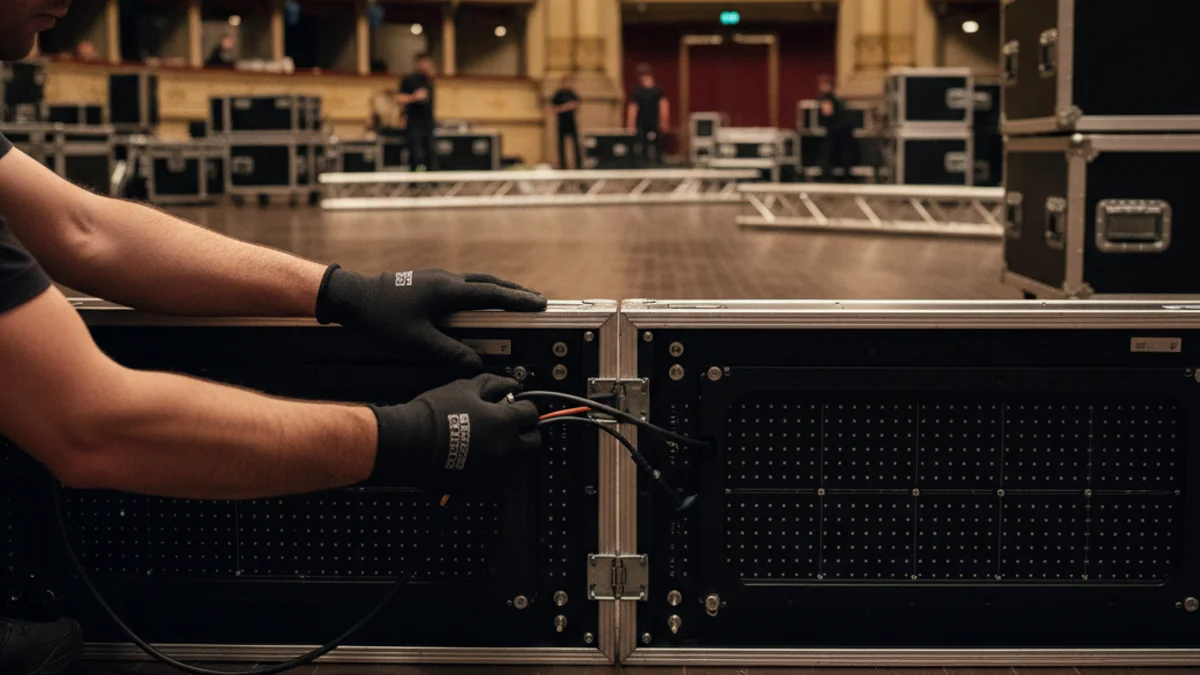
Typical LED Wall Rental Prices in Paris
The table below gives indicative 2026 day-rate bands for the Paris market, based on standard event specifications. Treat them as budgeting anchors, not quotes: final pricing depends on the venue, the dates and how the wall is rigged. All figures are before VAT.
| Wall size | Typical pitch | Best for | Indicative day rate |
|---|---|---|---|
| 3 m × 2 m | P2.6 / P3.9 | Meeting room, breakout, backdrop | €1,100 – €1,800 |
| 5 m × 2.5 m | P2.6 | Conference stage, corporate keynote | €2,000 – €3,200 |
| 6 m × 3 m | P3.9 | Concert, festival stage, large hall | €2,800 – €4,200 |
| 8 m × 4.5 m | P3.9 / P4.8 | Outdoor event, big-room coverage | €4,500 – €7,500 |
| Modular 2 m | P2.6 | Pop-up, activation, signage | €900 – €1,400 |
Two notes. First, these bands assume a controlled indoor environment; an outdoor build at 5,000+ nits with an IP-rated cabinet sits above the indoor figure for the same size. Second, a 16:9 canvas is not a given: a 5 × 2.5 m wall at P2.6 resolves to roughly 1920 × 960, so content has to be briefed to the native canvas, not to a designer’s 1920 × 1080 frame. See how tiled displays assemble on the video wall reference if that geometry is new to you.
Pixel Pitch: How Close People Will Be Looking
Pitch is the single biggest line on the quote, and it is easy to overspend on it. Buyers routinely ask for P1.9 “because it looks sharper” for an audience sitting 12 m away — where a P3.9 wall would be indistinguishable and materially cheaper. Match the pitch to the closest audience, not to the spec sheet.
| Pitch | Sharp from | Typical Paris use |
|---|---|---|
| P1.9 | ~2 m | Boardroom, product launch, on-camera background |
| P2.6 | ~2.5 m | Conference stage, keynote, mid-size gala |
| P3.9 | ~4 m | Large hall, concert stage, arena coverage |
| P4.8 | ~5 m | Outdoor festival, distant crowd, big-format signage |
The rule is not a hard limit — it is a budgeting heuristic. If the closest viewer sits 8 m back, the tighter pitch buys almost nothing visible and adds cost. If the screen sits behind a speaker on camera, the tight pitch is worth every euro, because the camera sees the pixels the room cannot.
Worked Example: A 5 m Wall for a Two-Day Conference
Here is how a realistic Paris quote for a two-day corporate conference breaks down, using our own booking structure. The wall itself is less than half the invoice.
| Line item | What it covers | Share of budget |
|---|---|---|
| Screen & cabinets | 5 m × 2.5 m P2.6 wall, spare cabinets | ~40% |
| Processor & signal | One processor driving the wall, clean signal chain, backup path | ~10% |
| Delivery & collection | Flight-cased transport to and from the venue | ~10% |
| Install & de-rig crew | Build, alignment, on-site standby, strike | ~30% |
| Power & rigging coordination | Load distribution, flying or floor-stack, venue sign-off | ~10% |
A 5 m P2.6 wall draws roughly 3–4 kW at exhibition brightness, before lighting and audio, and it is built in about half a day. Power is sized to the full technical load and ordered with the hall plan — it is not something to discover on move-in morning. For the room-level planning that sits alongside the screen, our conference LED screen rental page covers the typical stage layouts.
Worked Example: An Outdoor Festival Wall
The same physical size outdoors prices differently, because the cabinet, the brightness and the rigging all change.
| Line item | Indoor 6 m P3.9 | Outdoor 6 m P3.9 |
|---|---|---|
| Brightness | ~1,000 nits | 5,000+ nits |
| Cabinet | Standard indoor module | IP-rated, higher-output |
| Rigging | Flown or floor-stacked | Wind-load planning, heavier truss |
| Power | Sized to hall supply | Often generator-fed |
Outdoor builds also carry wind-load considerations that an indoor wall never touches, and they are frequently generator-fed, which adds a power-planning line the indoor quote does not have. If the event is outside, price it from our outdoor LED screen rental range rather than scaling an indoor figure.
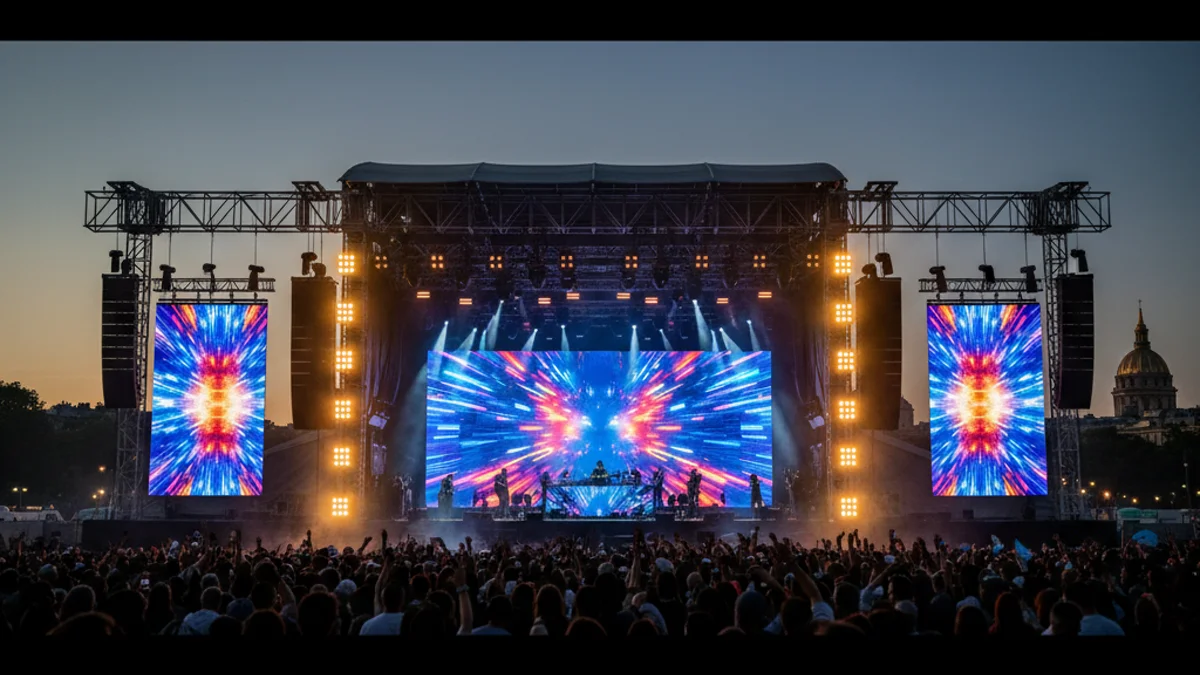
Indoors or Outdoors: How the Spec Changes the Price
Indoor screens in controlled light typically run around 800–1,200 nits. Direct-sun outdoor work needs 5,000 nits or more, plus an IP-rated cabinet and active cooling. That is why an outdoor wall of the same physical size costs more: the cabinet, the power draw and the rigging requirements all climb together. Brightness is not a preference here — it is the difference between an image you can read at midday and a grey rectangle. The illuminance reference explains the light levels a wall has to out-punch.
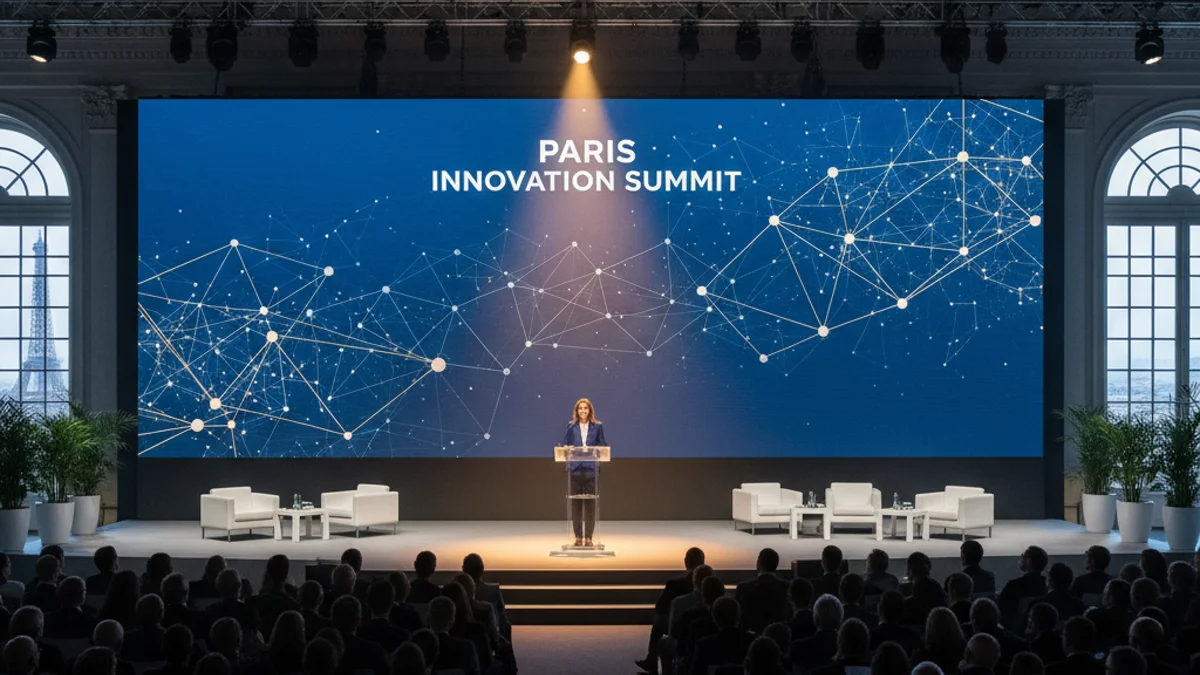
Standing on the Floor or Flown: Rigging and Cost
How the wall is supported is a line item most buyers underestimate, and it is decided by the venue, not the supplier.
- Floor-stacked needs truss bases, a level floor and checked sightlines. It is the faster build and the lower cost.
- Flown needs approved rigging points, load calculations and venue-approved riggers — a higher cost and a longer approval chain.
- Hybrid builds combine a floor base with a flown header, common on conference stages where the bottom of the wall must sit low.
- Load-in access decides which of the above is even possible: a flown wall needs the truss in the air before the wall goes up, which changes the crew sequence.
Rigging also determines who signs off. A flown build has to satisfy the venue’s structural requirements before the first cabinet is hung, so the stage rigging principles behind load paths and points are worth understanding before you commit to a flying height.
What Changes the Price in Paris Specifically
Paris is not a generic market. Three local factors move the number more than they would elsewhere.
- Venue access. Central Paris venues were rarely designed for 7.5 t trucks. Dock height, door widths and freight-lift dimensions decide how the cases get in, and a wall that has to be carried up in lifts takes longer and costs more in crew hours.
- Load-in windows. Many central venues allow load-in only in short, fixed windows, which concentrates crew time and can add an overnight or early-call premium.
- Season. May, June, September and the pre-Christmas period are dense. Booking late in those windows narrows crew and truck availability, and pricing follows scarcity.
None of this is a hidden fee — it is planning. The quotes that come in low are usually the ones that assumed a dock, a lift and a full day of access that the venue does not actually offer.
What a Proper LED Screen Rental Quote Should Include
Check each line before you sign. A quote missing any of these will cost more later.
- Cabinet quantity and pitch, stated in millimetres and square metres — not just “big screen”.
- Processor and signal chain, including a backup or spare path for live content.
- Spare cabinets and a spares kit on site for the run of the event.
- Delivery and collection, with the venue’s dock and lift constraints confirmed.
- Install and de-rig crew, with hours, not just a flat fee.
- Power requirements in kW, agreed with the venue before load-in.
- Rigging method — flown with approved points, or floor-stacked with truss bases.
- Content canvas size, so your media is authored to the wall’s native resolution.
- Standby support during the event, so a single failed cabinet is a swap, not a blackout.
Five Ways to Reduce the Cost Without Losing Quality
The cheapest wall is not always the smallest one. These moves cut real money without cutting the show.
- Match pitch to the closest viewer. If nobody sits within 4 m, a P3.9 wall usually reads as sharp as a P2.6 and costs meaningfully less.
- Hire for the full run, not per day. Multi-day and multi-show bookings amortise build and crew, so the effective day rate drops.
- Reuse the wall’s native canvas. Content authored to 1920 × 960 avoids rescaling and reprocessing, which saves post-production time and avoids a blurred result.
- Share logistics. If the same venue or the same week hosts other hires, combined delivery and crew reduce both.
- Confirm the venue spec early. The single biggest avoidable cost is discovering on load-in day that the freight lift does not fit the cases.
Booking Timeline for a Paris Event
Paris venues book out, and freight-lift slots are finite. Work backwards from the show date.
- 6–8 weeks out: confirm wall size, pitch and rigging method; request the venue’s technical specification (dock height, door widths, lift dimensions, available power).
- 4 weeks out: lock content to the native canvas; confirm the signal plan and any camera or streaming feeds.
- 2 weeks out: finalise crew call times and the load-in window; confirm power is ordered.
- Load-in day: build, align, and run a content test before doors — not after the audience arrives.
Indoor Wall, Projector or LED Trailer: Which Fits the Budget
An LED wall is not the only way to put a large image in a Paris room, and it is not always the cheapest. The right choice depends on ambient light, the size of the image and whether the content moves.
| Option | Indicative day rate | Best for | Where it fails |
|---|---|---|---|
| Projector + screen | €400 – €1,200 | Dark rooms, static or simple content | Washed out in ambient light; long throw distances |
| Modular LED 2 m | €900 – €1,400 | Pop-ups, activations, signage | Small canvas for a large room |
| Indoor LED wall 5 m | €2,000 – €3,200 | Conferences, keynotes, galas | Overkill for a small breakout |
| LED trailer / billboard truck | €1,800 – €4,000 | Outdoor activation, mobile coverage | Permits and siting in central Paris |
The crossover point is ambient light. A projector needs a dark room to look its best; an LED wall emits its own light and holds contrast under stage lighting, which is why conference stages moved to LED even though the projector is cheaper. If the room is dim and the content is a slide deck, a projector is the rational hire. If the room is lit, the content moves, or the screen appears on camera, the LED wall earns its cost. The LED display reference covers why emissive screens behave differently under ambient light if you want the underlying reason. For a live music context, see our concert LED screen rental page, and for recent builds in the region, the portfolio.
What the Wall Needs From You
Four inputs from the client decide how smoothly the build goes — and how much of the quote is contingency rather than cost.
- The content canvas. Give the supplier the wall’s native resolution, not your designer’s 16:9 frame. A 5 m P2.6 wall is about 1920 × 960; content authored to 1920 × 1080 will be rescaled and lose sharpness.
- The power load. Tell the supplier what else is on the same supply — lighting, audio, catering. A 5 m wall draws 3–4 kW before any of that, and the venue needs the total, not the screen alone.
- The access route. Dock height, door widths and freight-lift dimensions. This is the detail that turns a two-hour build into a five-hour one.
- The signal plan. What feeds the wall — a laptop, a switcher, a camera, a streaming encoder — and who owns each link in the chain.
Redundancy and Signal: The Line Cheap Quotes Skip
The most common way a low quote saves money is by removing the safety net. It looks identical on paper and only shows up when something fails.
A serious live-event build carries a spare processor path or a backup input, and enough spare cabinets to swap a failed module mid-show. LEDs fail at the module level, not the wall level: one dead cabinet is a visible black rectangle, and with no spare on site the only fix is to re-map the wall around it — if there is time. The spares kit and the standby support are the difference between a swap measured in seconds and a blackout measured in minutes.
Signal is the other quiet line. A single processor driving a single wall is fine until the source drops. A clean chain — source, switcher, processor, wall — with a tested backup path costs a small fraction of the wall and removes the most common single point of failure. When a quote is 20% below the others, this is usually where it came from.
Days, Schedules and Travel: How Cost Scales Over a Longer Run
Build and de-rig are fixed work, so they spread across the run. That is why the effective day rate falls sharply from a one-day hire to a week.
| Hire length | Build + de-rig | Effective day rate |
|---|---|---|
| 1 day | Full build, full strike | Highest |
| 3 days | One build, one strike | ~70–80% of the one-day rate |
| 1 week | One build, one strike, standby only | ~50–60% of the one-day rate |
The percentages are indicative and depend on the wall size and the venue, but the direction is reliable: the longer the run, the more the fixed work is amortised. If you have two events in the same week, hiring for the full window usually beats two separate hires — provided the wall can stay in place or the transport can be shared.
Common Pricing Misconceptions
Four assumptions that reliably push a Paris LED budget in the wrong direction.
- “The screen is the whole cost.” Hardware is typically around 40% of a conference build. Delivery, crew and rigging are the rest, and they do not shrink when you negotiate on the screen.
- “A tighter pitch is always better.” Pitch buys sharpness at a viewing distance. If the nearest guest sits 8 m back, the extra pitch is invisible and the money is better spent on content.
- “One day should be a third of three days.” Build and de-rig are fixed. A one-day hire carries the full cost of both, which is why the single-day rate is the highest.
- “The lowest quote is the cheapest.” The cheapest quote is usually the one that dropped spare cabinets, the backup signal path or the venue survey — costs that reappear as change orders or as a blackout.
Two technical details decide whether content looks right on camera, and both are cheap to get right: refresh rate, which governs how an LED wall behaves when filmed, and the ambient illuminance of the room, which sets the brightness the wall has to out-punch. The refresh rate and illuminance references cover the underlying principles if you are briefing a camera team.
What to Send Us for an Accurate Quote
Five details turn an indicative band into a fixed, itemised price.
- The venue name and address, so we can check the access route.
- The wall size you want, or the image size the room needs.
- The dates, including any load-in and load-out windows.
- What feeds the screen — laptop, switcher, camera, streaming.
- Whether the content is static, video, or live camera.
Frequently Asked Questions
How much does it cost to rent a big screen in Paris?
A 3 m × 2 m indoor wall typically runs €1,100–€1,800 per day, a 5 m × 2.5 m conference wall €2,000–€3,200 per day, before VAT and venue charges. Multi-day hires reduce the effective day rate.
What is a rental LED screen?
A rental LED screen is a modular wall of 500 × 500 mm cabinets hired for a fixed period, delivered, installed and de-rigged by the supplier, then returned — rather than a screen you own and store.
How much is an LED wall in Paris, all in?
All-in cost is hardware plus processor, delivery, crew and rigging. For a two-day conference with a 5 m wall, hardware is around 40% of the invoice; crew and logistics make up the rest.
Where can I rent an outdoor LED screen in Paris?
Outdoor rentals are specified separately: 5,000+ nits, an IP-rated cabinet and wind-load planning. They are priced above the equivalent indoor size because the cabinet and rigging requirements are heavier.
How much does it cost to rent event equipment in Paris?
Equipment hire is priced per item and per day, then combined with delivery and crew. For an LED wall the screen is one line; lighting, audio and staging are separate hires with their own logistics.
How far in advance should I book an LED screen in Paris?
Six to eight weeks gives room for venue spec checks and content revisions. Peak season dates and large walls benefit from earlier booking, because freight-lift and crew slots fill first.
Can I rent an LED screen for a single day?
Yes. Single-day hires carry the same build and de-rig work as longer runs, so the day rate is highest on a one-day booking and falls as the run lengthens.
What resolution should my content be?
Match it to the wall’s native canvas, not to 16:9 by default. A 5 m P2.6 wall resolves to about 1920 × 960, so content authored to 1920 × 1080 will be rescaled.
If your question is not here, the FAQ page covers the rest of the technical detail.
Get a Fixed, Itemised Quote
The number that matters is the one that already includes delivery, crew and rigging — not the headline screen rate. Send us the venue, the dates and the wall size you have in mind, and we will come back with an itemised Paris quote you can compare like for like.
Request a quote or browse the full indoor and outdoor ranges.
By the Paris Video Wall technical team. Our engineers build and de-rig LED walls across the Paris region every week, from boardroom-sized backdrops to flown concert screens, and quote from the venue plan rather than a rate card.