French exhibition halls are among the hardest rooms in Europe to make a screen look good. High ambient light, twelve-metre ceilings, shared rigging grids and a build-up window measured in hours, not days. An LED wall specified properly punches through that. An LED wall specified on price alone turns into a dull grey rectangle by mid-morning, and the only person who notices is the visitor who walks past it.
This guide is for the marketing lead, event manager or agency producer who has to turn an “immersive experience” brief into something that actually builds and actually runs. It covers how to match display hardware to the venue, the build-up sequence that keeps you out of trouble, and the logistics that quietly kill activations on French show floors. If you would rather skip to the numbers, start with a rental quote and we will size the screen to your stand footprint, as we do for LED screens for video conferencing.
What “immersive” actually means on a trade show floor
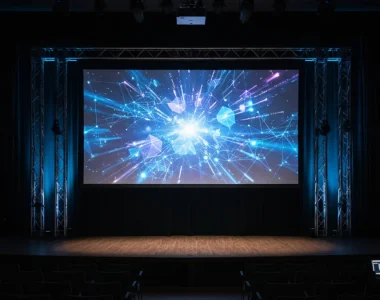
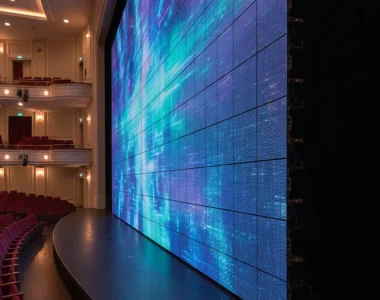
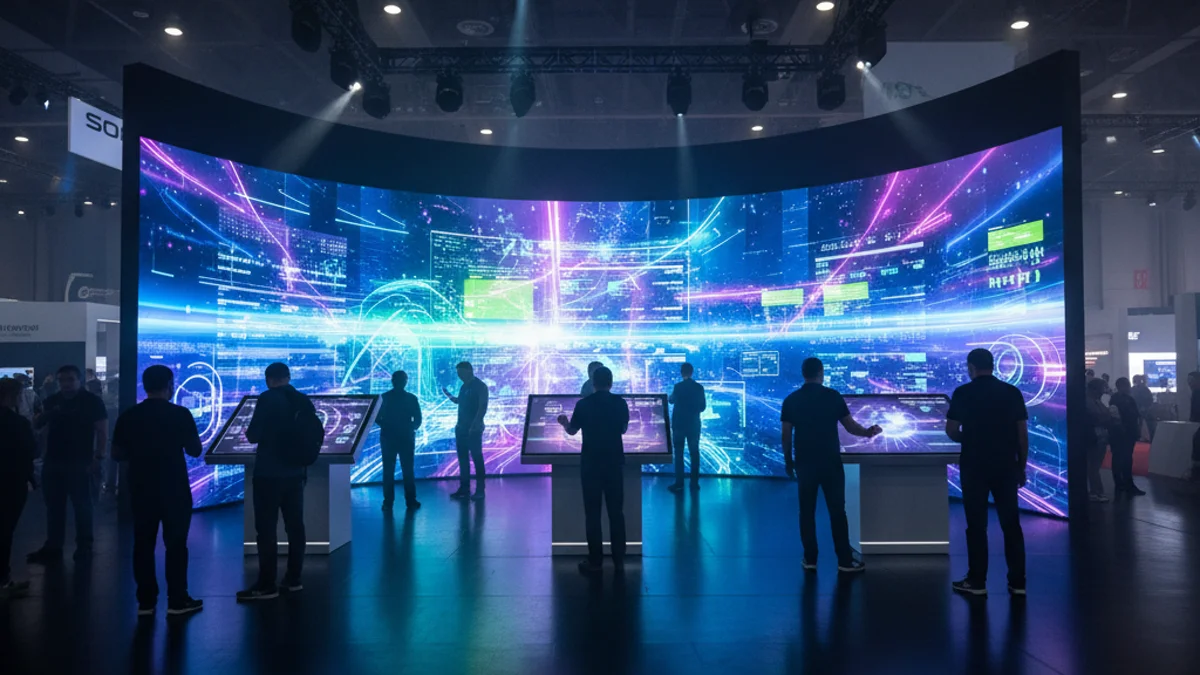
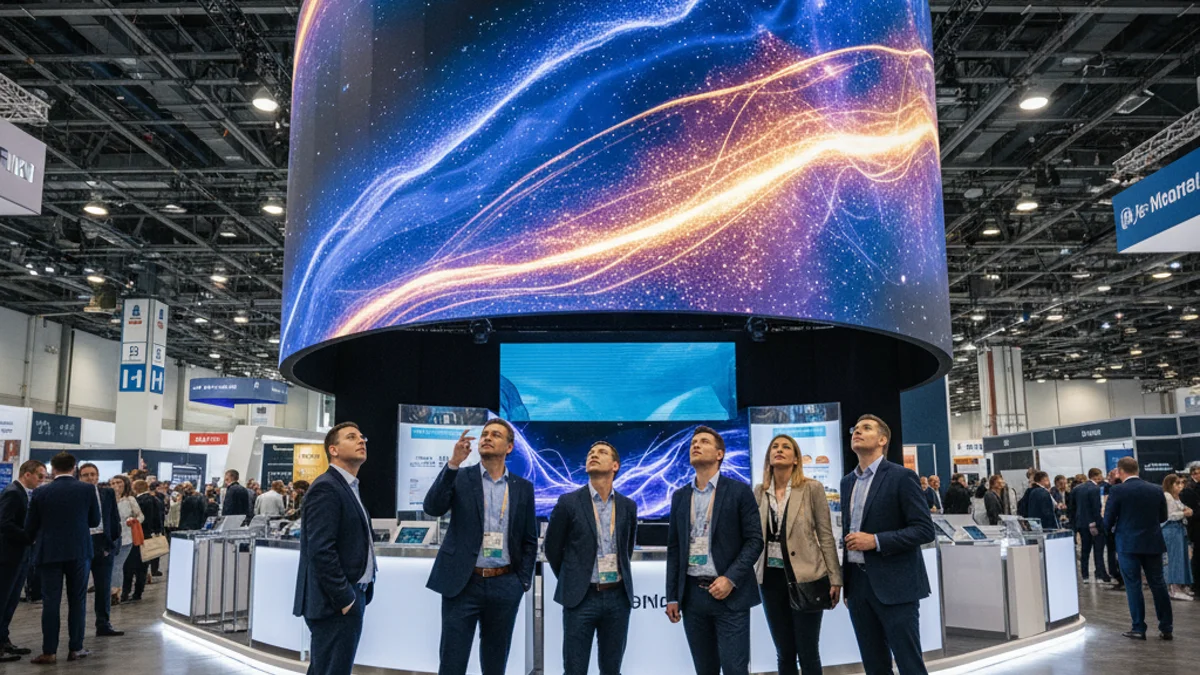
Immersive is not a 60-inch monitor playing a looping video. It is a space where the display, the sound and the movement of the crowd work together so the visitor stops being a spectator and starts being part of the scene. In practice that means a large-format rented LED wall, often curved, matched to directional audio and a content loop built for the sightlines of that specific hall. The same principle drives brand activations, as we cover in our guide to brand activation LED video walls.
The technology is only half of it. The other half is physics. Bright screens lose contrast under venue floodlighting. Curved screens need pixel pitch fine enough that visitors standing two metres away cannot see the seams. Interactive screens need a wired data line, not the hall’s shared Wi-Fi. Get those three right and the experience holds. Get them wrong and you have paid for a very large lamp.
Match the display to the space
There is no single best technology. There is only the technology that survives your venue, your stand geometry and your content. The table below is how we talk through the decision with exhibitors before anything is booked.
| Option | Behaviour under hall light | Space / sightline need | Works best for |
|---|---|---|---|
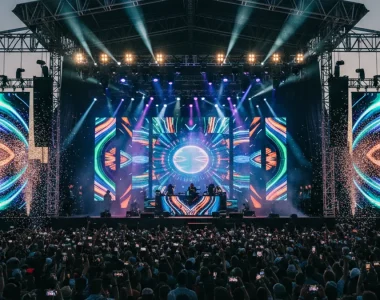
| Rented indoor LED wall (flat or curved) | High output; holds contrast even in a bright hall | Needs structural support or a rigging point; 2–3 m viewing distance | Feature walls, tunnel walk-throughs, stage backdrops |
| Projection mapping | Sensitive to ambient light; best in dimmed or enclosed zones | Throw distance behind or above the surface; careful shadow management | Storytelling on walls, floors and objects in darker zones |
| LED posters and kiosks | High output; free-standing, no rigging | Minimal footprint; plug-and-play positions | Wayfinding, product loops, lead capture at the stand edge |
| Interactive touch screens | Dependent on a wired data line and stable software | Reach height and elbow room for two users at once | Product configurators, polls, self-guided demonstrations |
| VR headsets | Independent of hall light but isolates the user | Dedicated space plus a staffed marshalling point; hygiene protocol | Virtual facility tours, simulations, training content |
Most strong activations combine two or three of these. A curved LED wall carries the visual story, an LED poster or two pulls people in from the aisle, and a kiosk captures the lead at the end. Layering works because each element does a different job — one attracts, one immerses, one converts. For more layout ideas, see our trade show booth ideas using LED walls.
The build-up sequence that keeps you out of trouble
French venues enforce their own build-up windows, rigging permits and power allocations, and none of them bend for a late exhibitor. Work backwards from move-in day and hold these milestones.
- 120 days out: Confirm stand footprint, orientation and ceiling height. Decide which walls carry screens and which are handled by print or structure.
- 90 days out: Lock the technology mix and screen size. Confirm pixel pitch against the closest realistic viewing distance.
- 75 days out: Submit the venue’s rigging and power forms. Flag any suspended load, because a hanging LED wall needs approved rigging points and the paperwork has its own lead time.
- 60 days out: Freeze the content brief. Native resolution, aspect ratio and loop length should be signed off before any editing starts.
- 30 days out: Confirm power drop location and amperage, order a dedicated wired data line for anything interactive, and arrange equipment transport and on-site handling.
- Build-up day one: Fly or stand the screen frame, hang the panels, and power the wall before any decorative finishing goes up around it.
- Build-up day two: Run content, calibrate colour across every cabinet, test the data line under load, and rehearse the opening sequence with the stand team.
- Show days: Keep a technician on call. Compression, dead pixels and dropped network connections are the three faults that surface under real traffic.
If an LED wall is the centrepiece of your stand, it is worth pairing it with a stand build that knows how to conceal cabling and support a suspended screen. Our LED screen rental for trade show booth building page sets out how the screen and the structure are planned together.
Power, rigging and data: where activations fall apart
Three logistics failures account for most on-show problems.
Power. A high-brightness LED wall draws considerably more than people expect, and the venue’s basic booth allocation rarely covers it. Confirm the amperage available at your stand position and order extra capacity early. A screen that flickers because it is sharing a circuit with a coffee machine is a screen nobody trusts.
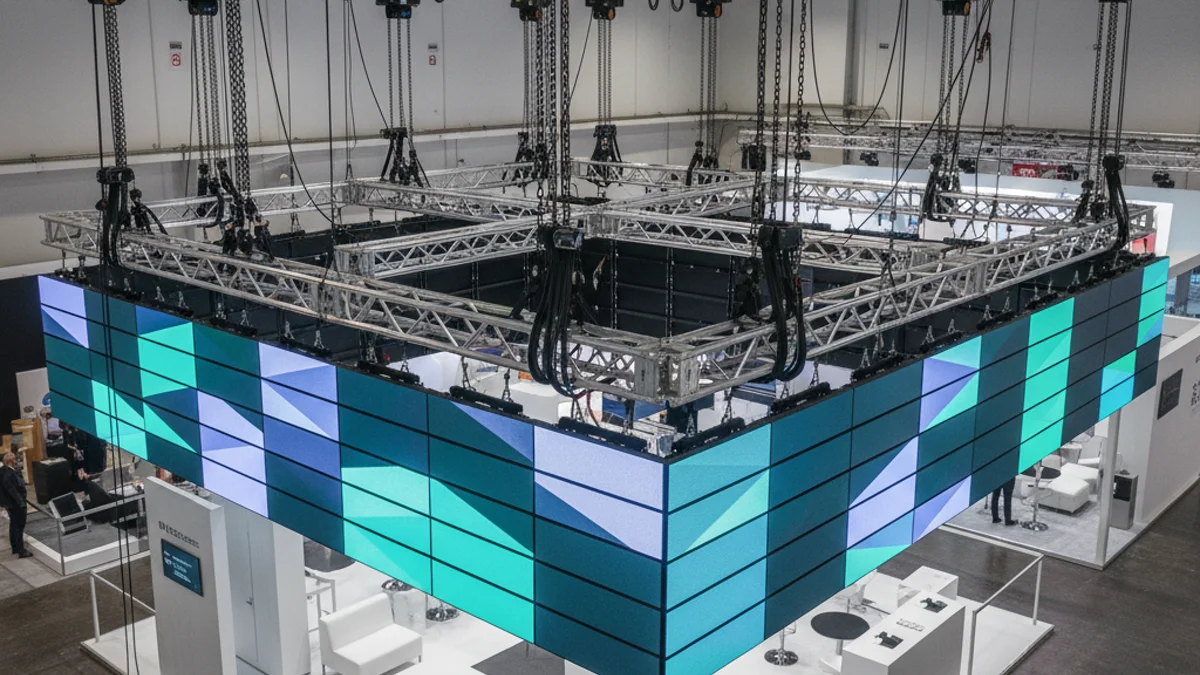
Rigging. Anything suspended above the stand is a structural question, not an AV question. Venues require approved riggers and documented load calculations, and the approval window is measured in weeks. Plan suspension into the design from the start rather than discovering it during build-up.
Data. Interactive content that depends on the hall’s shared Wi-Fi will fail under load, every time. If badges, configurators or live dashboards matter to your objectives, order a dedicated wired connection and test it with real traffic before the doors open.
Content rules that protect the investment
The best screen in the hall is worthless with generic footage on it. Three rules we repeat to every producer:
- Build content at the native resolution and aspect ratio of the screen, not a 16:9 file stretched to fit a curved wall.
- Front-load the message. Visitors give you a few seconds from the aisle before they decide to stop, so the first frame has to do the work.
- Design the interactive layer for two users at once and for a touch target that works with a badge in one hand. Fiddly interfaces lose the crowd.
Curved and multi-screen builds are where this pays off most — a visual that wraps around the visitor reads as an environment rather than a display. That is the difference our experiential marketing work is built around.
Measuring whether it worked
Define success before build-up, because collecting evidence after the show is guesswork. The practical metrics are lead contacts captured inside the activation, dwell time observed by the stand team, interaction counts from touch screens and configurators, and how often the activation shows up in visitor posts and conversation. None of these require invented benchmarks — they require you to agree the numbers you will chase in the brief and capture them on the day.
Frequently asked questions
How far in advance should I book an LED wall for a trade show?
Six months is comfortable. Complex curved builds, suspended screens and custom content can justify starting earlier, because the venue’s rigging and power approvals have their own lead time. Short-notice projects are possible when the equipment and crew are free, but you lose flexibility on size and pixel pitch.
Will an LED wall work in a bright exhibition hall?
Yes, which is exactly why rented LED is often preferred over projection in France. A high-output LED wall keeps its contrast under venue floodlighting, while projection needs a dimmed or enclosed zone to look its best. If your stand faces a glass wall or heavy daylight, specify LED and confirm the brightness of the panels against the hall conditions.
Do I need to handle power and rigging myself?
You need to plan them, and the venue needs to approve them. A rental provider coordinates the screen, its support and its power requirements, and works with the approved riggers on site. What you cannot do is leave these to build-up week — the approvals take longer than the install.
Can you deliver outside Paris?
Yes. We supply and install LED screens and video walls for events across France, including Lyon, Marseille, Nice and Cannes, as well as Paris. Delivery, installation and on-site support are quoted together so there are no surprises on the invoice.
Planning an immersive activation for your next show? Tell us the venue, the stand size and what you want visitors to feel, and we will come back with a screen specification and a build-up plan. Request a quote and we will size it from there. For practical advice on making your exhibit stand out, our trade show exhibit LED walls tips cover the details.