Why a video wall decides whether your activation gets walked past
An activation has roughly three seconds to explain itself. A guest crosses the venue floor, glances sideways, and either steps in or keeps moving. The structure you built, the staff you briefed, the concept you signed off — none of that registers until something bright and legible catches the eye first.
That first catch is almost always a screen. In France, brand activations live in tight venues: a pop-up on a Rue de Rivoli shop floor, a sponsor zone at a festival in Marseille, a press reveal in a Cannes beach club, a B2B stand at a Paris expo hall. Floor space is expensive, ceiling height is capped, and load-in windows run overnight. A modular LED video wall gives an organiser maximum visual real estate from a footprint measured in millimetres of panel depth — it sits flat against a wall, builds around a corner, or runs as a freestanding backdrop without a truss city behind it.
This guide is for event producers, agency planners, and venue teams in Paris, Lyon, Marseille, Nice, and Cannes who need the display layer to carry the concept. It covers what a video wall does that projection and printed backdrops cannot, how to size and specify one, and how to plan the technical build without blowing the load-in schedule.
What an LED wall actually delivers at an activation
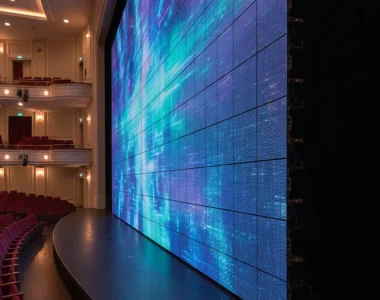
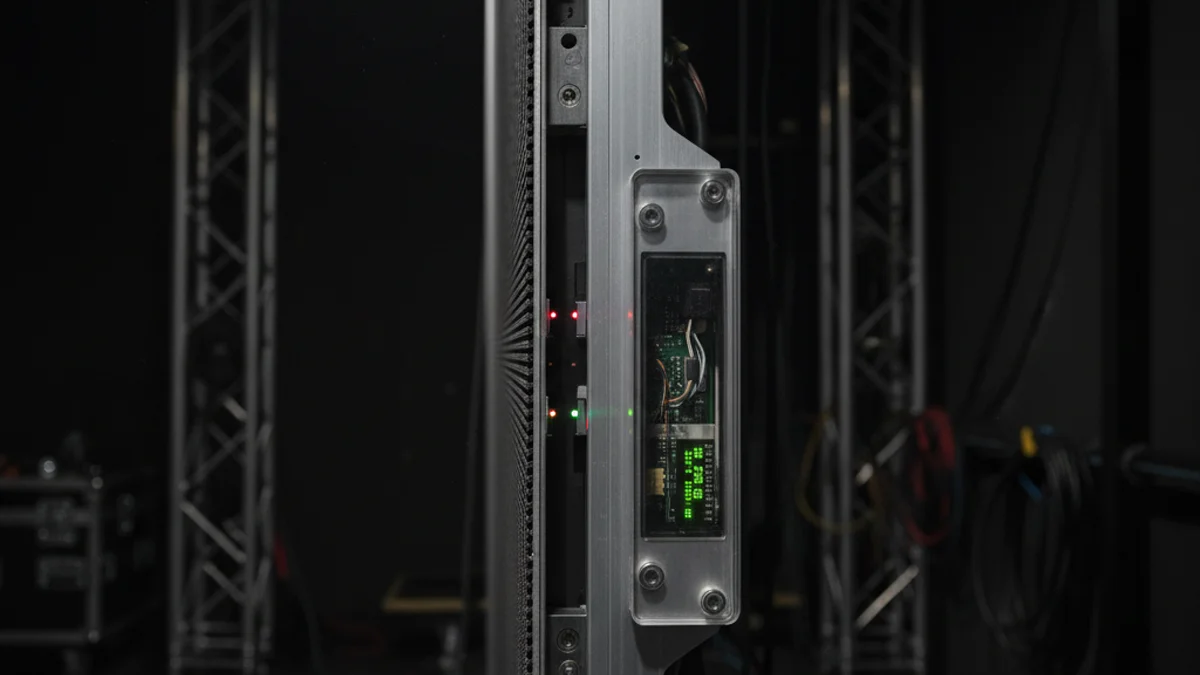
A rental LED wall is a matrix of panel cabinets — commonly 500 × 500 mm or 500 × 1000 mm — that tile together to any width and height on a 0.5 m grid. Each cabinet holds LED modules, a power supply, and a receiving card. Because there is no glass and no bezel, the image is edge-to-edge and stays readable under full house lighting or direct daylight. That last point separates it from almost every other display choice.
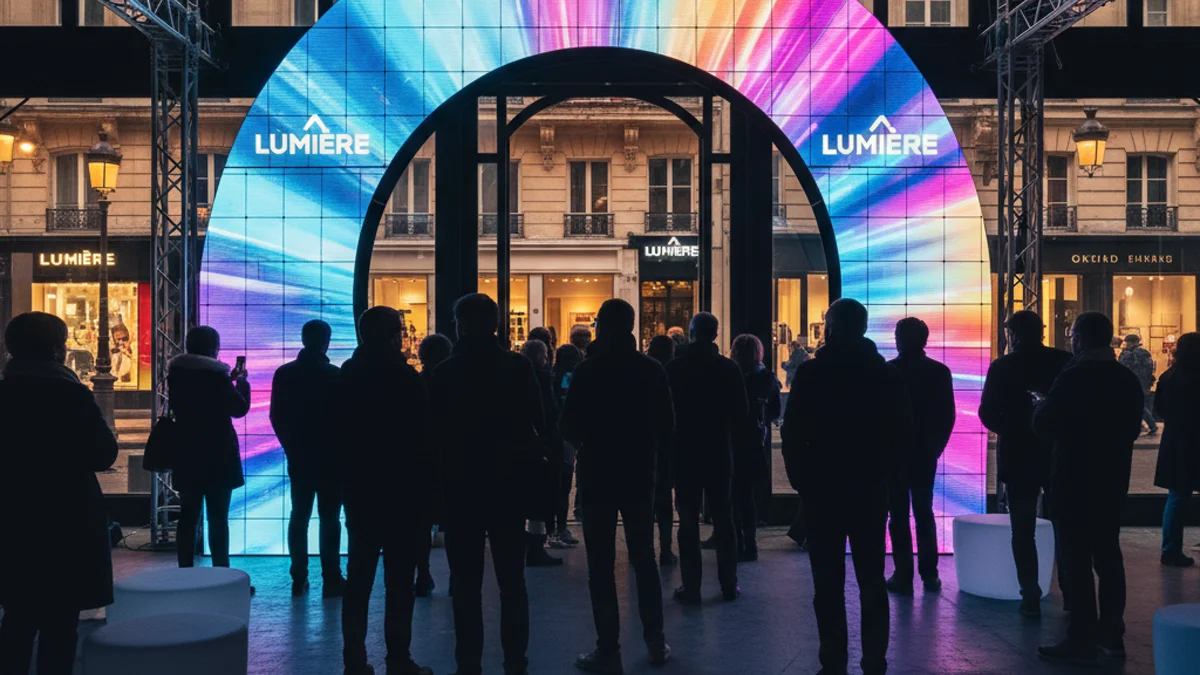
Three practical consequences matter on-site:
- Pixel pitch governs viewing distance, not room size. A P2.6 wall reads cleanly from three metres; a P3.9 wall is built for audiences standing six metres and further back. Choose pitch by how close the nearest guest gets, then size the wall to fill the intended sightline.
- Brightness wins against venue light. Rental panels run in the 4,500–5,500 nits range, so content survives extra ambient light instead of washing out — useful in glass-walled Paris venues and daylit festival tents.
- Content is live, not printed. You can sequence a countdown to a product reveal, swap brand films between demo sessions, or run social feeds, all from the same wall during the same day.
LED video wall vs projection vs printed backdrop vs TV screens
Planners usually shortlist four display routes for an activation. Each has a job it does well and a limit it cannot escape.
| Option | Best for | Reads in ambient light? | Footprint / setup | Main limitation |
|---|---|---|---|---|
| LED video wall | Hero backdrops, reveal moments, high-traffic zones | Yes — high brightness | Flat panels, on a 0.5 m grid, rigged or ground-stacked | Highest equipment cost per m²; needs power and signal planning |
| Projection mapping | Shaped surfaces, scenic props, low-ambient rooms | Poorly — washes out in light | Needs throw distance and a dark room | Blocked by guests walking through the beam; hard in daylit spaces |
| Printed backdrop / SEG fabric | Fixed graphics, step-and-repeat, photobooth walls | Yes (it is reflective) | Lightweight, quick to hang | Static — no motion, no content change mid-event |
| Large-format TV / video wall of screens | Small retail corners, digital signage, wayfinding | Moderately | Simple, plug-and-play | Visible bezels break the image; limited size per unit |
For a hero moment — the wall the brand reveal happens against — an LED wall usually wins once the audience stands within eight metres and the room is not dark. Projection earns its place on weird shapes. Printed fabric still beats everything on a fixed, cheap, permanent graphic. TVs suit wayfinding and small retail displays rather than a main activation face.
Matching the wall to the activation format
Different activations put different demands on the display. Three recurring formats in the French market:
Experiential and immersive activations
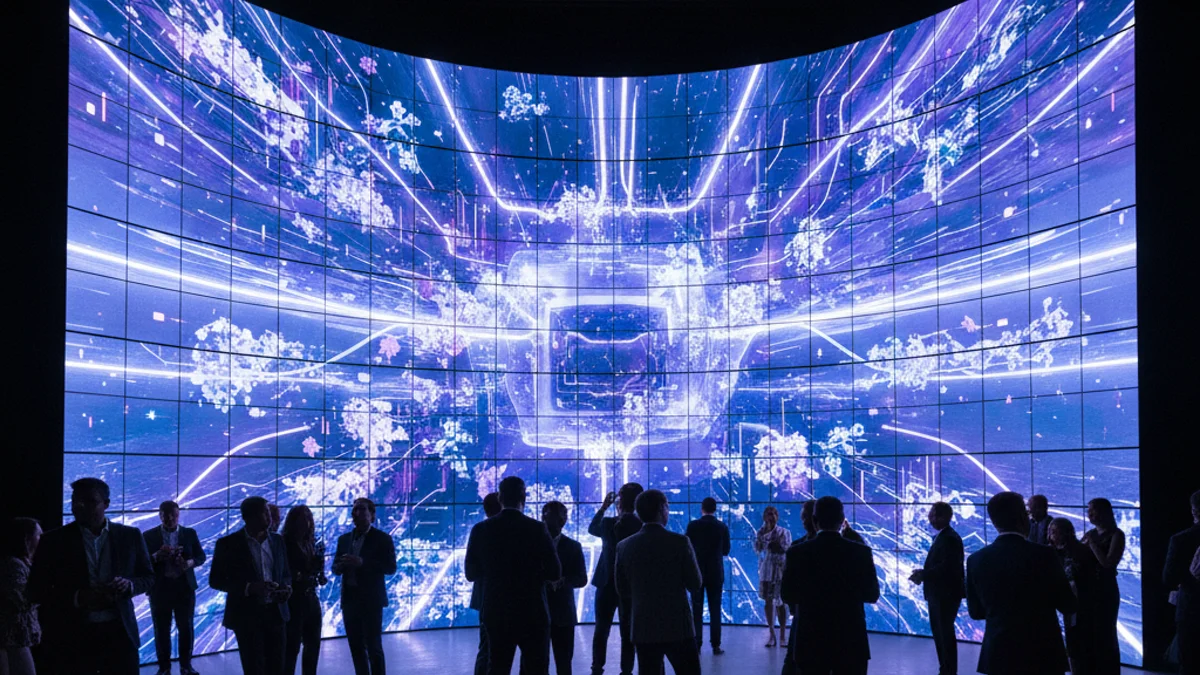
These run long dwell times — guests wander, interact, and film. A wall here is often a wraparound or a corner build so the content surrounds people. An immersive LED environment does the work that scenic fabrication would otherwise do, which keeps the build lighter and the load-in shorter — a principle we explore in our guide to immersive AV experiences for trade shows.
Event and conference activations
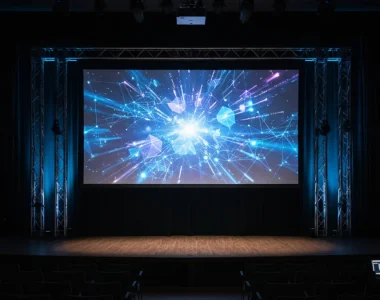
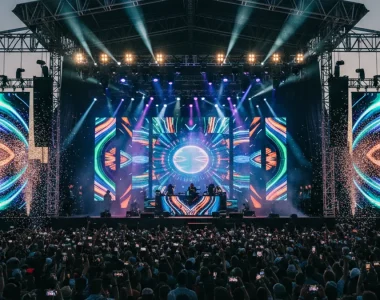
Launches, press days, and B2B programmes at expo venues need a legible stage backdrop that carries slidedeck content, live camera feeds, and brand films. A large-format wall behind the stage doubles as the presenter backdrop and the room’s focal point. The same panel stock is often reused next day in the foyer as a wayfinding or sponsorship display.
Retail and in-store activations
Shop floor space is the scarcest resource in Paris. A slim LED poster or a stack of rented screens delivers motion and content change in a footprint smaller than a shelving unit, without a venue build.
Planning checklist: how to spec and produce the display
Work these steps in order. Each one feeds the next, and skipping the early stages is what forces expensive changes later.
- Lock the sightline and the closest guest. Decide where the audience stands, how close they get, and the intended wall width. This sets pixel pitch and panel count before you talk budget.
- Set the content resolution to the panel grid. A 6 m × 3 m wall on 500 mm cabinets is 12 × 6 cabinets — build content to that native ratio, not to a random 16:9 canvas that will crop.
- Confirm power and signal on site. Ask the venue for available amperage, drop points, and whether the wall is rigged or ground-stacked. Ground-stacking needs a level floor and safe ballast or base plates.
- Book the load-in window. Paris and Lyon venue dock access is tight; a multi-day rigging slot may be required where ceilings are high. Confirm rigging points and any union or venue crew rules up front.
- Brief content and playback in one pass. Agree which team controls the media server — organiser, agency, or AV supplier — so nobody fights over the signal mid-event.
- Run a full technical rehearsal. Test the wall in the actual room light, not in the warehouse. Brightness, colour temperature, and camera exposure all change on site.
- Plan the strike. Agree load-out timing, panel packing, and venue restoration before the event opens, not after the last guest leaves.
Frequently asked questions
How far back can guests stand from a P3.9 wall?
As a working rule, keep the closest viewer at roughly ten times the pixel pitch in metres — so a P3.9 wall reads cleanly from about four metres and up. For audiences standing closer, move to a finer pitch such as P2.6 or P1.9.
Can an LED wall replace a stage backdrop?
Yes, and it usually outperforms both printed backdrops and projection. It carries motion, changes content during the programme, and stays legible under stage wash lighting that would flatten a projected image.
Do I need to rig the wall from the ceiling?
Not always. Ground-stacked walls on base plates are common in low-ceiling or listed venues where rigging is not permitted. Rigged walls allow more height and a cleaner floor but depend on venue rigging points and load limits.
How early should I book the display?
For a mid-size activation, allow four to six weeks so the panel configuration, content resolution, and load-in window can be agreed. Peak seasons around major Paris trade shows and the Cannes calendar fill earlier — book further ahead if your dates sit in those windows.
Is one supplier for the whole technical build better?
For multi-city activations, yes. Using a single AV supplier for the walls, audio, and lighting keeps content resolution, signal standards, and crew briefings consistent from Paris to Marseille, which removes a whole class of integration problems at load-in.
Bring the display layer in early
The brands that pull off a clean activation decide their display before the creative is locked, not after. Pixel pitch, wall size, and power planning shape what content is even possible — and getting them wrong is what forces rushed, compromised builds on move-in day.
Paris Video Wall supplies and installs rental LED walls, video walls, and digital signage displays for activations, experiential campaigns, and conferences across Paris, Lyon, Marseille, Nice, and Cannes. If your activation needs a hero screen, we can size it from your sightline and venue constraints and handle the technical build end to end. See how we support experiential marketing and event activation programmes, or explore digital signage display rental for retail and foyer work. If you’re designing a booth, our trade show booth ideas using LED walls are a useful starting point.
Request a quote with your venue, date, and wall size — we will come back with a panel configuration and a technical plan.