The flat backwall is the default — and often the wrong one
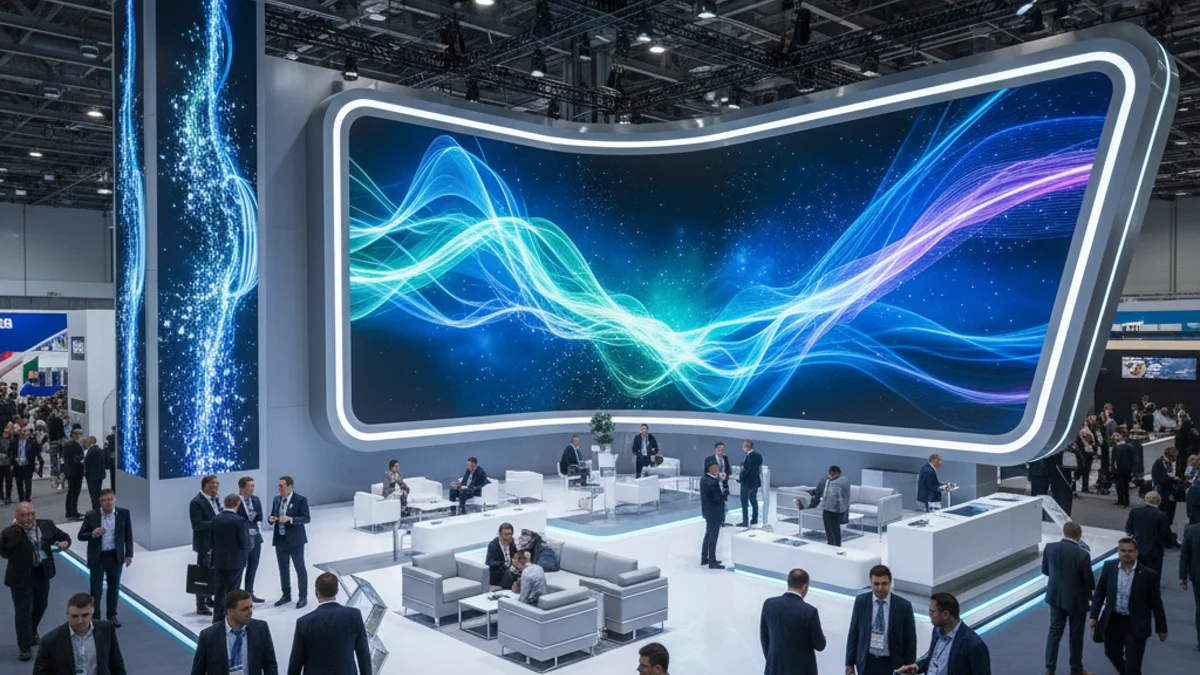
Walk any aisle at Paris Nord Villepinte and you will see the same stand repeated: an island with one flat LED backwall, a logo, a counter. It reads fine, and it wastes the format. An LED wall on a trade show stand is not a billboard you mount and forget — it is a piece of architecture that decides where visitors walk, where they stop and what they photograph.
Most exhibitors specify the screen last, after the stand design is signed off, and inherit whatever rectangle fits the shell. The right sequence is the opposite: pick the format that shapes footfall, then size the wall to it. That decision starts with rental LED screens built for trade show booths, matched to the stand’s geometry rather than dropped into a leftover space.
This is a working guide to the formats worth considering, what each one costs you in floor space, and the French venue constraints that decide whether a format is buildable at all.
The formats, and what each costs you in floor space
Every format below is available as a rental cabinet build in 0.5 m increments. The trade-off is always the same: presence against usable square metres.
| Format | What it does | Floor-space cost |
|---|---|---|
| Flat backwall | Reliable backdrop for messaging and product loops | None beyond the wall itself; lowest impact |
| L-shaped / corner wrap | Catches two aisle sightlines at once; reads as depth | Low; uses the corner already paid for |
| Column wrap or tower | A vertical beacon visible over neighbouring stands | Very low footprint, high visibility |
| Hanging banner / suspended wall | Above-headline messaging in a crowded hall | None on the floor; needs rigging and approval |
| Curved / ribbon wall | Encloses a demo zone; draws visitors inward | Moderate; cabinets curve in fixed radii |
| LED poster / totem | Free-standing side messaging, wayfinding, menu boards | Minimal; movable during the show |
| Floor / ceiling tile | Immersive walk-over or overhead effects | High; walk-over panels need reinforced structure |
Most stands do not need the highest-impact format. They need two formats working together: one that stops the aisle (a tower or corner wrap) and one that holds the visitor once they enter (a backwall or curved demo wall). If you want the thematic starting points first, the idea bank for trade show booth layouts using LED walls is the right place to sketch before you commit to a build.
Spec the format against the room, not the render
A format that looks right in a 3D render can be unbuildable in the hall. French venues route stand plans, electrical load and rigging details through the régie technique weeks before build. Submit late and your build slot is assigned by the venue rather than chosen by you — which usually forces a simpler format than the one you designed.
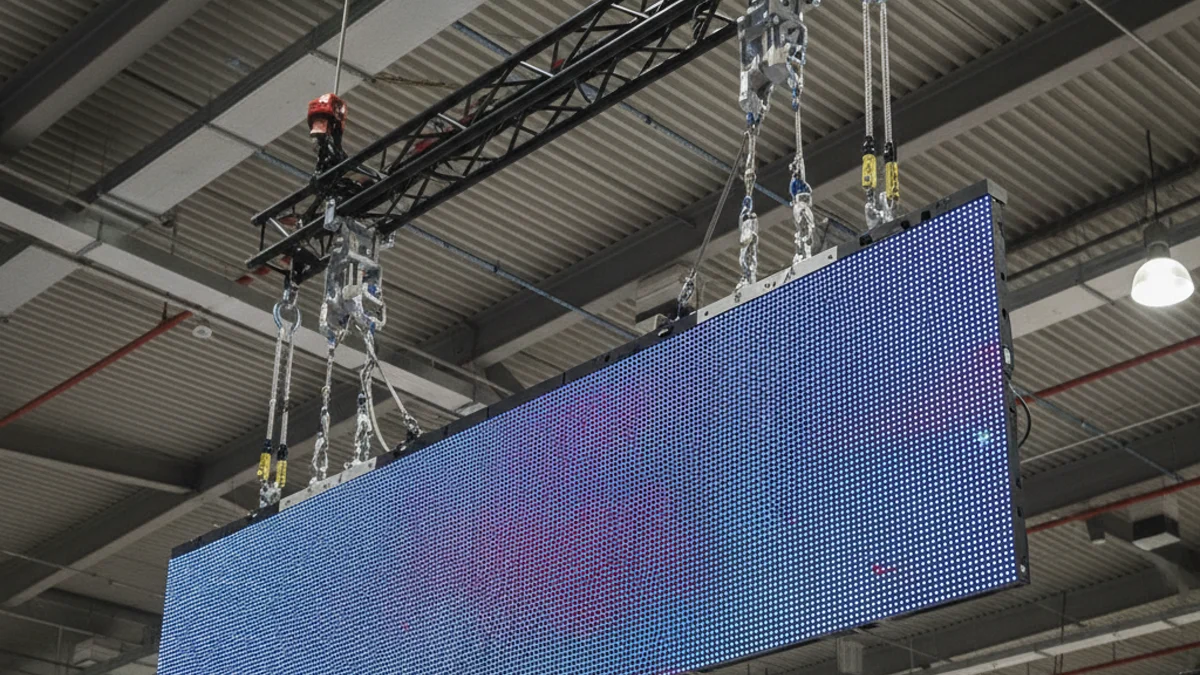
Suspended and hanging formats carry the tightest constraints. No self-clipping to hall trusses, and no assuming existing points will take your load: a suspended wall needs a structural note and venue approval, with the weight inside the truss capacity at that specific point. Ceiling and truss heights vary enormously between halls at the same venue, so get the hall plan with truss heights before you sign off a hanging design — a format tuned for a 4 m ceiling disappears under an 11 m ridge.
Materials face a documented fire class too. Rental LED cabinets, rigging hardware and any fabric elements should arrive with certificates showing M1 or the Euroclass equivalent B-s1,d0. Ask in writing before the build; a missing certificate on move-in day is a stall, not a delay.
Finally, power is metered and ordered, never included. A curved demo wall in the 5 m class draws in the region of 3–4 kW at exhibition brightness. Put that figure on the stand’s power application rather than hoping for a spare drop — upgrading a supply during build is expensive and sometimes impossible.
Content has to match the format, not the other way round
The most common miss is a strong format running weak content. On an aisle-facing wall, a passer-by gives you about four seconds of walk-past attention, so the visual loop has to be built for that: segments of 6–10 s, one idea each, no audio dependency, and a loop length of 45–90 s so returning visitors see something new.
Two content types earn a trade show wall. The first is product in motion — a 3D rotate, an exploded view, a silent process demo that explains the product without narration. The second is live or interactive data — a configurator, a live feed, a running metric. Static hero images burn visitor attention fast.
Watch legibility at the real distance. Burned-in subtitles sized for a seated conference audience are unreadable from an aisle, and text scaled to a laptop screen vanishes at the pitch-and-distance line. Size text to the nearest walk-by point, not to your editing monitor.
Interactive and hybrid formats: where they actually earn their keep
Interactive surfaces — touch walls, motion-triggered panels, configurators — pull visitors from a passive walk-by into a two-minute stop. That is real value, but it costs an operator and a content owner during the show. An interactive wall with no staff member driving it becomes a screensaver by day two.
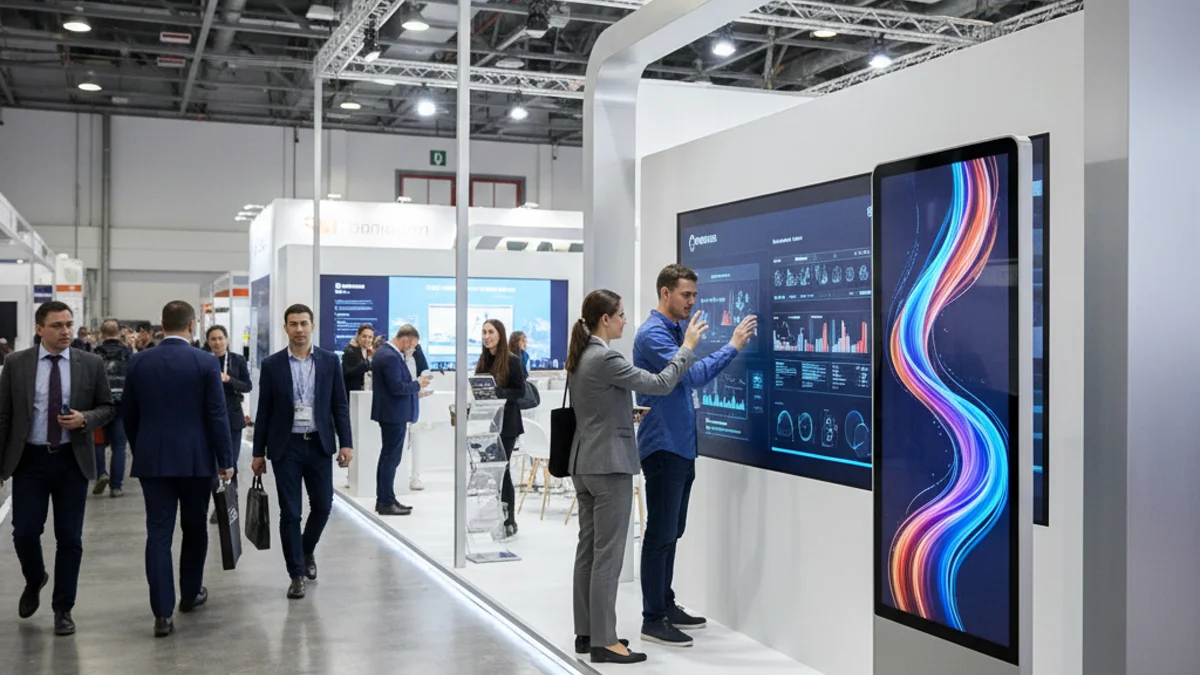
Where the format pays off without heavy staffing is the free-standing LED poster or totem. Small, movable, and reusable across shows, it handles side messaging, wayfinding and menu or schedule boards, and it can be repositioned mid-show as footfall shifts. That is the same role filled off-stand by digital signage display rental, and the two often run on the same content system.
One thing to settle with the stand builder early: who owns the visual layer. If the shell scheme and the LED are specified by different teams, the wall ends up fighting the architecture instead of shaping it. Managing that boundary is the core of exhibition booth building in Paris, and it is the reason the screen decision belongs in the first design meeting, not the last.
Build checklist
Run the format decision against this sequence, not against memory:
- 90 days out — hall plan with truss heights and metered power supply confirmed; format shortlisted against footfall goals.
- 60 days out — plan, electrical load and rigging details submitted to the régie; fire certificates (M1 / B-s1,d0) requested from the supplier.
- 30 days out — wall built to the native canvas in 0.5 m increments; content briefed to that canvas.
- Move-in day — rigging via venue-approved riggers for suspended formats; power connected to the ordered supply; test pattern run at the nearest walk-by point.
- Show day — a named owner drives interactive content; the loop is checked against the aisle sightline from both directions.
- Move-out — derig to the venue window; cabinets re-cased and counted against the manifest.
FAQ
Is a bigger wall always better on a trade show stand?
No. A wall that overruns the stand crowds the meeting space you are paying for. The right size is the one that stops the aisle and encloses the demo zone without eating the seating. Two coordinated formats usually beat one oversized wall.
Can we hang a wall without venue riggers?
Not at French venues for a suspended format. No self-clipping to hall trusses. Suspension calculations and venue-approved riggers come through the technical channel, and the point you use must be approved for the weight. Plan a floor-based or tower format if you cannot get rigging approval in time.
What pixel pitch suits a stand?
As a rule of thumb, 1 mm of pixel pitch buys about 1 m of comfortable viewing distance, and visitors pass a stand at 1–2 m. That puts P2.6 in the default slot for most stands, with P1.9 for close-up product detail and text-heavy content. Under-speccing pitch puts diode structure in front of the nearest visitor.
How long does the LED loop need to be?
Segments of 6–10 s, one idea each, looping over 45–90 s. That covers the four-second walk-by window and still gives a returning visitor something new on the second pass.
Choose the format before you choose the wall
A trade show stand earns its LED budget when the format, the room and the content are decided in the right order — format shapes footfall, the room constrains the build, content carries the story. Tell us the stand footprint, the hall and the aisle sightlines, and we will match the format to the geometry, with the fire certificates, power figure and rigging plan you need for the régie. Request a quote and we will come back with a buildable spec. For the detailed wall-by-wall comparison that pairs with this piece, see how to make a trade show exhibit stand out with LED walls.