The stand is built, the carpet is down, and the doors open at 9am. Then you notice the stand opposite has a 6-metre LED wall running a loop that stops people in the aisle, while yours has a 55-inch screen on a plinth showing a PDF.
That is the whole problem in one sentence. At Paris Nord Villepinte or Eurexpo Lyon, an exhibitor has roughly four seconds of walking-past time to register. An LED wall buys you those four seconds, but only if it is specified correctly for the venue, the rigging, and the content you actually have. Get the pixel pitch wrong and it looks like a wall of dots. Get the height wrong and the venue’s technical régie stops the build on move-in morning.
This guide covers what an LED wall on a trade show stand in France needs to do, how to size it, and the sequence that keeps installation day boring.
Why an LED wall outperforms a screen on a stand
A conventional display is a fixed rectangle with a bezel and a maximum size you can move through a door. An LED wall is a cabinet system. You build the size you need from 500 × 500 mm cabinets, and the result is borderless. On a 20 × 20 island stand at Porte de Versailles, that difference matters: a 5 × 2.5 m wall becomes the back wall of the stand rather than an object sitting inside it.
The practical advantages for exhibitors:
- Scale without seams. Cabinets lock together to produce continuous image across 4, 6 or 10 metres. No bezel grid interrupting a product reveal.
- High brightness in daylight halls. Venue glass roofs at Paris Expo and the Grimaldi Forum in Cannes flood halls with ambient light. An LED wall running 1,500–5,000 nits stays legible where a projector washes out.
- Shapes beyond 16:9. Ribbons, columns, L-shapes and hanging rings are all buildable from the same cabinets.
- Rental economics. You rent the cabinets, the processor and the rigging for four days instead of buying a wall you will store for eleven months.
Sizing the wall against the stand, not the brochure
Two numbers decide whether the wall reads well: pixel pitch and viewing distance. Pixel pitch is the distance between LED diodes in millimetres. Smaller pitch means more resolution per square metre, and a higher rental price.
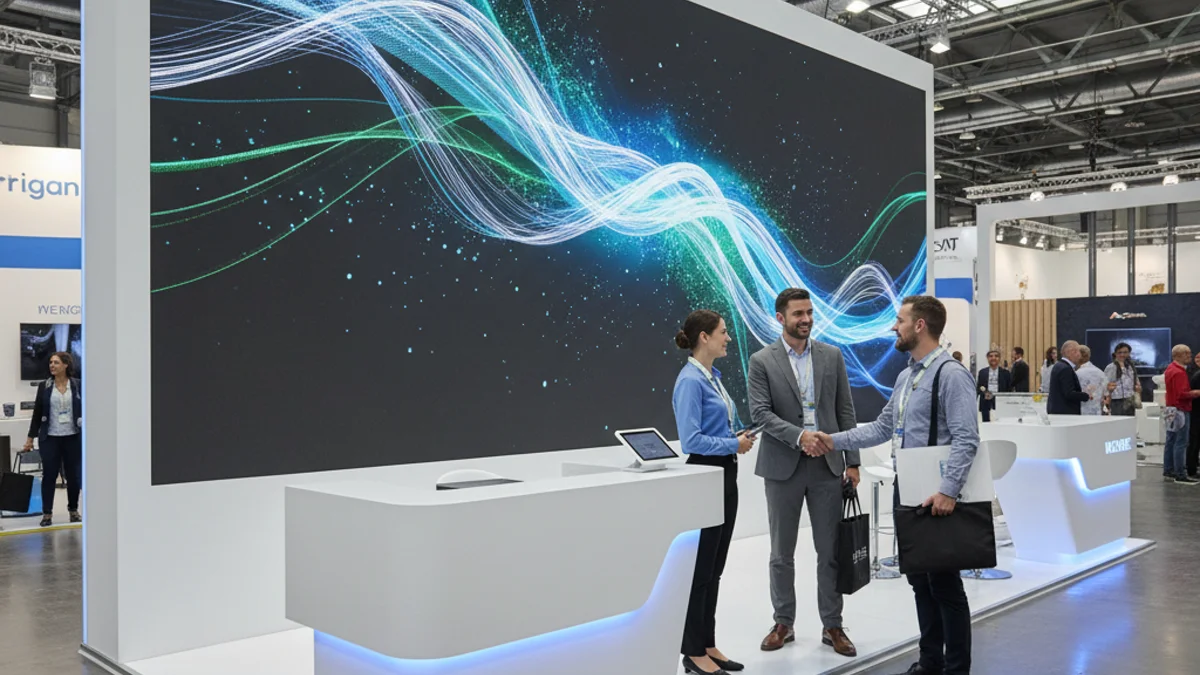
The working rule most production houses use is that one millimetre of pitch covers roughly one metre of comfortable viewing distance. A P3.9 wall is sharp from about 4 metres. A P2.6 wall holds up from 2.5 metres. On a busy aisle where people pass within 1.5 metres of the stand, P2.6 or finer is the safe specification. Put P3.9 on a stand in a narrow aisle and visitors at the front edge will see diode structure instead of your product.
| Wall size on stand | Typical pitch | Best for | Practical note |
|---|---|---|---|
| 2 × 1.5 m (back wall panel) | P1.9 – P2.6 | Product detail, close-up 3D renders, text-heavy slides | Fits inside a shell scheme without structural review |
| 3 × 2 m (feature wall) | P2.6 | Brand film loop, hero product rotating | Most requested size for 3 × 3 m and 4 × 3 m stands |
| 5 × 2.5 m (full back wall) | P2.6 – P3.9 | Island stands, keynote backdrop, stage set | Needs cabinet load figures for the venue’s technical file |
| 6 × 3 m+ or hanging ring | P3.9 – P4.8 | Aisle-stopping centrepieces, suspended above the stand | Rigging points and suspension calculation required |
| LED ribbon or column (0.5 m wide) | P2.6 – P3.9 | Edge frames, product plinths, wayfinding | Check sightlines from both aisles |
Then check the ceiling. Hall heights vary enormously across French venues, and a 3 m wall designed for a 4 m ceiling looks lost in a hall with an 11 m ridge. Ask the organiser for the hall plan with truss heights before you sign off the design.
Content that works at three metres and three seconds
The most common failure on an exhibition stand is not the hardware. It is a 90-second corporate film with a logo intro, a voiceover, and burned-in subtitles too small to read from the aisle.
Build the loop for a passer-by, not a seated audience. Segments of 6–10 seconds, one idea each, no audio dependency. Returning visitors see a different segment each time, which keeps the wall feeling live. Loop length of 45–90 seconds is comfortable. If you are still deciding what the wall should actually do, our trade show booth ideas using LED walls widen the brief beyond a single screen.
Three content types earn their place on a trade show wall:
- Product in motion. A rotating 3D model or exploded view shows what a static photo cannot — internal structure, assembly, material finish.
- Process or demo. A 15-second silent demonstration answers the question visitors ask first, before a host has to.
- Live data or interaction. A live dashboard, a leaderboard, a touch-enabled configuration screen. This is where an LED display and digital signage rental setup earns more than a passive poster.
Deliver files at the wall’s native resolution, not 1920 × 1080 stretched. A 5 × 2.5 m P2.6 wall resolves to roughly 1920 × 960 pixels — close to HD, but wider than 16:9. Design to that canvas or your logo will letterbox with black bars on a wall you paid for.
French venue realities that catch foreign exhibitors
Exhibition logistics in France differ from the US and UK in ways that affect an LED build directly.
- Technical file before build. Most French venues require stand plans, electrical load, and rigging details submitted to the technical régie weeks ahead. Late submission means your wall is installed in the order the venue decides, not yours.
- Reaction-to-fire classification. Materials on a stand typically need documented M1 or B-s1,d0 classification. Rental LED cabinets and their rigging hardware should arrive with the relevant certificates; ask for them in writing before the build.
- Electrical supply is metered and ordered. A 5 m P2.6 wall draws in the region of 3–4 kW at typical brightness. Order the connection with the stand’s power application, not on move-in day. Upgrading a supply on site is expensive and sometimes impossible.
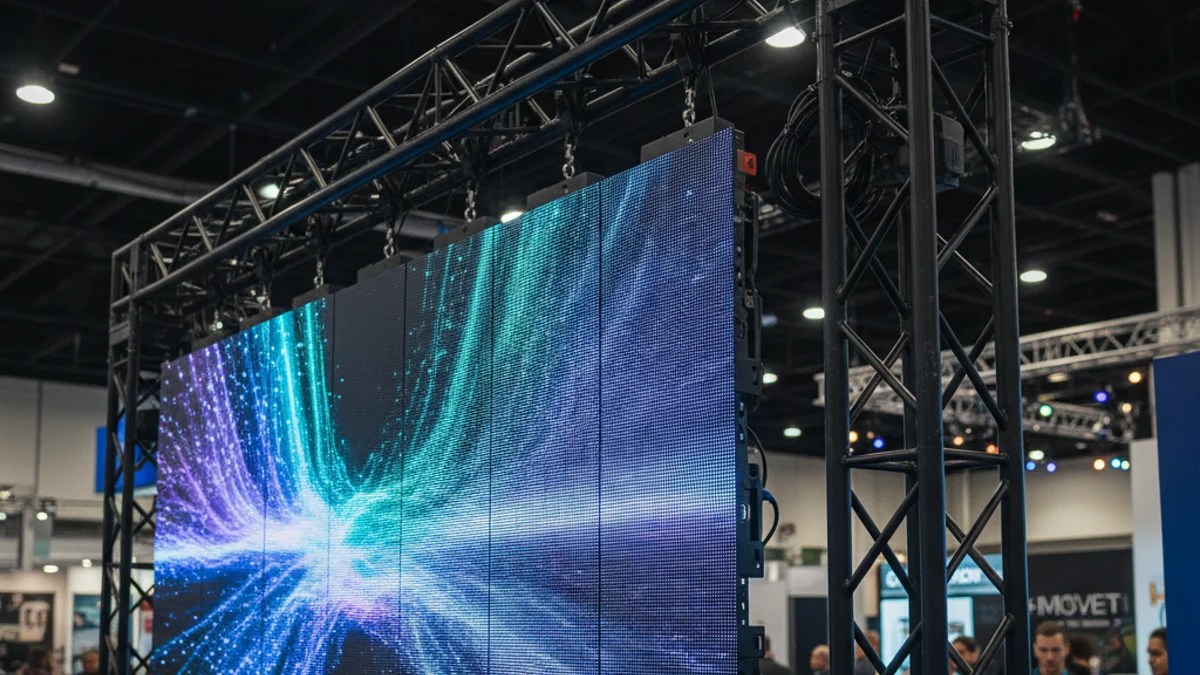
- Rigging is done by venue-approved riggers. You will not be clipping a 6 m wall to a hall truss yourself. Suspension calculations and the rigging crew come through the venue’s technical channel.
- Access and lift windows are fixed. Porte de Versailles, Villepinte, Eurexpo, Parc Chanot and the Palais des Festivals all run tight move-in slots. A 6 m wall arrives in flight cases on pallets and needs a route from the loading dock to the stand — check door widths and lift dimensions for upper-level halls.
Build checklist: from booking to doors open
12 weeks out
- Confirm stand dimensions, orientation and which aisle faces the traffic flow.
- Decide wall size and position on the stand drawing — back wall, side return, or suspended.
- Request pixel pitch and cabinet load figures from the rental supplier.
8 weeks out
- Submit the stand technical file to the venue: plan, weight, power requirement, rigging points.
- Order the electrical supply at the correct amperage.
- Lock the content canvas resolution to the wall’s native pixel dimensions.
6 weeks out
- Approve the content loop with a timed storyboard; cut anything over 10 seconds per segment.
- Confirm delivery date, pallet count and flight case dimensions for the freight forwarder.
- Request fire classification certificates for cabinets and rigging.
2 weeks out
- Test the loop on the actual processor and media player that will travel.
- Send final files plus a backup on a second USB drive and in cloud storage.
- Confirm the on-site technician’s hours and the escalation number for the build day.
Move-in day
- Position cabinets and verify the wall is level before locking; a 3 mm error over 5 m is visible.
- Run a full-brightness white and a full-colour test pattern to check for dead modules.
- Set brightness to the hall, not the maximum — over-bright walls wash out the stand’s own lighting.
- Walk the aisle at three distances and confirm the loop reads at each.
- Brief stand staff on how to restart the loop and who to call if a cabinet drops out.
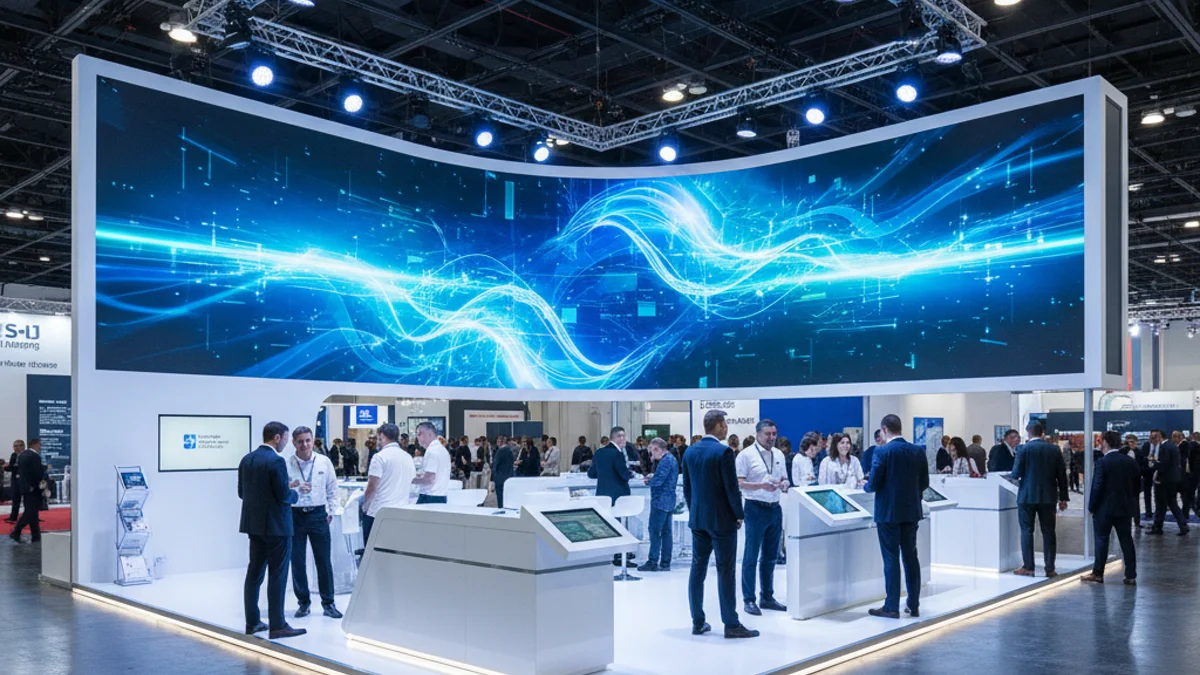
What a stand looks like when the wall is planned properly
The LED screen rental for trade show booth building route is the one most exhibitors take, because it puts the wall, the processor, the rigging and the technician in a single contract. Pair that with an exhibition booth build in Paris and the stand structure and the screen are designed together rather than bolted together on site.
When the wall is designed as part of the stand, three things improve at once: the structure is built to carry the cabinets, the content is authored to the wall’s real pixel canvas, and the power and rigging are in the technical file from the start. That is the difference between a wall that stops traffic and a wall the venue’s régie asks you to lower.
Frequently asked questions
Can we hang an LED wall above the stand?
Yes, if the hall has certified rigging points and the suspension is calculated by a qualified engineer. Suspended walls need a structural note and venue approval, and the weight has to sit within the truss capacity at that specific point. Allow extra lead time — this is not a decision to make at move-in.
Do we need a technician on site for the whole show?
For a single back wall, a technician on build day plus remote support is usually enough. For multiple screens, live content, or a wall above 4 metres, keep a technician on call for the duration. One dead cabinet in a 5 m wall is very visible, and swapping a module is a five-minute job for someone who has done it before.
What resolution should our content be?
Ask for the wall’s native pixel dimensions and design to exactly that. A 5 × 2.5 m P2.6 wall is around 1920 × 960. Deliver at native size or a clean multiple, and avoid scaling a 16:9 master onto a wider canvas.
Is an LED wall worth it on a small stand?
On a 3 × 3 m stand, a 2 × 1.5 m wall at P2.6 is often enough to lift the whole stand above its neighbours, because the visitor stands close and the pitch is fine. The mistake on small stands is going too big and leaving no space for a counter or a conversation.
What happens if a cabinet fails during the show?
Rental suppliers carry spare modules and cabinets for the show duration. The fix is a module swap, done from the front in most cabinet designs. Confirm the spare policy and response time in the contract, and note that a front-serviceable cabinet is easier to fix on a stand hemmed in by walls.
Next step
If you are specifying a stand for an upcoming show in Paris, Lyon, Marseille, Nice or Cannes, start with the hall plan and the wall position. Everything else — pitch, power, rigging, content canvas — follows from those two decisions.
Tell us the venue, dates and stand size, and we will come back with a wall specification, a power figure and an installation schedule. Request a quote for your next exhibition. Not sure yet what to hire? Our guide to trade show booth LED wall equipment breaks the kit down piece by piece.